Chaucer's England by Nicholas Orme
/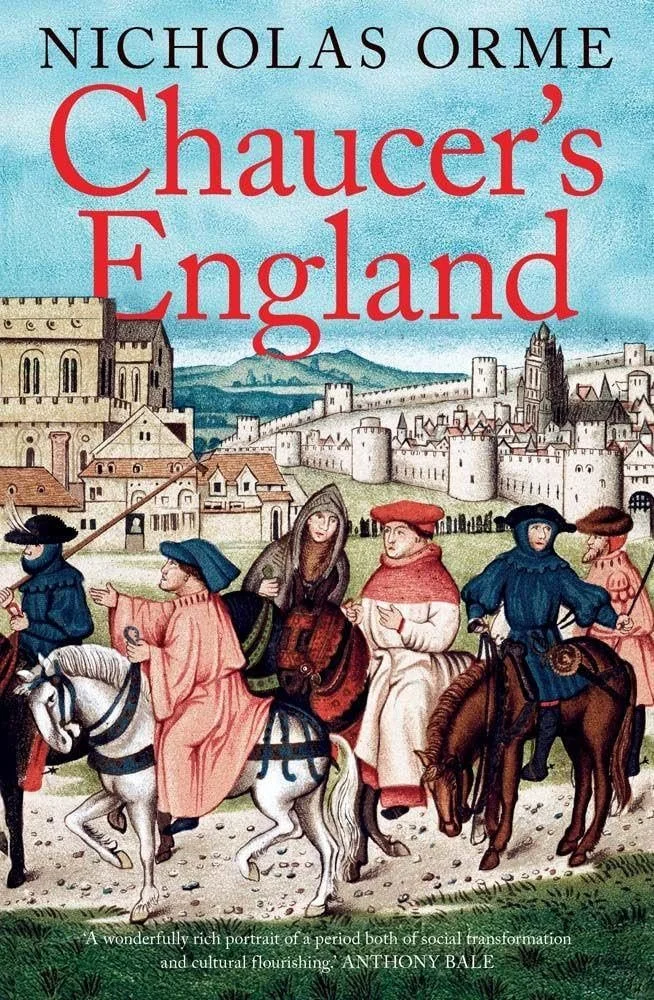
Chaucer’s England
By Nicholas Orme
Yale University Press 2026
For “Chaucer’s England,” the title of Nichols Orme’s new book, we can set rough guidelines extending either for the length of Chaucer’s own life, from the early 1340s to 1400, or more broadly for the whole of the 14th century, and we can immediately celebrate the fact that no previous century of human life has had a more generous and knowing portrait than the one Chaucer gave to his own time in the pages of The Canterbury Tales (no subsequent era has had such a portrait either, unless maybe the “USA” trilogy of John Dos Passos qualifies). In that work, Chaucer imagines a group of diverse travelers on a pilgrimage to the shrine of Thomas Becket in Canterbury, beguiling their travel by telling stories that range across the whole of their world and flesh it in such detail that an actual historical study of “Chaucer’s England” seems almost unnecessary.
The fourteenth century famously saw war, massive social upheavals, and, in Chaucer’s boyhood, the Black Death sweeping away an unthinkable percentage of Europe’s population and leaving, as Orme notes, a far less populated world for Chaucer to bustle about in than the one his grandparents would have known.
In other words, Chaucer’s England was anything but boring, which raises the question of why Chaucer’s England too often is. One suspects this is partly the effect of rote habit. Who knows how many times Orme, an Emeritus Professor of History at Exeter University, has covered this same material for drowsy students? Explain who Chaucer was; explain what Canterbury was; explain what The Canterbury Tales are; at least attempt to explain whatever the hell a “manciple” was. There’s no other practical route. The whole thing itself can start to feel like the one thing Chaucer’s own book never does: a dutiful pilgrimage.
This can be avoided only through generous helpings of historical insight and literary verve. Both of these things were present in abundance for Orme’s earlier book, Tudor Children, but they’re comparatively thin on the ground in Chaucer’s England. The book is beautifully produced by Yale University Press: sharp color pictures of manor houses, taverns, gravesite monuments, and deep forests fill the pages. And Orme’s command of The Canterbury Tales itself is sweepingly, easily complete. Every time Chaucer so much as alludes to a chapel or a mixing bowl or hunting dog, Orme is right on hand to explain the thing within an inch of its life. The Shipman’s vessel, for instance, the Maudelayne, is “technically a barge propelled by sails and oars, and so, more easily maneuvered in harbors or sea fights.” Good to know.
“The literary writers of the late fourteenth century offer valuable insights towards our understanding of their England,” Orme writes. “Chaucer and Langland in particular observed so much that was going on, as this book has shown.” Orme also provides insights, as when he mentions how Chaucer’s Prioress is so tender-hearted to animals that she feeds stray dogs with meat, milk, and bread, prompting Orme to remark, “Here Chaucer is at his most censorious,” he writes. “This was food for humans. It was a Christian’s duty to give up any surpluses left to the poor.”
Orme’s Chaucer’s England is better designed and more visually engaging than the Chaucer’s England by Diana Childress in 2000. It’s far more readable and less pedagogically dense than Barbara Hanawalt’s Chaucer’s England from 1992. It has less sweep and only a fraction of the eloquence of Matthew Browne’s Chaucer’s England from 1869, but it costs around $40 rather than whatever gouging amounts the dealers are charging for Browne’s volumes. Nobody wins any prizes for original titling, but as a companion to reading and enjoying The Canterbury Tales, Orme’s book works hard to be indispensable.
Steve Donoghue is a founding editor of Open Letters Monthly. His book criticism has appeared in The Washington Post, The American Conservative, The Spectator, The Wall Street Journal, The National, and the Daily Star. He has written regularly for The Boston Globe, the Vineyard Gazette, and the Christian Science Monitor and is the Books editor of Georgia’s Big Canoe News