Shakespeare at Thirty by Rory Loughnane
/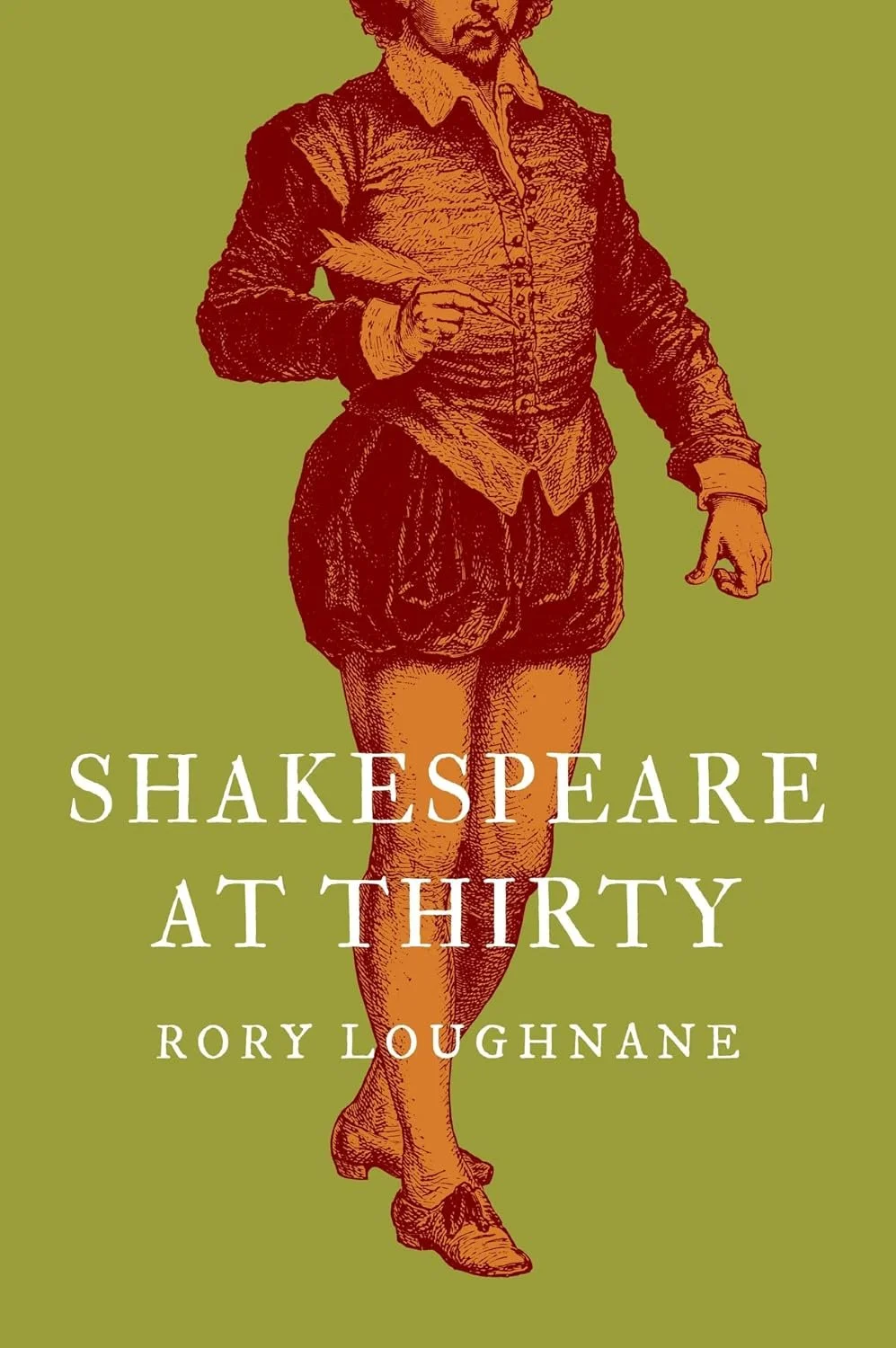
Shakespeare at Thirty
By Rory Loughnane
Princeton University Press 2026
For some literary folk, the title of Rory Loughnane’s new book Shakespeare at Thirty will recall the literary phenomenon of John Berryman’s 1951 series of lectures at Princeton, the first of which was titled “Shakespeare at Thirty.” Loughnane goes straight to this story and opens his book by recounting the effect the unexpected acclaim of the series had on the life and career of Berryman, then in his thirties and not yet an American poet of international renown. Rather, just like Shakespeare at thirty, he was “a relative nobody trying to find his way.”
Berryman asked his listeners to suppose with him Shakespeare the man in 1594, “waked, risen, washed, dressed, fed,” and “been congratulated” on the occasion of his thirtieth birthday, and Loughnane’s book asks the same supposition and proceeds to inform it. With readable, informed ease, he paints a very detailed version of the old familiar story: the young Shakespeare deciding to leave married life in Stratford and make his way to London, where he would begin writing and attempting to enter the stage world. Loughnane cleverly invokes COVID-19 in the form of the plague that shut the London theaters at about the same time Shakespeare was first attempting to make his living in those theaters, forcing him to scamble to make ends meet. Then there were the tentative early years, writing poems dedicated to a potential patron, hacking out amateur plays, working with a host of collaborators until he’d gained enough skill and confidence (and, implicitly, acclaim) to work on his own instead of subjecting himself to the sometimes slap-dash nature of collaborative work. “The fact that Shakespeare worked with other dramatists so frequently in his career,” writes Loughnane, “and then chose to work almost exclusively on his own until much later in his career – suggests that there must have been so incentive at this time.”
In order to walk the narrative up to the doorstep of that solo career, Loughnane asks several questions: What set young Shakespeare apart from his peers? “How did he lean upon and learn from them? Who supported him? What social mechanisms, personal circumstances, and professional networks fostered his creativity?” Attempting to answer these kinds of questions, Loughnane writes this book, “which presents the available evidence with minimal conjecture.”
What follows is, of course, a Mount St. Helens eruption of conjecture.
“Sometime in 1594, most likely late that year, [Shakespeare] joined the Lord Chamberlain’s Men playing company and became their de facto company dramatist,” Loughnane writes. “Young Shakespeare was connected professionally with other dramatists – George Peele, Thomas Watson, Christopher Marlowe, and Thomas Nashe,” he writes at another point. Statements like this droppeth as the gentle rain from heaven throughout the book, and they garland a pleasant narrative of a young man on the make. Is it a fact that Shakespeare became the de facto company dramatist of the Lord Chamberlain’s Men? Is it a fact that he was connected professionally with Christopher Marlowe? Is there even a single fact about Shakespeare’s “personal circumstances” from the mid-1580s to the mid-1590s that touches on his creativity in any way? Do we, in fact, actually know much of anything about Shakespeare at thirty? When Loughnane declares “These are the facts, plain and simple,” long-time readers of Shakespeare books will heave a sigh. The heart is sorely charged.
Loughnane necessarily offers periodic qualifications to all his plaster-of-Paris. Documentary evidence for Shakespeare’s whereabouts during the mid-1580s is “lacking,” he concedes, and he buffers many other passages with the customary “we can have little doubt,” “a best guess,” “it would have been natural,” and the ever-reliable “surely.” As in all Shakespeare books, these kinds of hedges begin to pile up like the snows of yesteryear. “Reading retrospectively,” Loughnane warns his readers at one point, seemingly unaware of likewise needing the warning himself, “we are tempted to recognize the potential for certain actions in others that they may not have recognized in themselves.”
Shakespeare at Thirty makes for very lively reading, and when Loughnane veers into simply analyzing Shakespeare’s writings, which he thankfully does often, he’s invariably sharp and insightful. He brings the theatrical world of early-1590s London vividly to life in all its brawling, tawdry multiplicity. And if he ever felt like writing Berryman in His Thirties, for which there are ample facts plain and simple, he should be encouraged to do so.
Steve Donoghue is a founding editor of Open Letters Monthly. His book criticism has appeared in The Washington Post, The American Conservative, The Spectator, The Wall Street Journal, The National, and the Daily Star. He has written regularly for The Boston Globe, the Vineyard Gazette, and the Christian Science Monitor and is the Books editor of Georgia’s Big Canoe News