All the Queen's Men by Sophie Shorland
/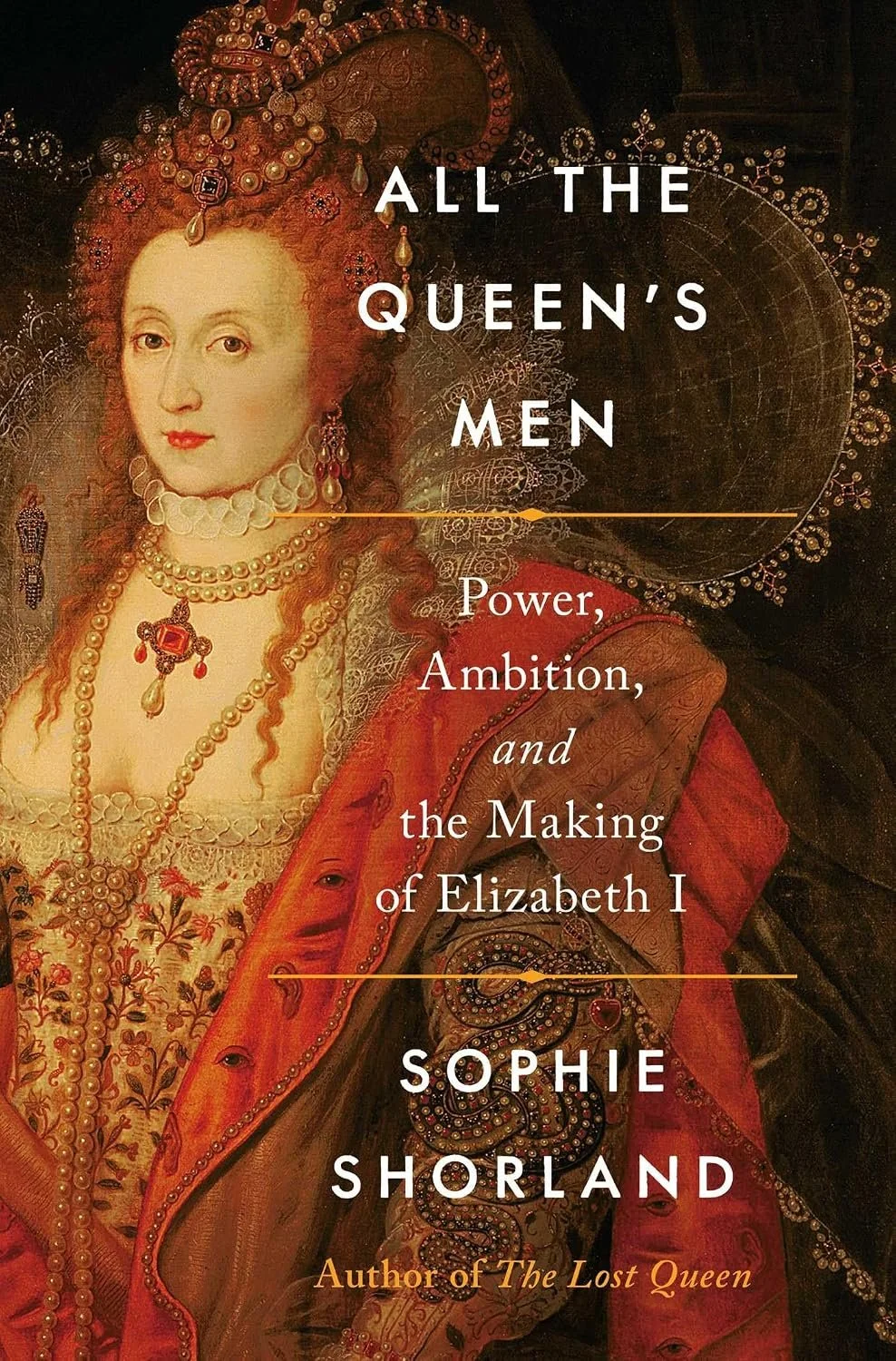
All the Queen’s Men: Power, Ambition, and the Making of Elizabeth I
By Sophie Shorland
Pegasus Books, 2026
When Elizabeth Tudor came to the throne, no one expected that a woman could rule on her own, and the entire world was consumed by the question of who this most eligible woman would – or should – marry. Ever since, the world has wondered how she avoided this trap. All the Queen’s Men: Power, Ambition, and the Making of Elizabeth I gives a comprehensive account of this marital (or, rather, non-marital) history, its larger context, and how it was experienced inside and outside England.
Drawing on ambassadorial dispatches, secret intelligence reports, and Elizabeth’s own letters, author Sophie Shorland explores the courtships that created and enhanced political alliances, chronicling the sometimes dizzying oscillations in Elizabeth’s stances.
Elizabeth I has her own contradictory and resonant mythos today, a mythos that formed during her lifetime. Virgin queen, Renaissance prince, head of the Golden Age. Alternately a grotesque, paranoid figure burning holes in her own skin with corrosive make-up, and a poised monarch who led her country fairly and inexorably to greatness.
It has long been understood that political necessity drove Elizabeth’s marital decisions. And while few historians have revisited this focus separately from larger biographical concerns, Shorland doubles down, revealing how Elizabeth used courtship as diplomacy and flirtation as statecraft while establishing her single status as the key to England’s survival.
The book is structured to emphasize this: each chapter describes a separate political option, starting in Elizabeth’s infancy to describe the early considerations and wranglings around her hand. Three more chapters cover the dealings in her brother’s and sister’s reign, all adding to a long list of personal reasons that would discourage Elizabeth from marriage. When the book reaches Elizabeth’s accession, Shorland abandons a strict chronology to explore each option fully, with the result that Robert Dudley’s candidacy is not raised until Chapter Nine. Not that we miss it – she does let us know it is coming, and in the meantime treats her readers to the plumbing of a suitor we do not hear enough about: Ivan the Terrible. While envoys first got access to the leader during her brother’s reign, Elizabeth pursued and expanded the relationship for all it was worth:
Not only would the English establish trade with Russia, but through it they would be able to trade with Persia, shipping woolen cloth and acquiring in return fine Russian furs and Persian silks. Elizabeth’s palaces would later glow with that valuable commodity Russian wax, while as historian Mildred Wretts-Smith has put it, ‘the fleet that defeated the Spanish Armada was largely rigged with Russian cordage and cables.’
The author was a semi-finalist in the New Generation Thinkers competition, a talent-search and media-development program run jointly by the BBC and the UK's Arts and Humanities Research Council to help early-career arts and humanities researchers turn complex academic research into engaging communications. Perhaps in that spirit, Shorland peppers analyses with contemporary phrasings (“rat Elizabeth out”, “lame dad joke”), and offers modern references like The Bachelor (and even trade sanctions) to bring to life situations and their nuances. The result is a delightfully fresh perspective on an ever-fascinating subject.
Janet Wertman is the author of the Seymour Saga trilogy. Her latest work of Tudor historical fiction is What Love E’er Meant, the second installment in her Regina series