Noticing by Richard Louv
/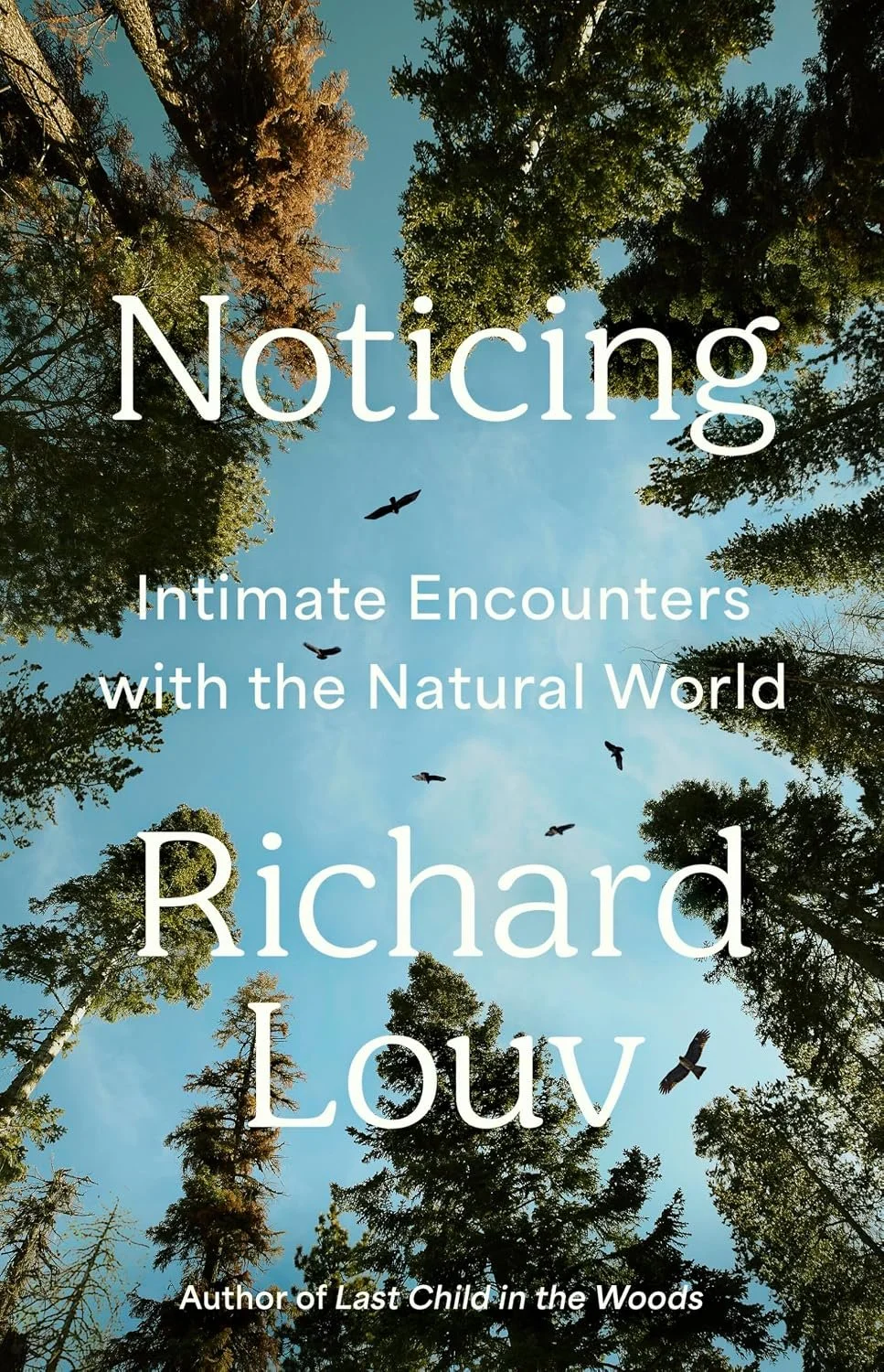
Noticing: Intimate Encounters with the Natural World
Richard Louv
Algonquin Books 2026
“Counterintuitively, even as we mourn the destruction of so many species, lands, and waters, the natural world offers us an antidote to our growing despair,” writes journalist and Audubon Medal-winner Richard Louv in his quiet and quietly odd new book Noticing: Intimate Encounters with the Natural World. “We can find relief right there in our peripheral vision, in a deep and wavering current followed by native trout, in a line of swifts living most of their lives in flight, in the tracks of a mountain lion along a worn path.”
Mountain lions haunt the book, including in some of its appealingly ghostly black-and-white photos, since Louv seems to want to concentrate on a wispy, evanescent view of the natural world, one which isn’t necessarily bounded by science, one in which kobolds and puk-wudgies and other supernatural creatures jostle alongside bobcats and turkeys and wild hogs. Indigenous “spirits” cluster in tree branches. Ancient indigenous beliefs that rocks are alive are treated as alternative possible truths rather than object errors of fact. Gaia comes up, inevitably. Well-done and sometimes genuinely funny anecdotes are rounded off with silly fortune cookie gnomic utterances:
As the group of friends stood looking at a gathering of turkey vultures on a house with a For Sale sign, my neighbor – an athletic woman who is a font of nature knowledge and who once biked across the Sahara – told us about a turkey vulture innovation. “When they’re sitting up there and they get too hot, they cool down by defecating on their own legs,” she said.
“I’ll keep that in mind,” I said.
Nature is beautiful but not always pretty.
Fortunately, this kind of dippy nonsense, which actually hurts public acceptance of conservation by making the natural world sound like something that’ll exist just fine in Narnia no matter what we do to it here on Earth, is steadily counterweighted throughout Noticing by serious inquiry and agile curiosity. Louv relates plenty of nature stories from his own life, but he also talks to scientists and specialists of all kinds, including, for instance, Paco Calvo, author of the legitimately unsettling book Planta Sapiens: The New Science of Plant Intelligence, which assembles some of the latest research into how plants think, anticipate, empathize, and cooperate without the benefit of brains or even neurons (Calvo is interviewed here but not recommended; oddly, Planta Sapiens doesn’t appear in the “Suggested Reading” list of Noticing). “Science,” Louv summarizes, “may be poised at the beginning of a new research era that will confound what humans (or at least modern humans) have assumed for generations about cognition in the green world.”
Again, it’s probably (you should pardon the word) natural that mountain lions should flit through these pages with the regularity they do, since they’re far more often rumored than observed (a guide in Louv’s book alludes to the age-old axiom: you don’t see the mountain lion, but the mountain lion sees you). They largely symbolize this author’s view of nature as both powerful (a 150-pound mountain lion can turn completely invisible in shin-high shrubbery one arm’s length from where you’re standing with your camera) and fragile, necessary to preserve.
The other, overriding sentiment of Noticing is less ambivalent and totally undeniable: walking out into wild spaces and quietly noticing the life that fills them is not only valuable but deeply personally reviving. Almost spiritual, one might say.
Steve Donoghue is a founding editor of Open Letters Monthly. His book criticism has appeared in The Washington Post, The American Conservative, The Spectator, The Wall Street Journal, The National, and the Daily Star. He has written regularly for The Boston Globe, the Vineyard Gazette, and the Christian Science Monitor and is the Books editor of Georgia’s Big Canoe News