Aristotle: The First Teacher by Philip Freeman
/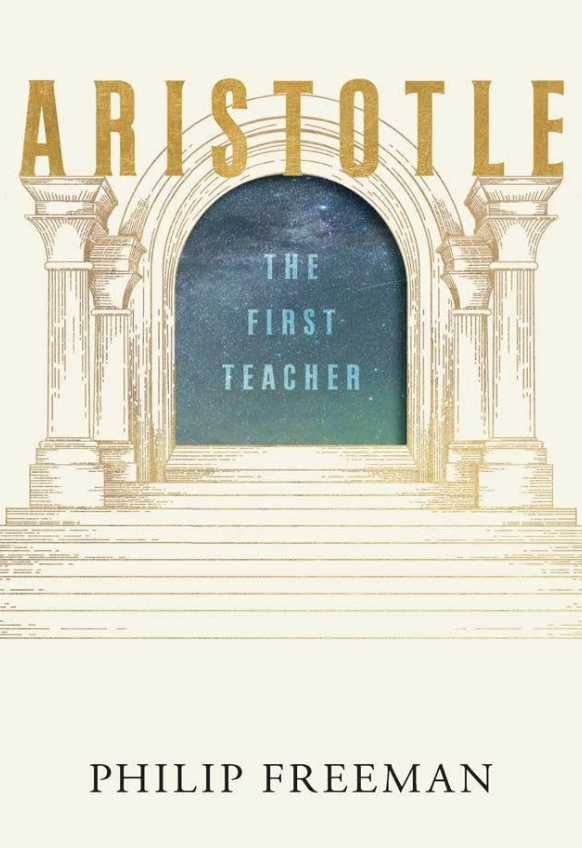
Aristotle: The First Teacher
By Philip Freeman
Yale University Press 2026
Popular historian Philip Freeman’s new book is a svelte little biography of the great Greek philosopher and proto-scientist, famed as a prolific author and student of Plato. Aristotle: The First Teacher appears as part of the “Ancient Lives” series from Yale University Press, and despite the mountain of verbiage that still survives from Aristotle and the mountain of verbiage that’s been written about him in the last two thousand years, Freeman’s book weighs in at scarcely 130 pages, plus a first-rate bibliography that extends well beyond our only even remotely reliable biographical sources for Aristotle (Diogenes Laertius and Dionysius of Halicarnassus, each, like all other ancient sources here, translated by the author).
Naturally, not all those sources nor any others tell us anything like as much as we’d want to know about this foundational figure, which prompts even as old and experienced a hand as Freeman to the kind of blandly unhelpful generalizations that so often lard out the lives of ancient figures. What was Aristotle like as a child, he wonders, for instance? “Probably it would have resembled that of any boy in ancient Greece, at least a boy of the upper classe,” we’re told. “He was undoubtedly a good student, but there are no reliable stories of the extraordinary abilities he was to show later in life or any hint of what he was to become.” Was he maybe not typical? Did he have a limp? A bad stutter? Was he a blockhead who bloomed late? Did he kick the slaves who were his tutors? We don’t know, we’ll never know, and simply punting to the mean isn’t a very interesting substitute.
Considering how thickly legends have accumulated around this subject, these kinds of extrapolations and guesses perforce continue into his adulthood and persist right through the years when even casual onlookers in Athens could have assumed biographies might one day be written about him. Those legends say he was something of a dandy in dress and affectation, for example, and who can say how much truth there is to any of it? Freeman again makes informed stabs based on likelihood. “During Aristotle’s twenty years in Athens as a student and researcher at Plato’s Academy,” he writes at one point, “one of his favorite activities must have been attending the plays performed at the Theater of Dionysius on the south side of the Acropolis.” Unless he hated going to plays.
Freeman is on much stronger ground when writing about the one absolutely concrete part of Aristotle’s story: his writings. This is the route most Aristotle biographers have taken in order to reach their word counts, and Freeman is good enough at it to make the reader wish he’d do it more often in these pages. “What is striking about his work on storytelling is how well it has aged,” he writes, for instance, about the Poetics. “The book that may have begun on the slopes of the Acropolis when the young man from Stagira was watching a play is as relevant today as it was centuries ago – yet another example of the astonishing mind of Aristotle.”
There’s not enough of Freeman in this little book and necessarily not enough of Aristotle. As an introduction to “the Master of Those Who Know,” it works as well as anything might, but the real introduction will always be the works themselves.
Steve Donoghue is a founding editor of Open Letters Monthly. His book criticism has appeared in The Washington Post, The American Conservative, The Spectator, The Wall Street Journal, The National, and the Daily Star. He has written regularly for The Boston Globe, the Vineyard Gazette, and the Christian Science Monitor and is the Books editor of Georgia’s Big Canoe News