Pericles by Paul Cartledge
/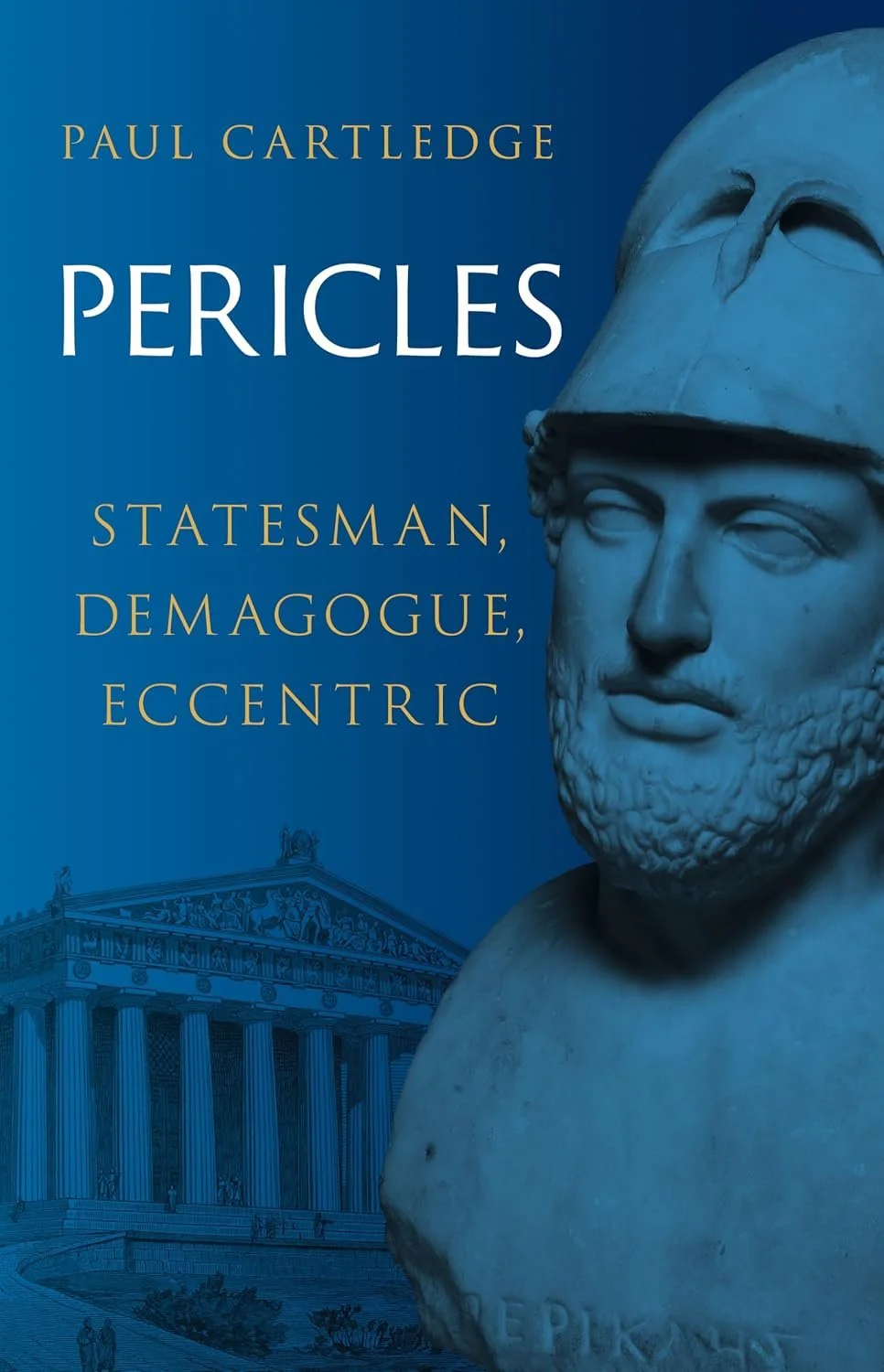
Pericles: Statesman, Demagogue, Eccentric
By Paul Cartledge
Reaktion Books 2026
At the beginning of his new book, a short biography of Pericles of 5th century Athens, veteran popular historian Paul Cartledge gamely alludes to the ten “rules” of biography proposed by the great Hermione Lee: 1) the story should be true, 2) the whole life should be covered, 3) nothing should be omitted or hidden, 4) all sources used should be named, 5) the biographer should know the subject if the subject is still alive, 6) (and yet) the biographer should be objective, 7) a reminder that biography is a form of history, 8) biography is “an investigation of identity,” and, of course, 10) there are no rules to writing biographies.
Lee’s tongue was firmly in cheek, and Cartledge would know this in any case since, as he promptly admits, “there is no ancient figure (Greek or Roman) about whom it is possible to write an acceptable, cradle-to-grave biography in the strong modern sense.” This is immediately made clear by the wreckage any life of Pericles makes of Lee’s rules. Living institution though he is, Cartledge never met the man; the sources (fewer than a dozen of them from the ancient world) are named, but the story they tell is almost certainly not true; and perhaps most tellingly, in over two thousand years, it’s been oddly difficult for most biographers to be objective about this particular figure (“Pericles for as well as against,” as Cartledge puts it).
This book, Pericles: Statesman, Demagogue, Eccentric, part of Reaktion’s “Great Lives of the Ancient World” series, manages to do right by the rest of those rules and by its readers. In fewer than 200 pages, Cartledge covers much of the same ground as Plutarch or Thucydides, from the man’s naval military experience to his time as leader of Athens to his unconventional domestic life, with the usual digressions about the Parthenon and the odd shape of the man’s head.
In all of this, as Cartledge notes, there are sometimes sloppy admixtures of fact and fiction, since Pericles was apparently a fruitful source of satire on the stage of his own day. “There he was mocked alike for his personal appearance, for his irregular, even immoral private life, and above all, for being a kept man, the pupped as well as the poppet of a – foreign woman. Horrors!”
Cartledge relates as much of all of this as is reliably relatable, and he provides a fantastic Bibliography to guide his readers beyond the knowing but minimal account he provides here. The “Great Lives of the Ancient World” series has sometimes been a bit uneven, but this entry is a solid, unassuming work of marble, the perfect place for any curious reader to start.
Steve Donoghue is a founding editor of Open Letters Monthly. His book criticism has appeared in The Washington Post, The American Conservative, The Spectator, The Wall Street Journal, The National, and the Daily Star. He has written regularly for The Boston Globe, the Vineyard Gazette, and the Christian Science Monitor and is the Books editor of Georgia’s Big Canoe News