Hippocrates: Man, Myth, Medic by Elizabeth Craik
/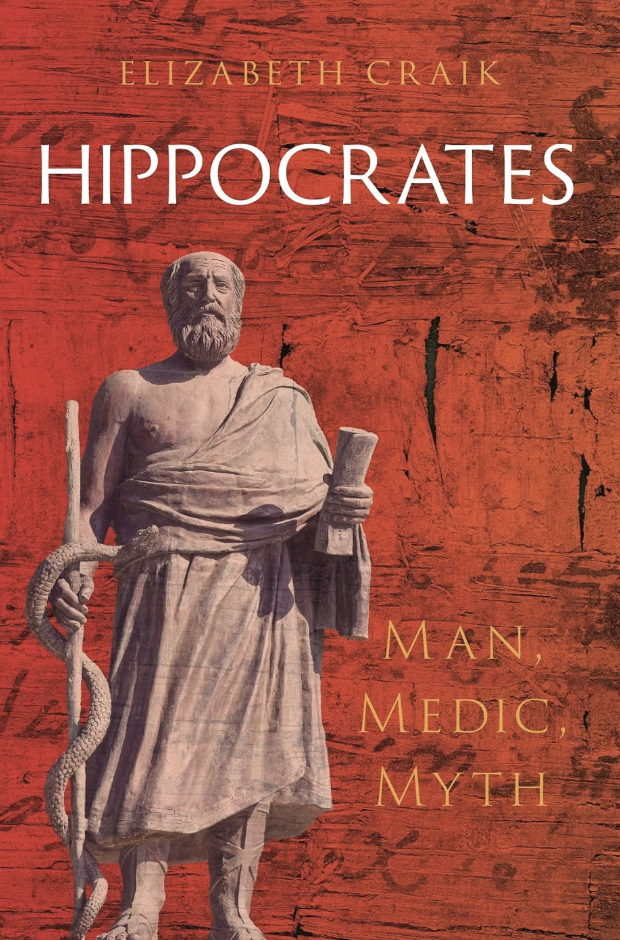
Hippocrates: Man, Medic, Myth
By Elizabeth Craik
Reaktion Books 2026
The remit of Elizabeth Craik’s new book, Hippocrates: Man, Medic, Myth is dauntingly ambitious for something stretching to fewer than 200 pages. The nominal subject here, in one of the latest in Reaktion’s “Great Lives of the Ancient World” series, is the fifth-century physician Hippocrates (460-c.370 BC), but as Craik acknowledges early and often in her remarkably thorough book, that presents a fundamental problem. Hippocrates was a real historical figure, a contemporary of Sophocles and Euripides and Herodotus and Thucydides and Plato, but the actual facts of his life have been so fractured and buried by layers of hagiography and legend that no strictly observed biography of the man is possible.
Rather Craik, Honorary professor in the School of Classics at the University of St Andrews, looks at three different aspects of her subject: Hippocrates 1, who’s “idealistic and prominent in leadership,” Hippocrates 2, who’s “practical and prominent in surgery,” and Hippocrates 3, an intellectual, “prominent in science.” And the thread running through all three aspects is a fundamental championing of the techne of medicine, the positioning of the art and science of medicine as a real endeavor, systematic and largely divorced from the whims of the gods.
All three of these versions of Hippocrates are plotted onto the far vaster and more varied backdrop not of the few and skimpy details of the man’s actual life but rather of what’s called the Hippocratic Corpus, a sprawling body of “Hippocratic” Corpus, a collection of writings by unknown Hippocratic authors expounding on all the experience-based biological understanding the techne had established in centuries before and after the life of the collection’s namesake. Craik wrote a book on the Hippocratic Corpus a decade ago, and there’ve been many other such books and annotated translations of chunks of the Corpus itself. Taken together, the Corpus represents what one translator simply called “the still living ethical ideal of the doctor”: reserved, kind, comforting, completely dedicated either to restoring the patient to health or mitigating their decline.
Craik interweaves these two broad subjects, the many aspects of Hippocrates and the many aspects of the huge body of work that bears his name, with a fluid ease that belies the sheer extent of the historical writing on these subjects. Her book makes an excellent companion to the Loeb Classical Library volumes of Hippocrates.
Steve Donoghue is a founding editor of Open Letters Monthly. His book criticism has appeared in The Washington Post, The American Conservative, The Spectator, The Wall Street Journal, The National, and the Daily Star. He has written regularly for The Boston Globe, the Vineyard Gazette, and the Christian Science Monitor and is the Books editor of Georgia’s Big Canoe News