Mahalia Jackson: Moving On Up a Little Higher by Mary Williams & Timothy Tyson
/
Mahalia Jackson: Moving On Up a Little Higher:
The Story of an American Civil Rights Pioneer
By Timothy B. Tyson & Mary D. Williams
Liveright 2026
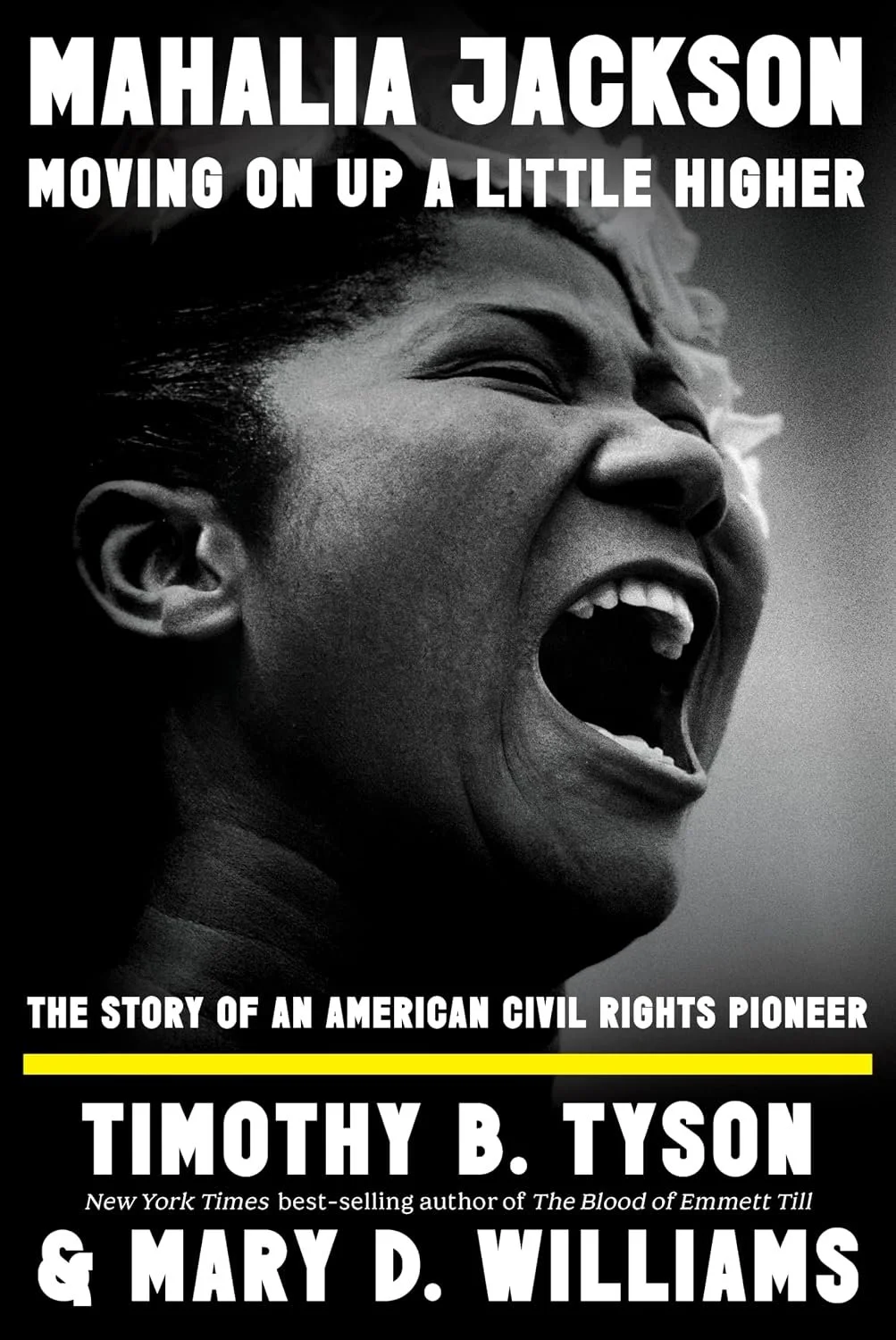
Mahalia Jackson: Moving On Up a Little Higher, a collaboration between civil rights historian Mary Williams and bestselling writer Timothy Tyson (author of 2017’s excellent The Blood of Emmett Till), highlights the great New Orleans-born gospel singer not primarily as an international recording sensation but as a Civil Rights advocate, singing and enthusing crowds at Birmingham and Selma and lending her burgeoning stardom to the cause.
It's a fascinating look at a figure who’s now known exclusively for her music. Although this isn’t a full-dress biography, it’s nonetheless a comprehensive reflection on a handful of some of the most important elements of her life: her faith, her music, and her very active social consciousness. Jackson the superstar repeatedly cedes the spotlight to Jackson the black woman living in the shadow of Jim Crow. She tells her friend Studs Terkel:
When I’m on stage and television working with white people … they just come up to me and hug me and love me, and say I am so wonderful. But when I am walking down the street like an ordinary person, they don’t recognize me. When I go into a department store in the South, I can’t get a sandwich, I can’t get a bottle of pop, I can’t even get a cab, and I am just the same Mahalia Jackson that they just got through saying how wonderful I am.
And the authors repeatedly reiterate it: “Mahalia longed for an America where she could walk down the street and be respected just like any other American citizen,” they write. “She wanted to be able to travel across the country without worrying if she could get a hotel room or eat at a restaurant.” Jackson is quoted as experiencing a dull pain in her gut at the thought that one of her musical tours will now travel to the American South. “Everything is fine, as long as I am singing,” she says. “But as soon as I walk off that stage, I’m just another colored person. Where can I stay that night? What motel will give me a room? Where can I find a place that will serve me food?”
As the authors point out, politics were intimately connected with gospel music from its origins in the “hard history of slavery and oppression,” and therefore Jackson’s faith and politics “mirrored one another with near precision.” “One thing that tied her faith and her politics,” they write, “is that she acted on both, often in the same motion.”
The book’s narrative can sometimes be oddly evangelical on the matter of Jackson’s faith. The text under a photo of her performing at the 1957 Newport Jazz Festival, for instance, ecstatically reads: “As always, she did not merely perform, but opened her sails to the Spirit and let the wind carry her to wherever God wanted her to go” (in fact, she merely performed, unless Williams and Tyson would like to provide additional photos showing this singer-carrying “spirit”) – but the passion of Jackson’s beliefs, religious, social, and political, are more visible in these pages than in any previous work about this fascinating figure. And if it sends younger readers out to find her music, so much the better.
Steve Donoghue is a founding editor of Open Letters Monthly. His book criticism has appeared in The Washington Post, The American Conservative, The Spectator, The Wall Street Journal, The National, and the Daily Star. He has written regularly for The Boston Globe, the Vineyard Gazette, and the Christian Science Monitor and is the Books editor of Georgia’s Big Canoe News