The Enigma Challenge by SC Godfrey
/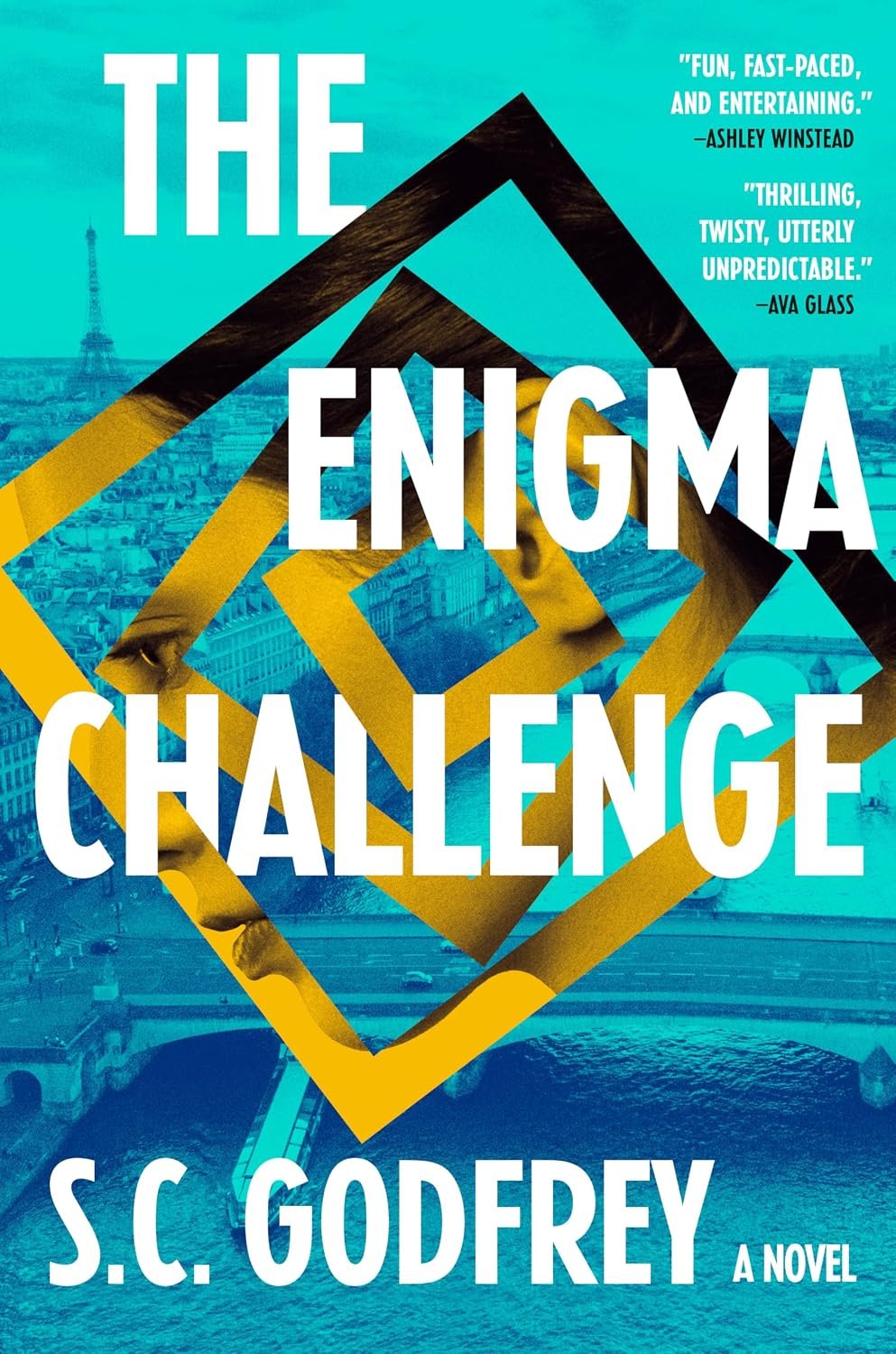
The Enigma Challenge
By SC Godfrey
Viking 2026
Cryptology, those of us who find it boring rather than fascinating are constantly told by those who find it fascinating, is not boring. Certainly this must be the position of Zoe Wilder, the main character in SC Godfrey’s debut thriller The Enigma Challenge, since she’s gone into the field professionally, as a postdoc at the small private Chessmont University specializing in decoding ciphers; as she helpfully puts it, “God, I love a puzzle.”
Zoe is visiting Madrid with her postdoc boss (and, just this minute, ex-boyfriend) Eric, where she’ll present a paper at the International Conference on Cryptology, and Eric has warned her sternly, as the novel’s opening note, that no matter what she does, she must not enter the infamous Enigma Challenge. It’s dangerous, he tells her, and people get hurt.
While he’s at it, Eric has another warning for Zoe: by all means steer clear of an American named Dane Seaver, since he’s guilty of a long litany of academic misdemeanors and is generally bad news.
This is on Page 4. Any guesses who turns out to be “obscenely handsome” on Page 19?
“He’s handsome in profile, lean, with a muscled chest and arms,” Zoe is soon in a perfect position to observe. “His black hair is short, and the side of his face has gorgeous contour.” At this point we still don’t have any idea what Zoe herself looks like, or her personality beyond loving puzzles, or what she saw in schlubby Eric, or what he saw in her. It’s almost as though she’s some kind of cipher.
Zoe presents her paper in due course, and even in the blunted precis given to readers, it’s fairly deadly:
I start with a general overview of cipher types: Caesar, Patristocrat, pigpen, homophonic, polyalphabetic, columnar transportation, and abbreviation. I present case studies on the Playfair cryptogram used by Dorothy L. Sayers in her 1932 crime novel, Have His Carcase, Rudyard Kipling’s Patristocrat puzzle from his 1902 Just So Stories, and a 1957 text that makes the intriguing, if unlikely, argument that Francis Bacon wrote William Shakespeare’s plays, based on a number of ciphers in the works. I notice people jotting notes and nodding along, which I take as a good sign.
Those poor saps in the audience might be nodding along, but readers of this slog of a novel are far more likely to be nodding off. Zoe (later on in the book, characters get chummy with her and shorten that to “Zo,” even though this doesn’t shorten anything and is the exact same pronunciation effort, like shortening “Joe” to “Jo”) immediately ignores all of Eric’s advice. She enters the Enigma Challenge because it would be damn odd in a book called The Enigma Challenge if she didn’t, and what with all that obscene handsomeness flying around, it would also be strange if she didn’t fall in with Dane Seaver, so she promptly does.
We learn more about the Challenge itself, including some of its potentially deadly consequences in the event of failure, and the narrative immediately jets off to half a dozen exotic locations as the stakes of the Challenge grow steeper. Once again, since she knows she’s a character in a novel and is naturally hoping to be in a movie based on a novel, Zoe obligingly describes her own basic character arc: “I’ve been sitting in front of computer screens for the past ten years, studying,” she tells dreamy Dane. “My nose was buried in texts. I’ve seen and done more in the past two days than I have in ten years.”
The cryptological adventures continue right to the end of the book, but they don’t happen at anything like the pace that’s needed in order to make the thing work. Zoe and Dane never have even a drop of chemistry; all the characters talk in cliches, the exotic locales are listlessly evoked, and, most crucially, the actual process of cryptology, which inevitably becomes central to the plot’s payoff, is never made the least bit interesting, much less exciting.
The cliffhanger ending is well-orchestrated, but the Berlin Philharmonic couldn’t orchestrate its way out of this murk.
Steve Donoghue is a founding editor of Open Letters Monthly. His book criticism has appeared in The Washington Post, The American Conservative, The Spectator, The Wall Street Journal, The National, and the Daily Star. He has written regularly for The Boston Globe, the Vineyard Gazette, and the Christian Science Monitor and is the Books editor of Georgia’s Big Canoe News