The Story of Your LIfe by Kathryn Jezer-Morton
/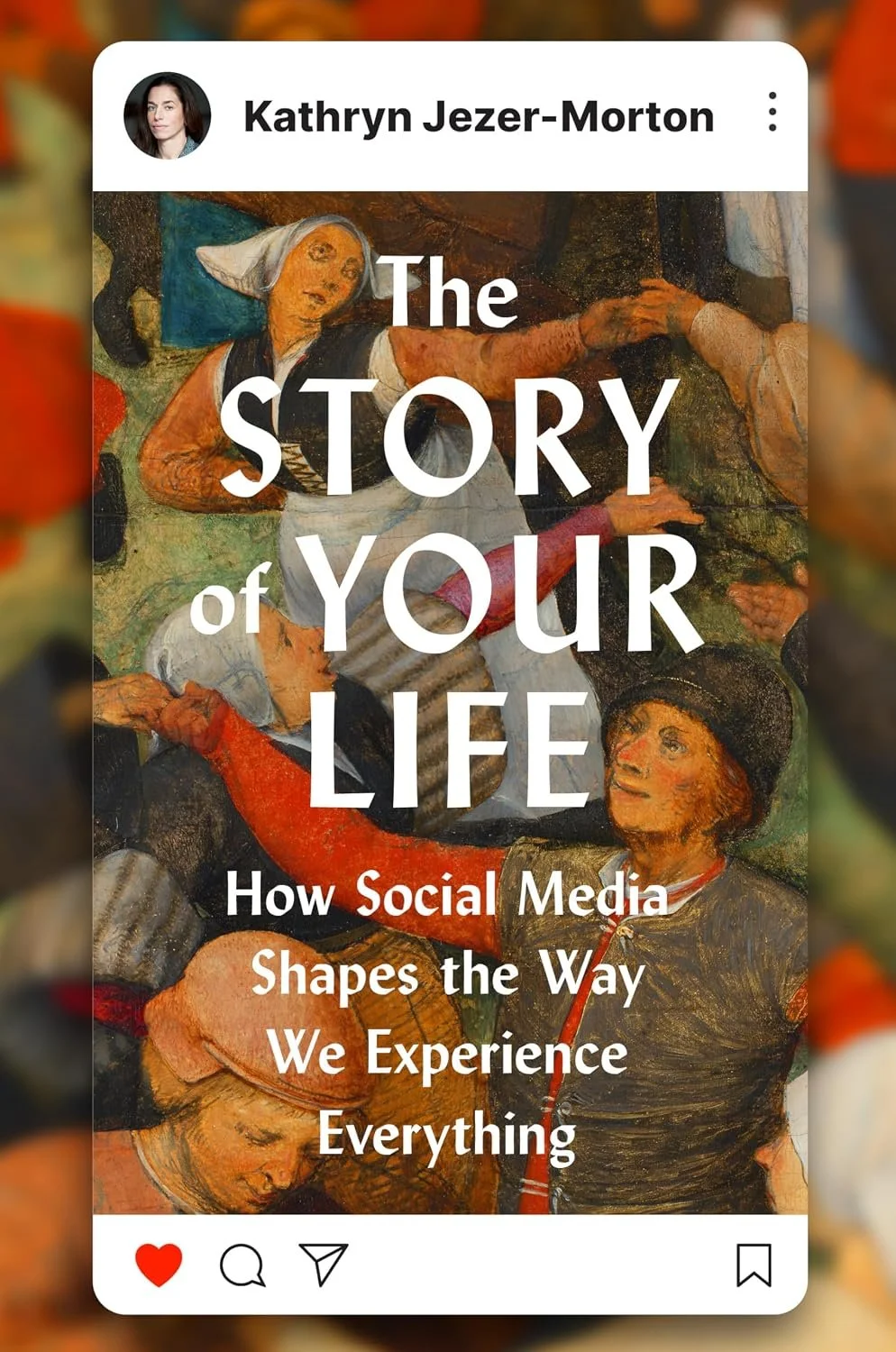
The Story of Your Life: How Social Media Shapes the Way We Experience Everything
By Kathryn Jezer-Morton
Viking 2026
For her nonfiction debut, The Cut columnist Kathryn Jezer-Morton takes as her central subject what she aptly calls “the perverse incentive structure of the social web” and the way that incentive structure has altered not only the way we understand the stories of others but also of how we shape our own stories. She consults a nice manageable number of sources and a small mountain of anecdotes in order to set up a series of contemplative questions to which every single one of her readers already knows the answers.
Inevitably, the book is about branding. Social media addiction has subtly, ineluctably taught millions of people to think of themselves as both snake oil peddlers and the snake oil itself, to create a kind of personal shale layer between their offline and online selves. In addition, obviously, to making all polls about every conceivable subject completely unreliable, since nobody is only one self anymore, this shift steadily eats away at the offline, which is to say non-monetized, self. The brand becomes everything; the actual self simply vanishes.
On some level, every social media addict knows about this horrifying process, and they’re all in this author’s sites when she brings out questions like “Is whatever competitive edge that you might gain from having honed a compelling personal brand worth the cost of your sense of self?” If asked, every single social media addict would promptly answer that question with a forthright “no.” But it would be meaningless, since it would be the offline self who’d be saying that, not the online self. The online self aggressively, mindlessly pursues that competitive edge, and the online self is running the show.
Jezer-Morton seems regularly aware of this. “Narrating vulnerability on social media is bound by just as many social rules as any other kind of narration,” she writes, “and all share the same common denominator: The brand must remain strong.”
Consistently, she stresses that this subject is a two-way process. As much as people use social media, it’s using them just as much. “Most of us are accustomed to the notion that social platforms are built for the maximization of profit, and that our idle moments of scrolling are ruled by algorithms that serve this market,” she writes. “What we’re perhaps less aware of is the extent to which we’ve internalized the algorithm’s rules in our own posting habits.” Any random foray on social media will confirm this; people self-censor, misrepresent, and outright lie as routinely as breathing, all in the service of shaping and maintaining an alternate version of themselves.
A monetized version, it should be repeated, even if the monetization is less than nominal and may never materialize. The allure of that extra $10 a year has an unholy strength that nobody in the pre-social media would could have guessed, and the strength of it has been incrementally built and encouraged by the makers of social media with more intensity as the years go on and the shareholder greed deepens apparently unlimitedly. “It’s not a coincidence,” Jezer-Morton writes, “that the years when social media still felt fun and freewheeling were also the years when the companies behind the apps weren’t expected to make money.”
As noted, there’s virtually nothing in The Story of Your Life that will come as any kind of astounding revelation to its presumed audience, the people who know social media quite well and spend far more energy on it than their offline selves would believe or their online selves would admit. But the energetic presentation of all this bad news in such lively prose serves a reminding purpose nevertheless.
Steve Donoghue is a founding editor of Open Letters Monthly. His book criticism has appeared in The Washington Post, The American Conservative, The Spectator, The Wall Street Journal, The National, and the Daily Star. He has written regularly for The Boston Globe, the Vineyard Gazette, and the Christian Science Monitor and is the Books editor of Georgia’s Big Canoe News