Up on Cove Mountain by Earl Swift
/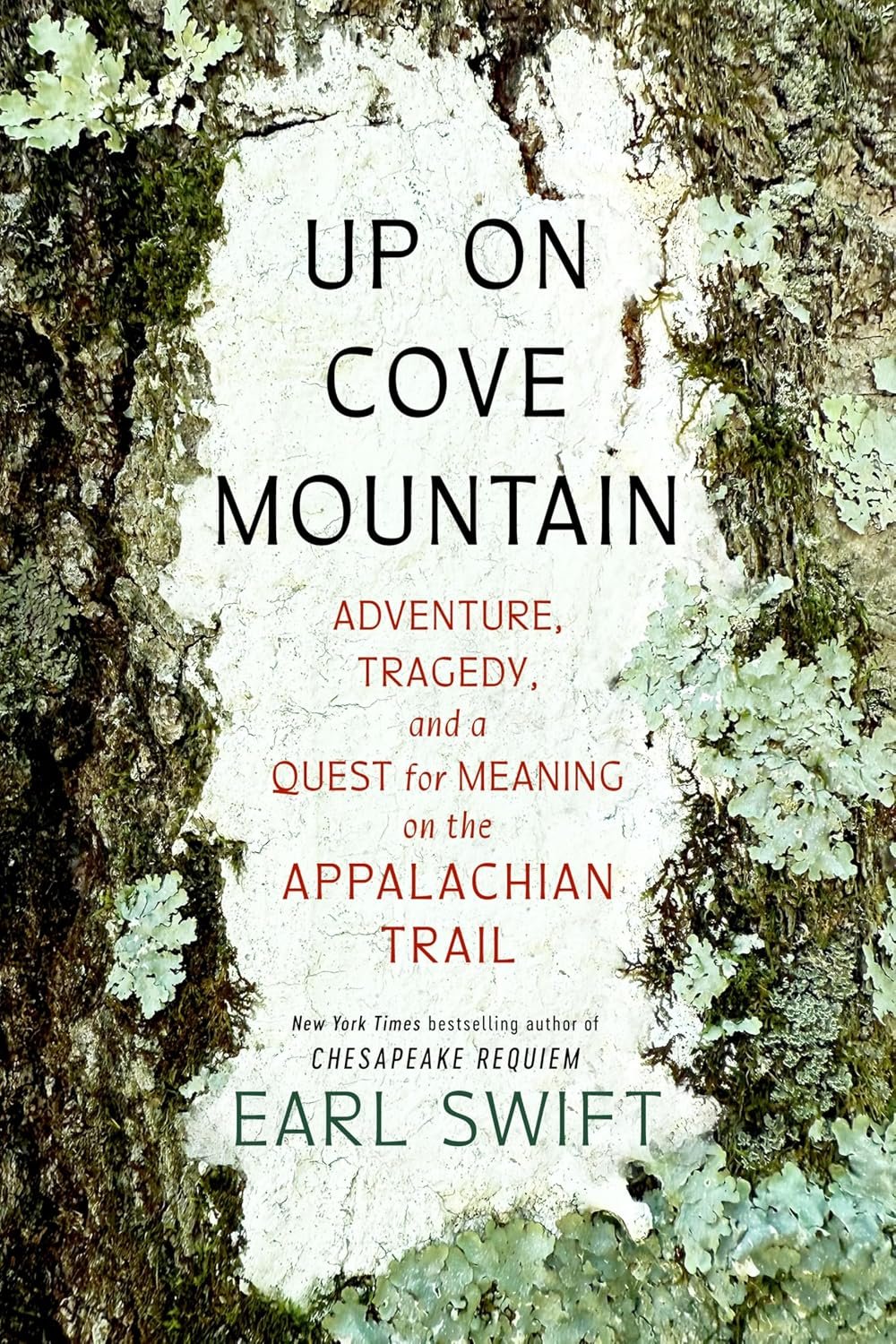
Up on Cove Mountain: Adventure, Tragedy, and a Quest for Meaning on the Appalachian Trail
By Earl Swift
Mariner 2026
“As a rule,” writes Earl Swift in his new book Up on Cove Mountain, “we venture into the wilds to escape civilization – its comforts and conveniences, its traffic, its smells and bustle and clatter.” This is both the essential truth and the essential irony of the book, which is braided with both an exuberant, eloquent evocation of the wilderness and a slow, piecemeal account of a horrific murder that happened in the wilderness in 1990.
The wilderness in question here is the fabled Appalachian Trail, which runs from Maine to Georgia and attracts millions of hikers every year. During each of those years, some few thousand of those many millions are “through-hikers,” people who are attempting to hike the entire trail rather than just smaller, easier chunks. As Swift notes, plenty of people who hike the AT do so in the firm expectation of a kitchen-cooked meal and their own bed that same night.
Swift through-hiked the trail in 1990 and imagined doing it again in 2024 as a challenge on at least a couple of levels: not only does the weight of 35 years add strain to the already-demanding process of a through-hike, but revisiting the trail would mean revisiting the tragedy that happened there back in 1990 when two popular, well-liked hikers, Molly Larue and Geoffrey Hood, were brutally murdered during their own through-hike by an escaped criminal who’d been observing the pair closely before he struck. Swift notes that back in 1990, he’d been clueless, careless, and inexperienced. “I struggled to understand why fate chose them,” he writes, “when I made a far fatter target.”
He'll eventually have an answer to that kind of question, but first the book unfolds in a succession of camping horror stories, friendships made and maintained, and loving nature descriptions, all the familiar fare of Bill Bryson’s bestselling 1998 book A Walk in the Woods, only here rendered with more literary skill and, necessarily, far fewer cheap laughs. And given the grim half of his narrative, Swift apparently feels compelled to reassure his readers that violence of any sort on the AT is “vanishingly rare.” “Three to four million people stepped onto the footpath in the course of a typical year, according to the trail’s stewards, and precious few of them encountered any trouble from others,” he writes. “Over the preceding century, crime on the trail has claimed five lives.”
Even considering only those cases where crime has definitely been concluded (ruling out for the time being, in other words, all the disappearances or questionable outcomes), this number, five in a century, is flatly absurd, but its inclusion is understandable: despite gradually revealing the terrible story of what happened to Larue and Hood, he’s still trying to write an encouraging book about second chances and personal challenges. And his descriptions of those personal challenges will be starkly familiar to anybody of a certain age who’s ever attempted even a partial hike: “I’m carrying five days of food, two liters of water, and a full array of winter gear in anticipation of colder nights ahead,” Swift writes. “Every ounce asserts itself as I chug up the steeply graded path – in my hips, my quads, my shoulders, and in my breathing, which soon quicks to shallow gasps.”
Whenever the narrative returns to the tragedy of 1990, it raises the same questions about random chance and the unpredictability of most violence out in the wild world. You sit on a log to eat your lunch, the whole time unknowingly sharing the space with a six-foot rattlesnake who complacently ignores you but bites the next person who sits on that same log; you enter a sunlit meadow on a beautiful day and surprise a doe with a beautiful fawn, and the next day somebody enters that same meadow and surprises a mother grizzly with two cubs.
In the end, Swift simply decides it comes down to dumb luck:
Sometimes you get lucky. No reason for it – you just get lucky. Other times, fate works against you. It doesn’t mean you’re blessed and it doesn’t mean you’re damned. It just means you’re vulnerable to the whims of chance.
This might not be particularly comforting to readers who are contemplating an attempt on the AT, but it’s undeniable. And readers who are content to trek the trail from the comfort of their reading chairs will get more of the experience, good and bad, ugly and beautiful, than any book has conveyed in many years.
Steve Donoghue is a founding editor of Open Letters Monthly. His book criticism has appeared in The Washington Post, The American Conservative, The Spectator, The Wall Street Journal, The National, and the Daily Star. He has written regularly for The Boston Globe, the Vineyard Gazette, and the Christian Science Monitor and is the Books editor of Georgia’s Big Canoe News