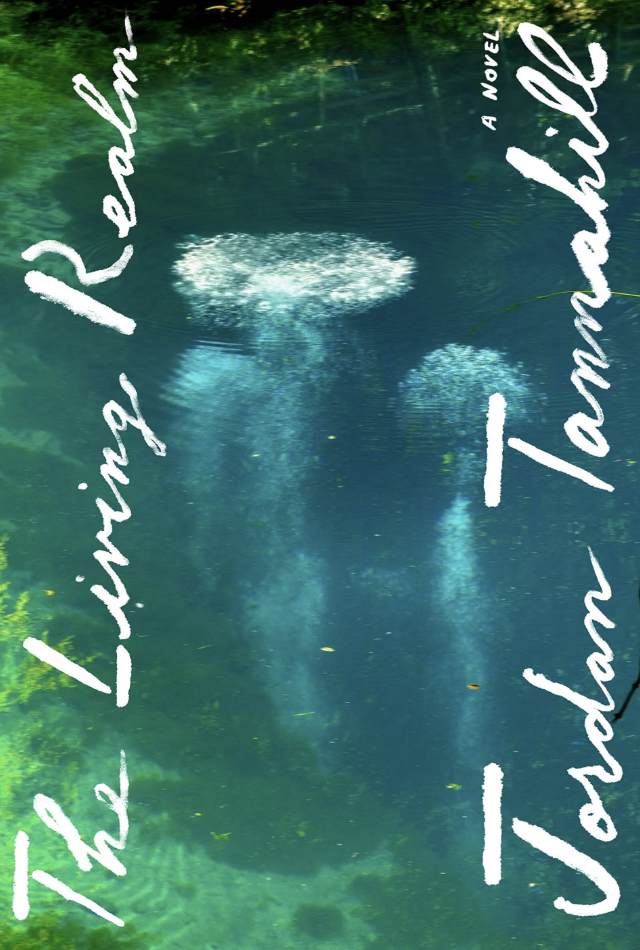
The Living Realm by Jordan Tannahill
/
The Living Realm
By Jordan Tannahill
Farrar, Straus & Giroux 2026
A horrible searing drought is afflicting Berlin in Jordan Tannahill’s new novel, The Living Realm, scorching the grass and cracking the ground, all except Teufelssee, a glacial lake deep in the Grunewald forest whose waters stay every bit as cool and refreshing. Those waters attract overheated bathers, various nudists, and an assortment of gay men seeking anonymous pleasure regardless of meteorological conditions. It’s a place that attracts the narrator of Tannahill’s story, along with his friends, Birgit and Gabor, for innocent outings.
Our narrator (he doesn’t have a name, which is economical since he doesn’t have a personality either, but he’s an archeology postdoc from Cambridge) originally came to Berlin years ago at the behest of Birgit, who set him up in an archeology program at Freie Universität, straightened out his visa, and even found him his first apartment. He and Birgit and Gabor (a former elementary schoolmate of Victor Orban, obviously in self-imposed exile from Hungary) take to spending time in the woods around Teufelssee to cool off.
But things cool considerably for our narrator when he spots a man in the forest who’s an exact double for one of his long-lost lovers. It’s more than mere similarity; he’s certain it actually is Lukas, somehow transposed to the way he looked thirty years ago at his physical prime, and naturally, the vision haunts him.
He’s not overly alarmed, because he knows he’s a character in a novel. And since Birgit and Gabor likewise realize they’re supporting characters in a novel, they suggest he seek psychiatric help, but they’re not insistent about it, even when their friend starts seeing other old lovers in the forest. Even the ghost lovers seem to be wondering who’ll play them in the Hollywood adaptation.
Since Tannahill is also a playwright, the main problem with his book will be very familiar to him: that deadly second act. Once our narrator has started seeing old lovers in the forest, once those visions have no real effect on either him or anybody else, once it all starts to seem like a mere trick of the omnipresent heat (or, as distantly and whimsically suggested at one point, maybe leftover Chernobyl radiation – after all, if it can irradiate hogs, might it not resurrect hotties?), well, then what?
Tannahill’s answer, lieber Gott, is … municipal history, page after page of it, as our narrator learns the extremely detailed history of Berlin, Teufelssee, gayness, and being gay in Teufelssee in Berlin. The book is chary of paragraph breaks as it is, but that’s only made worse by frequent passages like this:
As Maes explained it, in 1134, a great storm broke through the Flemish coast and carved a fifteen-kilometer tidal inlet that, through another channel, suddenly offered sea access to the formerly inland city of Bruges, and caused the city to rise in prominence as one of the foremost centers of European trade. But this new waterway and economic lifeline, named the Zwin, began to fill with silt from the late thirteenth century onward, and by 1500 it had grown so shallow as to render it unusable, cutting off Bruges again from the sea. As merchants shifted their business activities to nearby Antwerp, Bruges stagnated, and it was during this time of economic decline and hardship, when scapegoats were sorely needed, that an explosion of sodomy cases were brought forward and prosecuted by municipal authorities. In the public records, Maes had found a marked increase in sodomy trials, convictions, and public burnings in the Grote Markt between the years 1450 and 1525.
In non-professional circles, this is what’s known as padding, and The Living Realm has more of it than a furniture showroom. This is a dead giveaway that a novel should have been a short story, and it’s hardly saved by our narrator’s eventual inner crisis, when he decides to surrender himself to whatever the heck is going on in the woods:
As much as I could grasp, I understood that there was a force that dwelled within the Teufelssee so vast, so heavy and ancient, it bent the very fabric of reality around it, bent desires, lives, and lured us to our destruction, to the very making and unmaking of meaning … I would walk deep into the darkness, as deep as it took, and I would present myself to Teufelssee, and I would demand from the shadows that they appear.
It turns out he’s not that demanding, and by the time a cute little plot twist happens in the Teufelssee late in the book, even the ghosts seem to have lost interest.