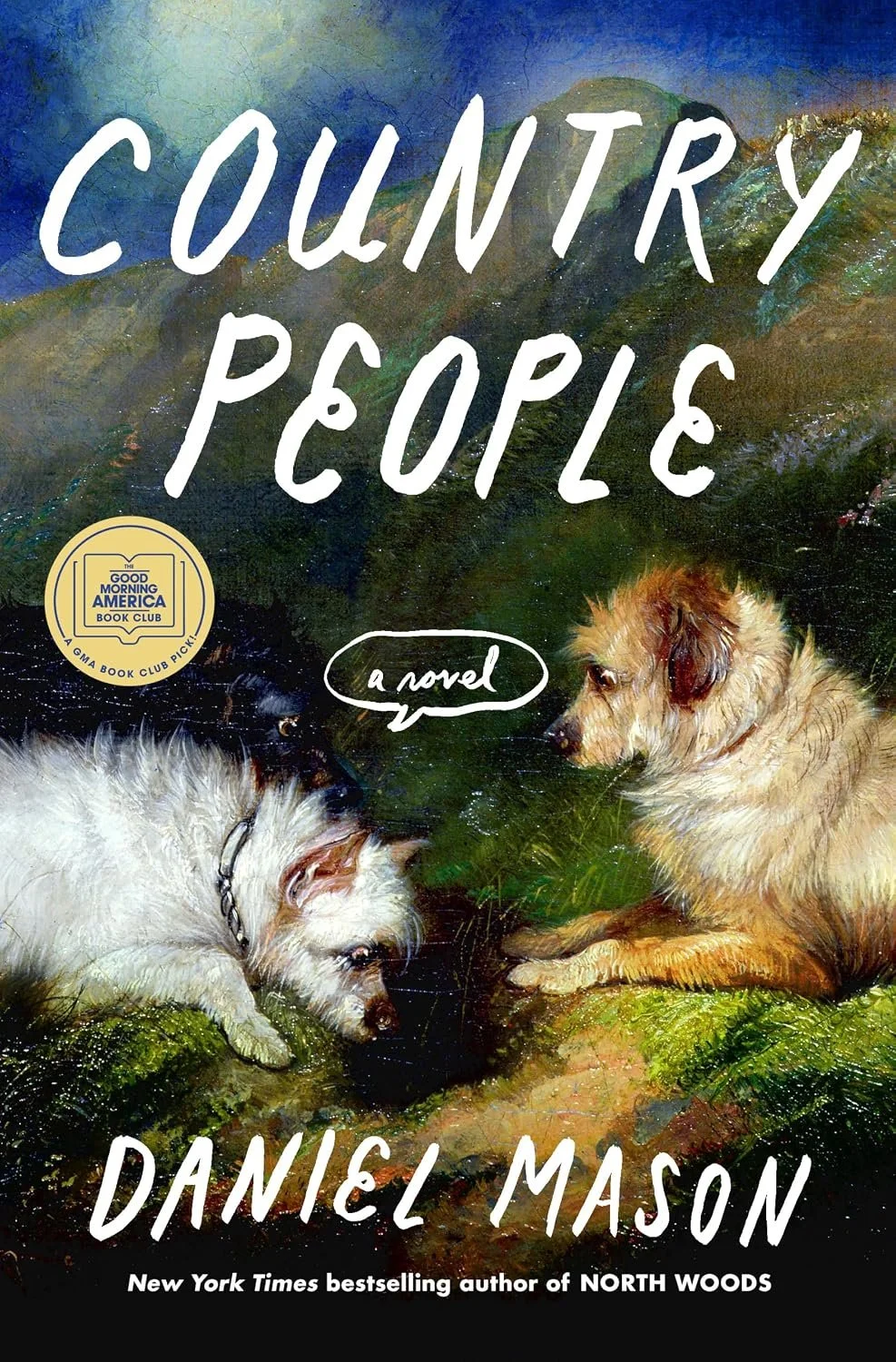
Country People by Daniel Mason
/
Country People
By Daniel Mason
Random House, 2026
Literary critics are fraud investigators. Our jobs are complicated because what we investigate are admitted frauds—fictions and poems. We are on the lookout for what can be called secondary fraudulent activity, works that are not what they pretend to be. Zadie Smith’s novel The Fraud? A historical novel pretty much innocent of unnecessary fictionalizing. I looked into Daniel Mason’s novel Country People for admittedly personal reasons. It was described in glowing reviews as about college life in a small Vermont town. I grew up in Calvin Coolidge’s home hamlet Plymouth, worked in the woods and on roads with old Green Mountain Boys (probably called “hillbillies” in West Virginia), and even taught at a college in little Northfield, Vermont. By the way, reviewers can be fraudulence accomplices, sharing the fraud’s desire to please readers. Another by the way: we fraud investigators take no pleasure in our work; we serve to protect you, the literary consumers.
Country People is called a novel, but really it’s a tale like the anything-can-happen Russian folk tales that the 44-year-old protagonist collects, writes about, and adapts for bedtime stories he tells his two children. Mason mentions Coleridge’s “suspension of disbelief.” It’s necessary to appreciate tall or small tales, but try as I might the further this tale went on the more my suspenders stretched out and I began to feel manipulated.
I resented Mason’s bait and switch. Country People does begin like a novel, an academic novel, the visiting professor subset that David Lodge made popular years ago. A brilliant Milton scholar and her husband, who has spent 14 years not writing his Ph.D. dissertation, and their two primary school children leave the familiar world of Silicon Valley so the professor can teach at Greensbury College in southern Vermont. Not to be confused with Middlebury College or Bennington College or any other factual locations, for all are invented. The investigator had just a flicker of suspicion. Reportedly someone who escaped COVID in New England, Daniel Mason may have never lived in Vermont.
I almost forgot the lovable dog, described as a member of the family who gets about as much space in the book as the two children. Homeless people know the appeal of having a dog lying next to their signs. The son seems to have escaped from one of Richard Powers’ novels about child prodigies. The younger girl becomes a remarkably skilled skier. Their father Miles is a familiar figure in college novels, a good parent but socially inept and an incurable procrastinator. Arriving in the summer, the family loves Vermont, even though their rented house is full of rats. They also have minor problems with small-town food and men who can talk only about lawnmowers. But Miles eventually takes unlikely pleasure in learning how to use a scythe from another husband accompanying a wife teaching at the college. In the winter, Miles takes unlikely joy in learning how to cross-country ski from a Norwegian import.
The tale is not outrageous, but where are the promised “country people”? I know Vermont has been overrun by foliage fanatics and snow-sliders, what natives call “down-country folks.” But given Mason’s title, I was led to expect some Vermont-born characters I’d call “country people,” someone like Josiah Coolidge, Cal’s cousin who tended the Plymouth dump, or Josiah’s son Warren, who, dressed in coat and tie, sold Christmas cards door to door in the summer. Given the novel’s plethora of recent arrivals and part-time residents, and the cliches that could have been plucked from Vermont Life, I had difficulty suspending my belief that Mason’s story could have been set just about anywhere.
Anywhere with snow, because it’s in a long winter chapter that my suspension failed and my investigation activated. Maybe Country People wasn’t a tale but a self-referring fantasy. When Miles is injured while skiing, he meets in the local emergency room a man who uses a disability scooter and gives Miles a ride home—and then spends three nights snowbound with the family. The man is a Black autodidact who has an old library card catalogue in his repurposed ambulance. He collects hundreds of index cards about follies, wacky ideas, crazy theories, and persistent fraudulences, all about as fantastically unlikely as he is. Around 1.5% of the population of Vermont is Black, so this small-town savior is quite a fortunate find or DEI discovery for Mason. Except for his race, the man could also be a character in the Russian tale “The Blind Man and the Cripple.”
After this meta chapter on fraudulence, Mason’s tale becomes even taller or the fantasy becomes even more fantastic when Miles attends a secret coven—composed of both Vermonters and aliens—of people (including his savior) who believe in a “hollow earth” beneath the rocky ground. Mason has made up a source and text for this belief, Jeremiah Wylkes’ Colloquies. Maybe if Mason, like his wife, had finished his dissertation and taught in a literature department, he’d have known an American fraudster named Poe had been there first with “holes at the poles” references in his tales. We get the names and occupations of Wylkesians but not enough to judge if they are country people.
My distrust of Mason increased when I discovered the novelist was a psychiatrist who taught at Stanford, not some starving artist in a Brooklyn or Oakland warren who is trying to make some easy money from an easy fantasy. Of course, a psychiatrist is free to make up tales or fantasies (though he might not want his patients to do so). But wouldn’t a psychiatrist have more serious things to do? Couldn’t he be expected to be interested in what real undereducated individual country folk were depressed by—such as woolen mills closing, family dairies losing to Big Milk, old folks putting their “antique” junk out on their lawns to sell, once proudly independent Vermonters becoming—like him the tale-teller—participants in the entertainment industry, selling farms to become building lots for second homes, cleaning rooms at ski resorts, moving into garages to become AirBNB hosts? About the author, the investigator can only ask questions, not bring charges.
If anything, Mason appears to mock the natives’ problems by including “transcripts” of a radio talk show where people call in to the host and his “expert guest” for practical help. In Mason’s book, these transcripts are about the only elements that didn’t require suspension of disbelief, but the transcripts don’t address the alienation many individual Vermonters feel from their old way of life before their state became a “Winter Wonderland” for others. Yet another, possibly relevant by the way: the investigator no longer lives in Vermont and didn’t vote for Vermont’s immigrant truth teller Bernie Sanders.
Only occasionally entertained by Mason’s casually solicitous style and burbling congeniality, I kept waiting for something I might call real or, at least, realistic, something like the sharp wit and dangerous comedy of Flannery O’Connor’s “Good Country People.” Even a psychiatrist using “country people” as his title must know that story, where a soft-soaping Bible salesman seduces an educated woman and ends with the salesman running off with her wooden leg. Country People has several happy endings covering everyone and the dog. They weren’t promised but were expected and delivered.
O’Connor’s story of local color fraudulence actually applies to both Mason’s readers and to Vermonters. Reviewers and then, presumably, readers may be seduced and pleased by his entertainment. Vermonters were seduced by the promise of dollars that entertaining tourists could bring to the state. Mason’s tale could be harmless; it cost me just thirty bucks. The country people of Vermont are seeing a much higher cost: the destruction of their local culture. Vermont was once a republic, then a state, now a playground.
Tom LeClair is the author of eight novels, one of which, Passing Away, is about cultural change in Vermont.