1942: Crux of War by Jonathan Parshall
/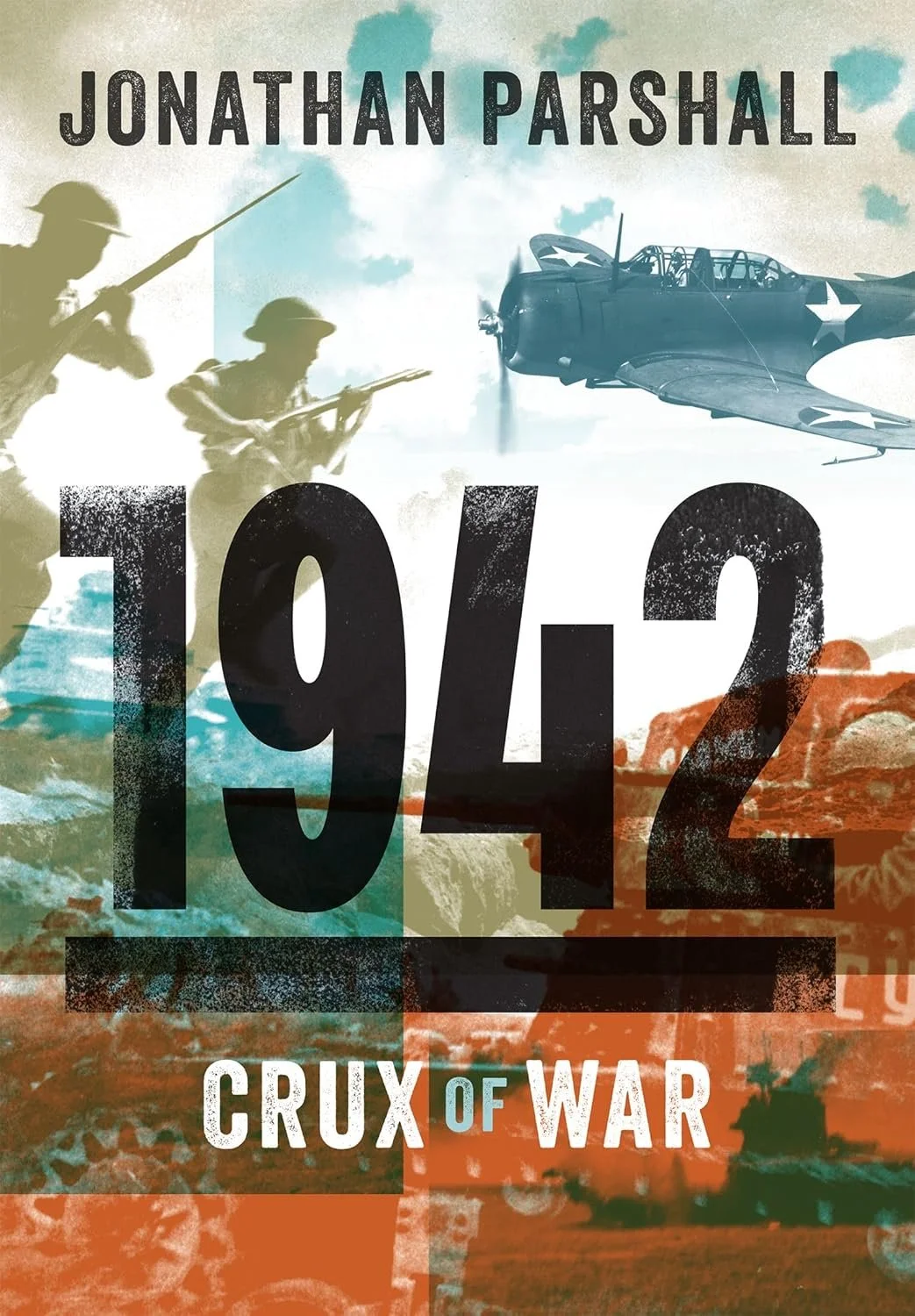
1942: Crux of War
By Jonathan Parshall
Oxford University Press, 2026
Take every quality of every conflict prior to it that your mind can conceive of, then begin multiplying, intensifying, widening, or deepening them, as the case may be. Next, stir in a host of new ingredients from radar to rocketry and the atomic bombs. Finally, reach for every superlative in your repertoire and apply them liberally – you’ll run out, but at this point you will start to have a decent picture of the Second World War.
It isn’t possible, in other words, to really get your arms around the subject. As a result, every historian has an angle, a remit, or a premise that guides them. Sometimes it’s Ian Toll expertly recounting the naval war between the United States and Japan, Rick Atkinson narrating the US Army’s role in liberating Europe, or Pritt Butar attempting (apparently) to write about everything that happened on the Eastern Front. In more revisionist ‘idea-based’ instances, we might read Sean McMeekin arguing that Stalin, not Hitler, was the driving force behind the war, or Phillips Payson O’Brien reasoning that “there were no decisive battles in World War II” and instead focusing on the theater sized “super-battlefields” of the air and sea.
Adding to the immense literature of this colossal war is Jonathan Parshall’s new and exactingly titled 1942: Crux of War, which seems to try to scale itself to the subject, right down to its physical construction. It is a non-standard sized hardcover clocking in shy of 1300 pages, chalked with rich maps and visuals, a deep bibliography in which he cites all the ‘right’ people (Glantz & House on Stalingrad, Richard Frank on Guadalcanal, Mark Harrison on economics, and so on), and peppered full of lively and knowing notes (sometimes just the former, when Parshall first cites Clausewitz, his footnote hilariously reads: “Drink! For it is written that all serious students of military history shall raise glasses when the name of the great Prussian military thinker is invoked”).
Parshall argues that 1942, with the U.S. having entered the war in December 1941, was “the critical year of World War II, and its tipping point.” Specifically, it “was the only year either side could have shaped a course to ultimate victory.” So concatenated to the facts of this crucial year itself, Parshall is giving his theory of the case, of the war as a whole. The drumbeat of that case comes down to a word: contingency.
Parshall effectively situates his approach between books “. . .purporting to describe the critical battle or turning point in this or that theater of the Second World War,” and conceptually novel (Sean McMeekin, Phillips Payson O’Brien) and deterministic accounts (Paul Kennedy): “The moral of the story is that the outcome of this global conflict, at least during 1942, was contingent on hundreds of events and on the gradual improvement of Allied military performance.”
He simultaneously draws on these accounts, and gently pushes against them, by narratively taking the year globally and month-by-month while answering an array of outlined fundamental questions, “the answers to which, cumulatively, compose the answer to the most important matter of all: who was going to win this war?” That is to say, he gives battles like Guadalcanal and Stalingrad their due, in authorly zest and page dedication, while not assigning them war-changing status; likewise, he marvelously details the practical and administrative nuts-and-bolts of war economy and engagingly illustrates the personalities and consequences of commanders at war, while equally denying them any sort of monocausality: “The Allies couldn’t win the war by virtue of their larger wallets alone. They had to fight, and fight well, when things looked really bleak.”
Still, it must be said, a principal impression of this book is that given a certain level of military competence, organization and economics were the rub of the war - and here it was not an equal fight. The punch-drunk Axis Powers were running on fumes from the start:
Despite Goebbels’s successful propaganda efforts to portray the Reich as an industrial and military juggernaut, Germany was in no way positioned for a sustained effort when war broke out in 1939, because it was already living hand to mouth. The only reason Germany had subsequently been able to undertake BARBAROSSA was because of the haul of war booty, trucks, and petroleum that it had captured after its campaign against France.
And then in 1942 we see that “Deep in America’s heartland, and behind the shield of the Urals, the armories that would pound the Reich to rubble were already being put in place.” Furthermore, as he understates the point, “it certainly didn’t hurt to have their [the Allies] war effort underwritten by the hefty bank account of the world’s richest nation.”
In short (perhaps an inappropriate phrase for this behemoth book), the arc of 1942 has a definite form: 1941 ends and 1942 begins with the Axis Powers malevolently and freely stomping over their theaters of operations, from Russia and North Africa to Southeast Asia and the Pacific; as the year progressed, the “foundational bankruptcy” of Axis strategy began to show and they could only hope their “excellence on the operational level” would compensate; by the end of 1942, as Parshall masterfully demonstrates, they had “failed most of their crucial tests” while “the Allies had passed most of their own.” Finally, looking ahead, the brute result of the morbid drama of the year was that “After 1942, the Allies would never ultimately be denied in any theater.”
This book, of course, is not so businesslike in its exposition. Incessantly informative at every level and rendered in sprightly idiomatic prose - where which German attacks hit like a “spring-loaded cement block to the face” and American “soldiers and sailors” are “greener than St. Paddy’s Day” - Parshall’s communicable love for the subject will, at its heights, have even veterans of the subject bouncing in their easy chairs (see The Naval Battle of Guadalcanal) – and, in the end, left deeply impressed.
In his generally forgotten history of the Second World War, Francis Trevelyan Miller described the event as “the greatest story in the annals of mankind.” It is a story that affronts comprehensiveness and requires simplification, but goads authors to set fire their pen and write history worthy of it. With 1942: The Crux of War, Johnathan Parshall has delivered and raised a banner title of Second World War literature.
David Murphy holds a Masters of Finance from the University of Minnesota.