In Paperback: Paul of Dune
/
In Paperback: Paul of Dune
By Brian Herbert & Kevin J. Anderson
Tor 2026
Brian Herbert and Kevin Anderson have written 19 books set in the “Dune” science fiction universe created by Herbert’s father Frank, author Dune and its five sequels. Those original six novels covered thousands of years of a future history in which humanity has developed a quasi-feudal arrangement in which the noble houses of the Landsraad counterbalance the more mercantile organizations, and all are ruled by an emperor. And since this history is not scrupulously contiguous, there are gaps in the storyline that act like dinner signs to any writer seeking to fill them in.
There were plenty of those fan fiction writers before Herbert’s own son tried his hand at it, teaming up with Kevin Anderson for 1999’s Dune: House Atreides. But this and all subsequent novels had the imprimatur of Brian Herbert’s surname and the aegis of Tor Publishing, and they fed the appetite of Dune fans who earnestly wished Frank Herbert had written more books about Paul Atreides, the spice, the sand worms, and the desert planet Dune.
Herbert and Anderson dutifully recreate the names and settings of those original six novels by Herbert’s father, and they zero in on virtually every gap or lacuna found anywhere in Frank Herbert’s books.
One of the most notorious of those gaps is the one between Dune and Dune Messiah. At the end of Frank Herbert’s blockbuster original novel, widely regarded as one of the greatest science fiction novels of all time, young Paul Atreides has managed to seize the emperor’s throne, marry the emperor’s daughter Princess Irulan, and positioned himself to unleash his savage Fremen hordes on a complacent galaxy. At the beginning of Dune Messiah, years have passed, the Fremen jihad has conquered the galaxy under his flag, and Paul has learned the bitter realities of imperial rule.
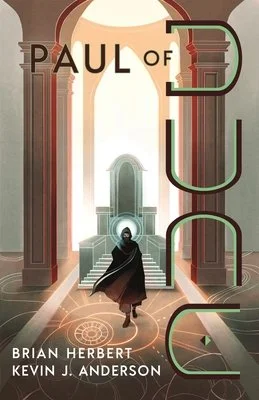
2008’s pastiche novel Paul of Dune seeks to tell the story of that gap, and after nearly 20 years, Tor has re-issued the book in a little trader paperback with lovely new cover art by Sonia Lai.
In this book, Paul is facing the practical nuances of establishing his rule. In a thematic concentration that runs throughout the book, this process involves an intricate balancing act between Paul’s two halves: the son of House Atreides who managed a successful coup against as sitting emperor, and Muad’Dib, the religious leader commanding the fanatic loyalty of the Fremen (some variation of “If Muad’Dib commands it, we will obey” is repeated roughly 500,000 times in the course of this book’s 500 pages). And instead of reading Frank Herbert delicately sketch this balancing act in fine brush-strokes, we get his son and co-writer … simply explaining it all:
Though Paul’s prescience told him he had to win many victories, he hoped to prevail on most leaders of the Imperium with subtlety and intelligence, using sophisticated means of persuasion. His mother had already begun to make overtures for him. He had to demonstrate that surrender to and alliance with Muad’Dib was a smart decision, the best alternative. The only alternative. But in order to accomplish that, he needed to employ the Paul Atreides side of his brain, rather than the raw Fremen side of Maud’Dib. Through all available means, he needed to control what remained of the Landsraad. He needed to gather allies.
Paul has the support of his Fremen, including the fanatical but scheming Korba, and he relies on his mother, Lady Jessica, and his family’s faithful retainer, Gurney Halleck. And when he briefly returns to his home planet of Caladan, he seems to gain another supporter, the foppish Ginaz Swordsmaster Bludd (every bit as cringe-worthy has Frank Herbert’s character Hayt — it seems to be a family trait; Brian’s lucky he wasn’t christened Wheelbarrow or Moonblossom). Bludd is easily the book’s most memorable character (not exactly a reassuring recommendation, considering the book’s title), a fascinating combination of pomposity and deviousness. He knew Paul when the Fremen savior was a child, and this gives him the kind of presumption that leads him into intrigue and eventually peril. The process is skillfully put forward as an exemplar of what a great many old Atreides retainers must have experienced during this period in Frank Herbert’s story. Every time Bludd confronts Korba, each bristles with possessiveness over the side of Paul they know best:
Bludd couldn’t believe this desert fighter would try to engage in a game of one-upmanship with him. In response, he said, “I knew Paul Atreides when he was just a stripling, and I saved his life when your mother was still scraping out the stink of your swaddling clothes. Read your history, Korba — Imperial history. Divvy Dinari got most of the credit, but I was there with him at the wedding massacre. I know the truth, and so does Paul.”
“Imperial history,” Korba sneered. “Paul Atreides. I speak of Muad’Dib, not the son of a Landsraad nobleman. His life before he came to Sietch Tabr and took the name of Usul has little relevance now.”
“You cannot know a man by half his life,” Bludd said, annoyed. “Isn’t that why Princess Ireland wrote his biography, which you all carry around like a holy textbook?”
Paul of Dune never quite feels like any of Frank Herbert’s original Dune novels. But Brian Herbert and Kevin Anderson are by this point old hands at spinning science fiction yarns, and this one satisfies.
Steve Donoghue is a founding editor of Open Letters Monthly. His book criticism has appeared in The Washington Post, The American Conservative, The Spectator, The Wall Street Journal, The National, and the Daily Star. He has written regularly for The Boston Globe, the Vineyard Gazette, and the Christian Science Monitor and is the Books editor of Georgia’s Big Canoe News