The Letters of Robert Frost, Volume 4
/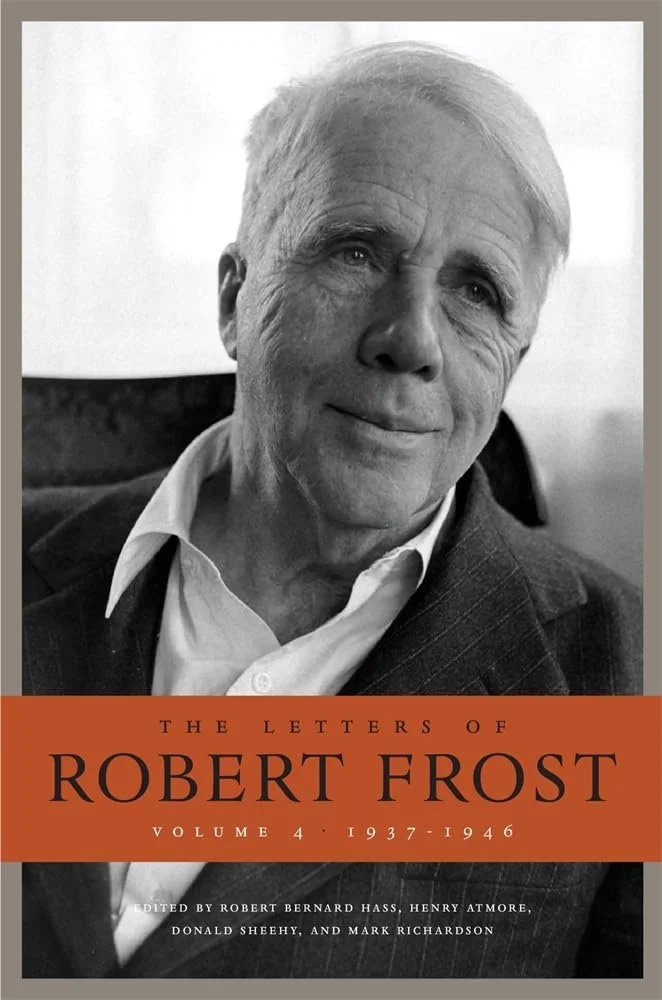
The Letters of Robert Frost: Volume 4 – 1937-1946
Edited by Robert Bernard Hass, Henry Atmore, Donald Sheehy, and Mark Richardson
The Belknap Press of Harvard University Press 2026
The Belknap Press continues its superbly authoritative collection of the letters of Robert Frost with volume 4, the penultimate volume, covering the years 1937 to 1946. It’s a big hefty volume, lovingly and magnificently annotated, covering years that were full of tragedy for the great poet (the death of his wife, his son), surprise joy (falling in love, after the age when some men expect it), and the steadily-strengthening reality of his own celebrity. He’d already won three Pulitzers by the time this volume opens and would go on to win his fourth by the time it ends. Students, shop clerks, stock traders, and scholars read his work with the kind of shared enjoyment that had been known by figures like Longfellow before him but would be known to no American poet after him. And as editors Robert Bernard Hass, Henry Atmore, Donald Sheehy, and Mark Richardson make clear in their brief, insightful Introduction to this volume, the experience still had the power to amaze the man himself:
As the thirties gave way to the forties, and the forties to the fifties, he would attain bona fide celebrity. Already in March 1936 he could write his son Carol about the reception of the lectures he gave as Charles Eliot Norton Professor of Poetry at Harvard: “I’ve never been welcomed anywhere with the noise and enthusiasm I met with … You’d think I was some musical hero.” It would grow harder for him to keep from being king when it was in him and in situation. His poetry had developed, if not a ring of false commerciality, than anyway an occasional ring of generalized Rotarian dicta.
In these letters, we see Frost’s fame steadily emboldening what earlier volumes in this series made clear was an inherent propensity for flintiness. At almost every turn in this latest volume, even, perhaps touchingly, in the missives that approach the closest to being love letters, we see the struggles of a man for whom expected kindliness was a distinct strain that often cracked. When he’s fretting about being appointed Ralph Waldo Emerson Fellow in Poetry at Harvard, he protests a bit too much to his friend Robert Hillyer (eschewing, as per usual, apostrophes):
Listen! I have scared myself with what I have set going. It wont do for me to profess Latinity. I have been warned off already. [Arthur Stanley, of Harvard] Pease though writing warmly to welcome my idea, yet winds up with the suggestion that I might like John Finley as a watcher in my classes. Don’t I know those bozos from of old? They are too humanistic to be human. I am only fooling myself if I think that large treatment can make them over into anything but what they are. Dont let me speak scornfully of them. They have their proper pride in their peculiar knowledges that I would be the last one to want to reduce.
These are the first years when Frost can feel free to fully embody the talismanic grumpiness that would go on to become an even visual reference for the man. Partly, as these letters make clear, this was a measure of self-defence. Fame brought fame-seekers. Opportunists, schemers, and good-hearted but overreaching folk started to want more from Frost than he was willing to give, and they got blunter and blunter responses, as in 1942 when the representative of the Rocky Mountain Writers’ Conference were congenially snapped at:
Now listen. You dont want me kicking round at my age for nothing. I can’t run here and there for the sake of running. There must be some return proportioned to my expenditure of strength. Seven hundred dollars wont be enough to bring me to the Coast. And there must be some warmth of assurance that somebody wants me besides you and Earle Bernheimer. I haven’t had one word of invitation yet from anybody but you. Unless you make things look better – more inviting – right away, Im afraid you will have to give me up, and make up your mind to get along with only my ghostly presence at your conferences …
As with the earlier volumes in this series, this fourth volume is a quiet marvel of concentrated scholarship. Every quotidian detail undergirding these letters, every recoverable reference big and small, is provided as promptly, smoothly, and unobtrusively as a Buckingham Palace equerry slipping you a breath mint before you fully realize you want one. And the result is something at once more demanding than a standard biography of Frost would be (not that these are exactly thick on the ground, Jay Parini’s terrific book being now distinctly long in the tooth) but entirely more satisfying.
Steve Donoghue is a founding editor of Open Letters Monthly. His book criticism has appeared in The Washington Post, The American Conservative, The Spectator, The Wall Street Journal, The National, and the Daily Star. He has written regularly for The Boston Globe, the Vineyard Gazette, and the Christian Science Monitor and is the Books editor of Georgia’s Big Canoe News