The Forsaken Founder by Scott Greenberger
/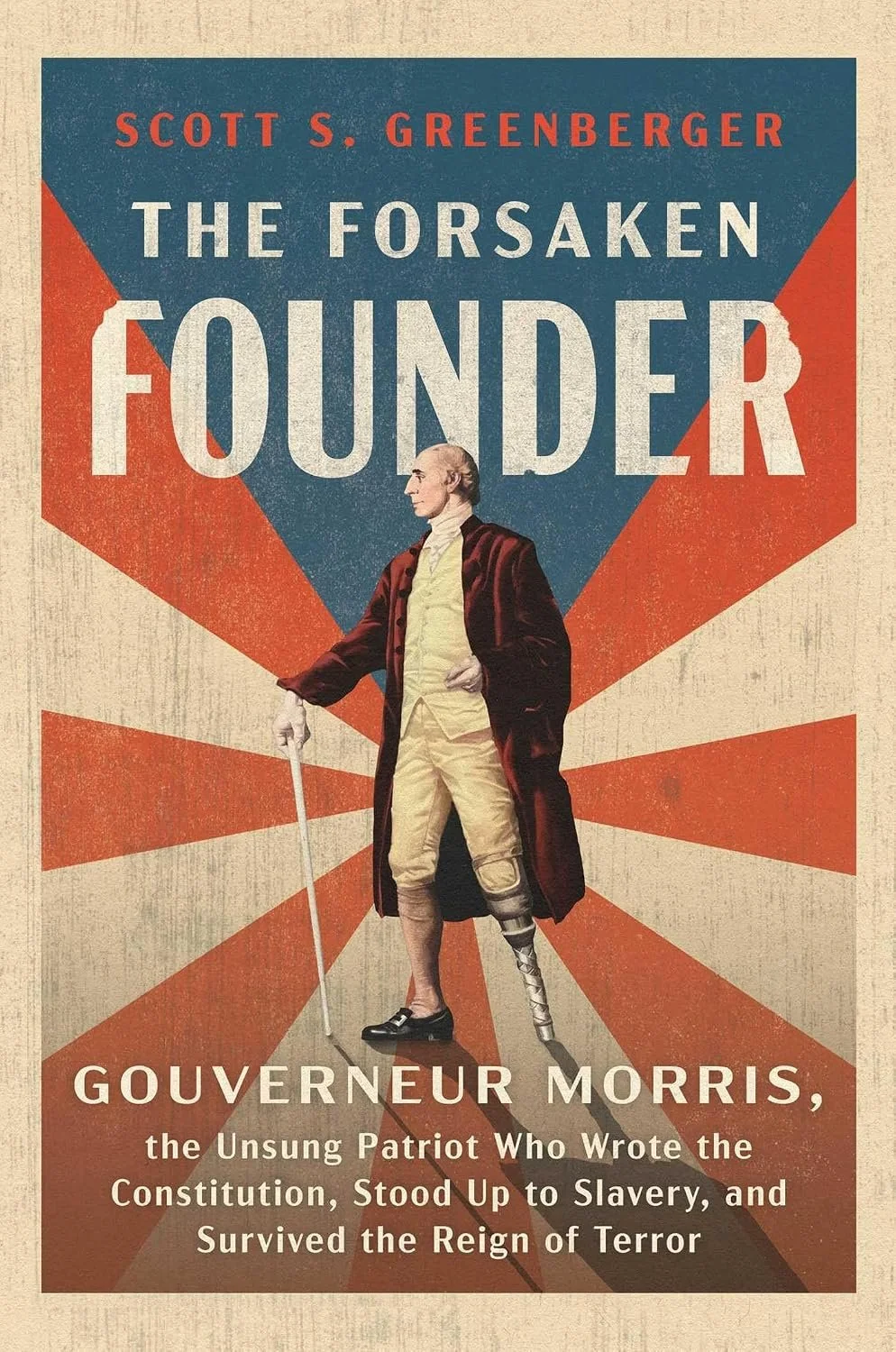
The Forsaken Founder: Gouverneur Morris, the Unsung Patriot Who Wrote the Constitution, Stood Up to Slavery, and Survived the Reign of Terror
By Scott S. Greenberger
37 Ink/Simon & Schuster 2026
Ten years ago, Scott Greenberger produced his delightfully table-overturning book The Unexpected President: The Life and Times of Chester A. Arthur, in which he took the 21st President of the United States and insisted he was not, in fact, a buffoonish walrus but rather a secretly significant trailblazer unjustly forgotten by history.
In his new book, The Forgotten Founder, his subject is that perennial Founding Father dark horse, Gouverneur Morris, who “reorganized the ragtag Continental Army into a force that vanquished the preeminent military power of the age,” “played a pivotal role in putting the new nation on solid financial footing,” and “rewrote the final draft [of the Constitution] so that it did not endorse slavery – either explicitly or implicitly.” Oh, and designed the street grid of New York. “James Madison? The president was often drunk on wine or high on opium and so withered that his wife had signaled her openness to an affair,” Greenberger writes, directing the reader’s attention instead to his man Morris: “He was the penman of the Constitution, and the sole author of its eloquent Preamble.”
As might be guessed from such opening remarks, Greenberger has no intention of being a faint-hearted fan. He can draw something of a decorous veil over the man’s scabrous philandering, although more public performances present a steeper challenge, as when Morris heaved and stumped to the front of a crowd in 1799 to mumble his way through a tribute to George Washington, who’d died a few days earlier (before reading the plea Morris had sent him at Mount Vernon, urging him to run for a third term as President):
The City of New York asked him to deliver a eulogy at St. Paul’s Chapel. “In him were the courage of the soldier, the intrepidity of a chief, the fortitude of a hero,” Morris said. “He loved glory, but still more he loved his country.” Though he fretted afterward that he had botched the delivery, he sent copies of the address to friends in Europe – a gesture not of vanity but of reverence. Washington had been his moral compass; he wanted the Old World to know what America had lost.
He had, in fact, botched his delivery, and his mass-circulation of his bland remarks was, in fact, a gesture of vanity, but it’s nice to have a talented biographer for a friend. It comes in handy, for instance, if you continue to botch your public speeches. Morris was ushered to the bedside of the dying Alexander Hamilton, most famously, and then later gave a eulogy for the friend who’d been his enemy for so many years. He botched this eulogy too, but Greenberger is ready:
Posterity judged the eulogy much as Morris had feared: less a stirring oration than an act of moral composure. Yet in its restraint lay its power. Where others demanded retribution, Morris offered dignity; where grief might have flamed into civil chaos, he preached order and mercy. History came to see it not as a failure of passion, but as the last service one founder could render another – a farewell that steadied a mourning nation rather than inflaming it.
Greenberger’s reclaiming zeal worked to make his President Arthur biography so enjoyable, and it works the same magic here. This forgotten Founding Father has had a great many biographies (somewhere, James Otis must be seething), but none so entertaining as this one. “Our most colorful Founding Father has been denied his rightful place in American history,” Greenberger insists. “It’s time to set the record straight.”
Melanie Miller had the same mission in her 2024 book on the unjustly forgotten Morris. So did Dennis Rasmussen in his 2023 book on the unjustly forgotten Morris. And James Kirschke in 2005. And Richard Brookhiser in 2003. Theodore Roosevelt, writing for the great old American Statesmen series, banged the drum of the forgotten Morris particularly stoutly in 1888. So did Jared Sparks in 1832, when some of the Morris bastards were just hitting puberty. These biographers are railing against the injustice of how history bestows its laurels, and of course they know better, know that this process can’t be forced and is indifferent to actual merit. Gourverneur Morris will go right on being forsaken, much to the relief of the publishing industry.
Steve Donoghue is a founding editor of Open Letters Monthly. His book criticism has appeared in The Washington Post, The American Conservative, The Spectator, The Wall Street Journal, The National, and the Daily Star. He has written regularly for The Boston Globe, the Vineyard Gazette, and the Christian Science Monitor and is the Books editor of Georgia’s Big Canoe News