Shadow Before the Flame by Catherine Grace Katz
/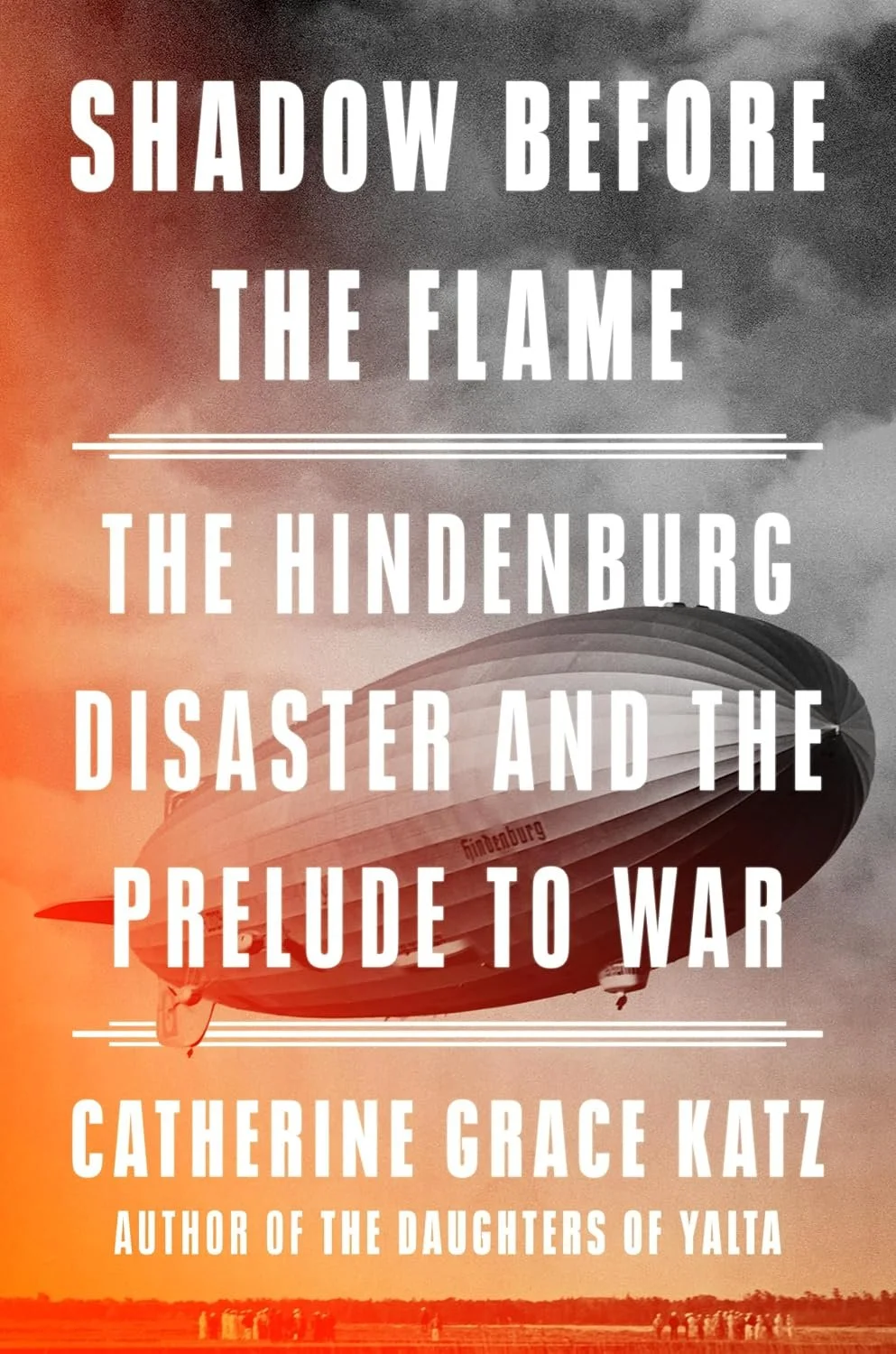
Shadow Before the Flame: The Hindenburg Disaster and the Prelude to War
By Catherine Grace Katz
Viking 2026
If the 21st century knows anything at all about the disaster of the Hindenburg, likely two items suggest themselves: the quick black-and-white video taken on May 6, 1937 at Lakehurst, New Jersey, showing the massive airship being consumed in flames as it sinks to the airstrip, and the accompanying audio by news broadcaster Herb Morrison, famously sobbing “Oh, the humanity, and all the passengers …”
Historian Catherine Grace Katz fleshes out that bare-bones picture smartly and elaborately in her new book Shadow Before the Flame: The Hindenburg Disaster and the Prelude to War, and the corny portentousness of the title is matched, unfortunately, by long patches of oddly clunky prose throughout the text itself, sometimes clogging the story’s momentum even at what should be the peak of excitement:
“It burst into flames! It burst into flames and it’s falling! It’s crashing!” Herb Morrison shouted as the Hindenburg, which had been standing still before him just a moment ago, was suddenly engulfed in fire. To some on the ground, it looked as if, just for a moment, a tiny light had appeared on the Hindenburg’s cover just in front of the tail like a flame from a paper match smoldering at a distance. Almost instantaneously, a neon glow ran along the nearby riblike girders. Then a burst of light appeared, which erupted into a giant inferno near the airship’s tail as the crowd around Morrison let out a terrified scream. Before anyone could register what they had just seen, the entire tail section of the zeppelin was consumed in a fireball spitting tongues of flames up into the sky as if the Hindenburg were made of flash paper.
That “giant inferno” occupies dead center of Katz’s narrative, which extends beyond it into the usual follow-up of what happened to all the witnesses and survivors, as well as what happened to the zeppelin industry itself. But more intriguingly, Katz also extends her story backwards from that immortal moment, examining in satisfying detail something that people tend to forget: the giant airship that died so famously at Lakehurst, New Jersey had a tail fin decorated with an enormous swastika. Katz chronicles not only the burgeoning of airships as a means of fast luxury travel (on the one hand, you could make an Atlantic crossing in half the time of a steamship; on the other hand, well, the Hindenburg disaster – ironically, the Hindenburg and the Titanic were about the same length) but also its increasing co-option by the Nazi state, which Katz views with a very effective combination of scorn and caution. “Beneath the Nazis’ regular bouts of buffoonery, the threat of what still could come lingered palpably over the correspondent corps,” she writes of those earlier, darkening days. “Small but obvious signs were everywhere.”
But it’s the few moments of the disaster itself that must ultimately command any Hindenburg book, and Katz has assembled an intensely-packed catalog of grotesqueries, from a mother throwing her little children out a window of the burning craft without being sure she wasn’t simply throwing them to their death to a passenger who was careful to remove his false teeth before he hurled himself from a rail way and hoped to survive the impact. Even here, at the heart of the story, an odd awkwardness lingers around the book’s prose:
“Everybody outside,” Lehmann commanded as he went out the starboard window. Pruss, Sammt, Wittemann, and the other officers did the same. It was still about a five-meter drop, and Sammt landed on all fours. Pruss was disoriented as he landed and ran backward into the raging flames, disappearing into a wall of fire as the bright-white smoke of hydrogen was quickly replaced by black clouds of burning diesel fuel.
Ran backward? Like in a circus act?
For the most part, Shadow Before the Flame manages to recover from this kind of bumpy passage. Certainly it’s the fullest and most richly contextualized history of the Hindenburg disaster to appear in English. Readers will approach those famous few seconds of Herb Morrison sobbing with an enhanced awareness of the bigger picture.
Steve Donoghue is a founding editor of Open Letters Monthly. His book criticism has appeared in The Washington Post, The American Conservative, The Spectator, The Wall Street Journal, The National, and the Daily Star. He has written regularly for The Boston Globe, the Vineyard Gazette, and the Christian Science Monitor and is the Books editor of Georgia’s Big Canoe News