Weimar Germany by Victor Sebestyen
/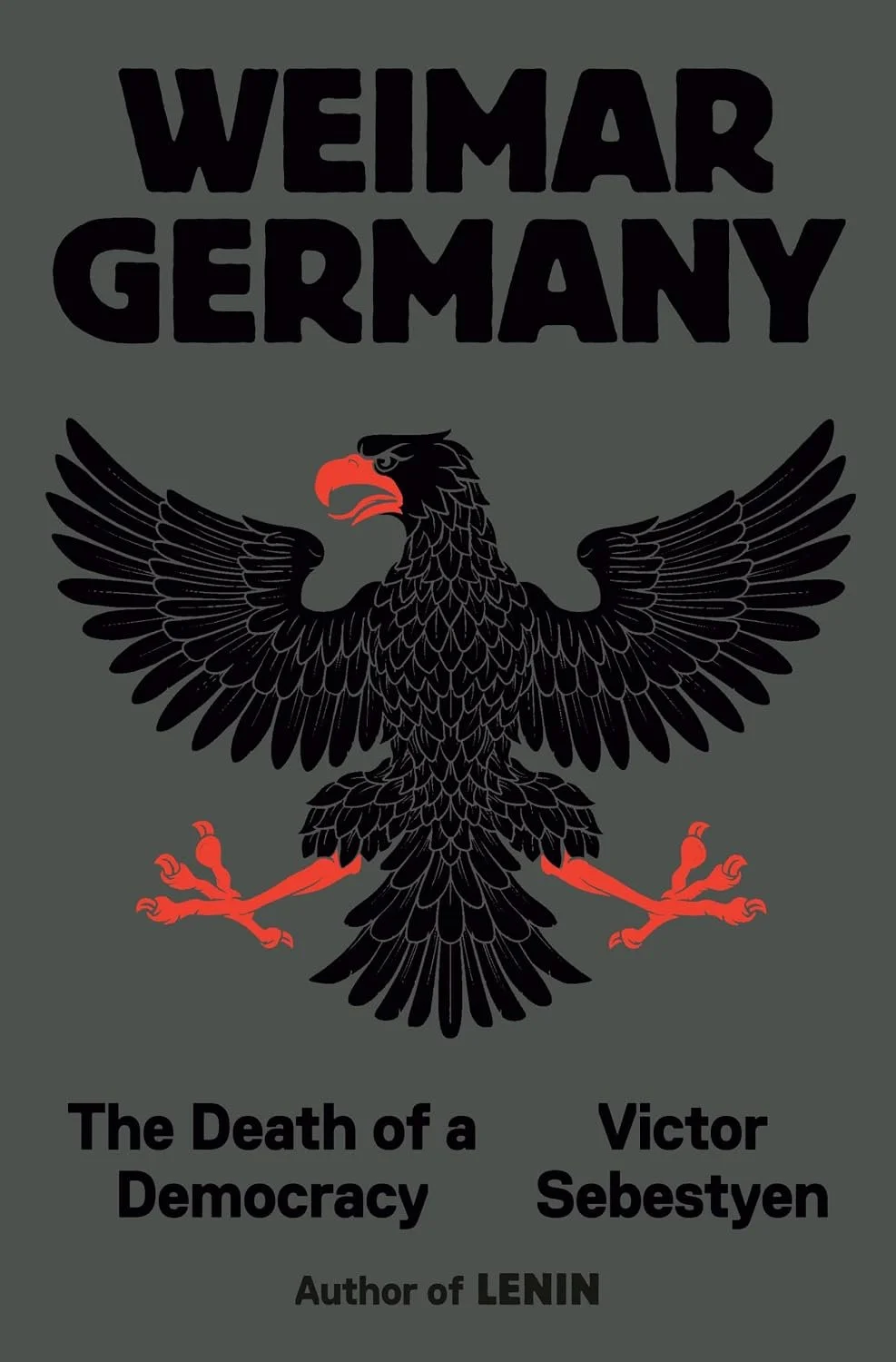
Weimar Republic: The Death of a Democracy
By Victor Sebestyen
Pantheon 2026
How and why the Nazis gained power in the 1930s, ultimately unleashing the deadliest war in human history, has been the subject of immense historical analysis and debate for decades. The bottomless inquiry is largely led by a desire to prevent the next potential catastrophe or vile dictator-to-be. While the ‘how’ is relatively clear, the ‘why’ remains an enigma, one that is particularly relevant in today’s tumultuous political climate. In his latest book Weimar Republic: The Death of a Democracy, Victor Sebestyen attempts to untangle the cultural, political, economic, and psychological forces that dissolved democracy and opened the door for fascism. In a blended work of history and journalistic storytelling, Sebestyen immerses readers within the short-lived Weimar Republic, a booming, blistering culture utterly unaware of the horrors looming on the horizon.
The fallout of WWI left Europe in a state of unprecedented devastation, not merely in terms of human casualties and financial ruin, but political devastation as well. The 1917 Russian Revolution saw the overthrow of the Romanovs and Germany, too, witnessed the abdication by Kaiser Wilhelm II in 1918, ending the Hohenzollern dynasty’s 400-year rule as the war on the Western Front drew to a close. In Weimar Germany, Sebestyen quickly catches readers up to speed with an overview of the German Revolution of 1918, establishment of the Weimar Republic, and the political assassinations of Rosa Luxemburg and Karl Liebknecht. The focus then shifts to the newly formed Ebert government, whose initial moves included removing previously restrictive censorship and giving free rein to artistic expression–reforms that immediately “began to divide the country and became one of many aspects of modern life that drove people further apart.” From the revolutionary Bauhaus school to the hypnotic dancing of Anita Berber to raunchy cabaret numbers, Sebestyen dazzles in his intertwining of artistic and cultural developments into the historical narrative at its foundation. Spanning thirty-six chapters, the work follows a largely linear timeline, but frequently dips into isolated chapters on the emergence of the “New Woman,” rampant drug use and prostitution, American-imported Jazz, and all sorts of distinguishing characteristics that mark this infamous era.
Balancing these digressions, Sebestyen uncovers the forces leading to widespread desperation and frantic cultural unraveling across the nation. An examination of reports and public response makes clear that the humiliating terms of the Treaty of Versailles were not the sole cause of resentment and political radicalism, but they thrust the country into deeper economic collapse, worsened unemployment, and fueled the reactionary Right, which already seethed at the so-called “November criminals.” Sebestyen outlines how the political center was already hollowing out by the 1920s, with an overwhelming number of youth aligning with the Right and as the country continued to drift toward ultranationalism. In addition to its lack of legitimacy and the radical cultural shifts that polarized the country, the republic was politically weakened by the refusal of the highest judges to rule in favor of the Reichstag’s sweeping reforms. Choked by political violence and financial strife, German citizens grew increasingly open to vitriolic rhetoric as long as it came from a zealous, seemingly forceful leader. And although popularity of the communist party persisted in the Weimar Republic, a division between socialists and communists crippled the Left as Sebestyen explains:
Despite the misery of the poor and the working class in the Depression, the mass unemployment and the fast-growing popularity of the Nazis, the socialists and Communists, for their own party reasons, could never find a way to work together - or even to stop fighting each other on the streets. A suicidal error, as it made life so much easier for the Far Right, which was adept at exploiting the splits on the Left.
Attempting to break new ground is quite difficult when the subject is the rise of Adolf Hitler and the Nazis, yet Sebestyen manages to deliver an intriguing examination of the pivotal and compelling period. His narrative is well-paced, seamlessly drawing upon quotes and experiences from prominent artists and revolutionary figures to construct thrilling accounts that paint a vivid image of mercurial Berlin. However, Sebestyen’s limitations and journalistic tendencies appear and hinder the work’s shelf life. He too often dates his analysis with modern references and draws upon the current political atmosphere to construct parallels—some useful and others paper thin. His explanations remain surface-level when discussing the major moments, such as the 1930 election and the dissolution of the Reichstag, which is recounted in a few paragraphs.
Written in the midst of global political uncertainty, Weimar Republic is a gripping and relevant historical work. More than a broad overview of post-war Germany, Sebestyen educates and entertains readers on the cultural and artistic elements that defined the era and became generationally influential. Limited in rigor and scope, it fails to deliver a thorough examination of the political and economic movements, but by sacrificing those details, sheds a brighter light on the artistic scene. Though not a defining work on the transient republic, it serves as an equally engaging and informative read.
Brock Covington is an entrepreneur and writer. He can be found on the YouTube channel "The Active Mind" and on his substack: brockcovington.substack.com