The Taper Man by Nick Harkaway
/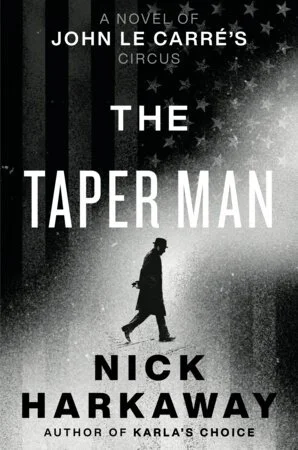
The Taper Man
By Nick Harkaway
Viking 2026
The odd and incongruously successful phenomenon of first-rate novelist Nick Harkaway writing novels set in the fictional universe created by his father, John le Carré, continues with Harkaway’s latest book, The Taper Man. Following up 2024’s Karla’s Choice, this novel once again takes readers into the world of Cold War British espionage, the so-called “Circus” with its core cast of characters from le Carré’s most famous novels, most especially George Smiley, the slight, unassuming intelligence mastermind who was le Carré’s immortal creation. The Taper Man is set in 1965, and although the Circus is run by a man named Control, Smiley is already the greyest of grey eminences; at one point when he’s counseling operative Bill Haydon about how much to tell Control, Haydon asks how much he should tell Smiley himself and gets the response, “It’s the same thing.”
Smiley here travels to the quintessential fantasyland in search of a deeply-embedded Soviet agent (called a “taper man” because such agents are tasked with keeping the flame burning): Los Angeles in the 1960s, full of huge cars, huge roads, and huge buildings (“It was as if the people here responded to the land and built for giants,” Smiley thinks, “and lived in their houses, never wondering when they’d come home”). I’m on the moon, Smiley regularly reminds himself. I’m just visiting.
He deals uncomfortably with his bluff, brash American counterpart, Jack Easterwick, whose psychologically damaged brother Molson is already known to him. Smiley wants to dig into events from ten years ago, wants to interview the pertinent people, wants to ferret out the truth of murky events, and the narrative splits between his efforts with American cousins of the Circus and the efforts of Circus operative Roy Bland, in Russia pretending to be a defector, to help a bleakly courageous women named Solana.
Smiley’s investigations quickly uncover a name neither Easterwick nor most other American agents admit to remembering at all: E.L. Vane, a black woman Smiley eventually finds, who gives him crucial information while disabusing him of many notions about the US. “There’s no secret history of America, Mr. Smiley,” she tells him at one point. “It’s all right there, unless you look away.”
In dealing with Vane and contemplating the heart of his profession, Smiley not only shares a chunk of painful personal reminiscences (“She looked at his face and eventually accepted this as truth,” we’re told, followed by a quintessential le Carré clarification: “Which it was, in that it had happened, and Smiley knew the man it had happened to”) but also clarifies the whole process of cultivating a source:
You possess information and want to share it. I have an appetite and am in a position to remunerate its satisfaction. Between us is betrayal, a Rubicon both shallow and deep which we must cross, while I lay down a cloak to keep you from getting your feet wet.
This is a neat, sustained parallel, since poor beleaguered Roy Bland is likewise dealing with dangerously muddled concepts of the good guys and the bad guys:
A lot of people, especially in the Foreign Office, misunderstood Russia and believe it was really just Europe behaving badly. To Bland, it was something else: a completely other place that happened to share a continent with Paris and Rome, but owed itself to the vast interior and a different, uncommon past.
Naturally, this being a Circus novel, neither Smiley nor Bland ends up happy with how their stories turn out. But is any of this natural? This is the strange underlying question pulling at the ends of every plot twist, every character sketch, every extremely careful folding of this story into the le Carré canon: neither Smiley nor his Soviet nemesis Karla can die, for instance, and any traitors in the Circus itself cannot yet be uncovered or even suspected. The Taper Man is a Nick Harkaway novel in which he himself, an incredibly talented writer, creates virtually nothing and can do virtually nothing. The characters are largely fixed in place; their fates are largely circumscribed; their natures cannot be radically different from what readers have already found in The Looking Glass War, much less Tinker, Tailor, Soldier, Spy, set later than the events in The Taper Man. The wild inventiveness of great Harkaway novels like Tigerman or Titanium Noir is completely forbidden him in these pages.
That leaves him two things to do: describe things marvelously, which he does without flagging, on literally every single page (this is the kind of book you’ll carry everywhere with you, the kind of book you’ll eagerly want to resume after even the briefest interruption), and to, maybe for want of a better word, inhabit things thoroughly and convincingly.
That happens triumphantly throughout the book. This is the most eloquent inhabitation of George Smiley and some of the other satellite Circus characters that’s ever been put in galleys. Roy Bland’s crude, blunt bravery and Smiley’s plangent, world-weary sadness are perfectly captured. The whole thing feels too knowing and sophisticated to be called fan fiction, but it can’t be anything else, since surely only John le Carré can write a real George Smiley novel? “It was as if the people here responded to the land and built for giants,” we were told, “and lived in their houses, never wondering when they’d come home.”
Whatever this is, it’s easily, easily too good to miss. Whatever Nick Harkaway is doing to the fictional world his father created, it’s a thing of fitting nuance and, ultimately, honor. Any sane reader will hope it continues.
Steve Donoghue is a founding editor of Open Letters Monthly. His book criticism has appeared in The Washington Post, The American Conservative, The Spectator, The Wall Street Journal, The National, and the Daily Star. He has written regularly for The Boston Globe, the Vineyard Gazette, and the Christian Science Monitor and is the Books editor of Georgia’s Big Canoe News