A Washington Irving Sketchbook by Phillip Lopate
/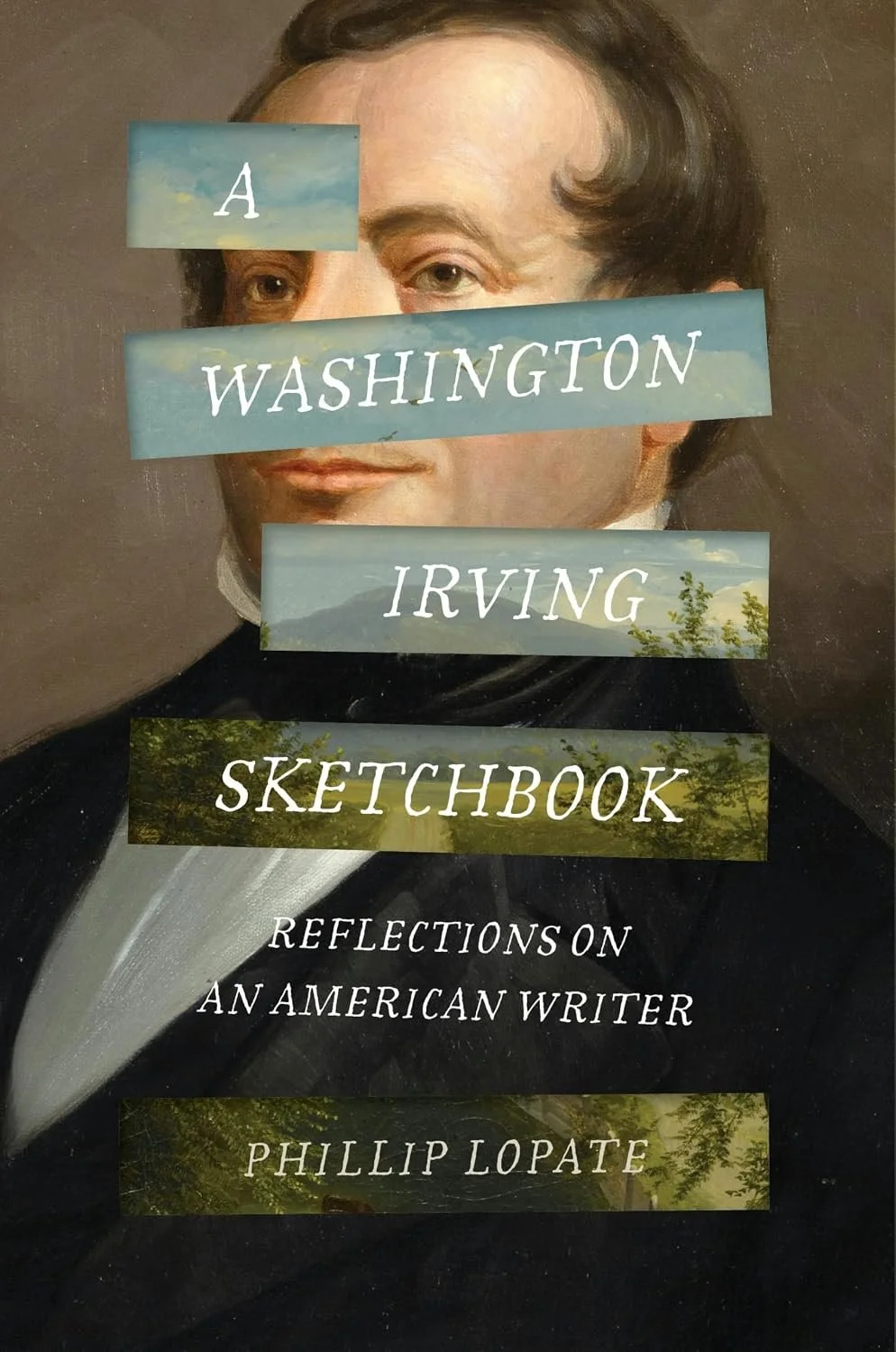
A Washington Irving Sketchbook: Reflections on an American Writer
By Phillip Lopate
Princeton University Press 2026
There’s a curiously funereal cast to A Washington Irving Sketchbook, a slim new book by Phillip Lopate. The “sketchbook” mention in the title, as Lopate notes, is an allusion to the “sketches” and semi-fictional essays that dotted Irving’s career and helped make him an internationally-beloved literary figure, the very first such figure in United States history. Lopate models is own book along such lines; this is much less a full-dress biography and much more a fragmentary portrait of a man one critic characterized as “modest, equable, cheerful, affectionate, sincere,” and who represents to Lopate “the prototype of a writer’s life.”
The short chapters in this short book (the latest full biography of the man, by Andrew Burnstein, is twice as long) largely alternate between the works, the sign-posts of Irving’s life, and the resonances both have for Lopate himself, who provides at regular intervals exactly the kind of spot-on observations readers have come to expect from this author, particularly in the subtle ways he attempts to feel his way to understanding the sometimes murky depths sloshing around underneath Irving’s always-cheerful always-upbeat public exterior (when encountering Irving’s mention of “the companionship between the author and the reader,” for instance, Lopate sharply wonders if this suggests “[Irving’s] way of surmounting his own solitude”).
Lopate stops at every literary landmark in his subject’s life in order to opine a bit. He mentions Bracebridge Hall as a kind of failure, puzzlingly, and links it intriguingly to his own professional writing career. Lopate, the editor of a first-rate trilogy consisting of The Glorious American Essay, The Golden Age of the American Essay, and The Contemporary American Essay as well as the mind behind the now-classic anthology The Art of the Personal Essay, fancies he feels a fellowship with Irving at this stage of his career: “It could be that Irving had begun to tired of the personal essay game and was grinding them out. It is a form that depends almost too much on spontaneous charm and can turn arch or jejune if one isn’t careful,” he writes, adding simply, “Don’t I know it.”
But as engaging as all this is, it can’t quite escape the aforementioned funereal pall. Lopate makes it clear that one of his main reasons for writing about Irving is that nobody else is likely to do so. His Irving, the author of “Rip Van Winkle” and “The Legend of Sleepy Hollow,” is an overlooked figure, an underrated one, quite forgotten, almost pining to be forgotten. At one point Lopate is describing the moment when Irving, on the occasion of being named minister to Spain in 1842 , is invited to a dinner with all the assembled New York literati, who take the occasion of the invitation (Irving didn’t actually go) to praise him elaborately. Lopate takes care to bracket Irving’s reaction to this praise coming and going in decidedly killjoy tones:
Irving was always preparing himself to be forgotten. “I thought I had become so old a story as to be past all such bozzing, but they seem to think me brought out in a new edition at Washington.” His fears were simply premature: His time to be forgotten would come after his death.
Not quite forgotten, if one of our foremost men of letters could feel compelled to write a book about him, and if one of our foremost university presses could feel it feasible to publish said book, and if eight readers out of ten would recognize if not the man’s name then at least a couple of his works two hundred years after they were written, but the point is nevertheless well taken, and Lopate’s celebration in these pages will be infectious even to the uninitiated. “To read him is to love him,” one of those contemporary critics said of Irving, and if the reverse is also true, Lopate has certainly done his part.
Steve Donoghue is a founding editor of Open Letters Monthly. His book criticism has appeared in The Washington Post, The American Conservative, The Spectator, The Wall Street Journal, The National, and the Daily Star. He has written regularly for The Boston Globe, the Vineyard Gazette, and the Christian Science Monitor and is the Books editor of Georgia’s Big Canoe News