Plant Lady by Minyoung Kang
/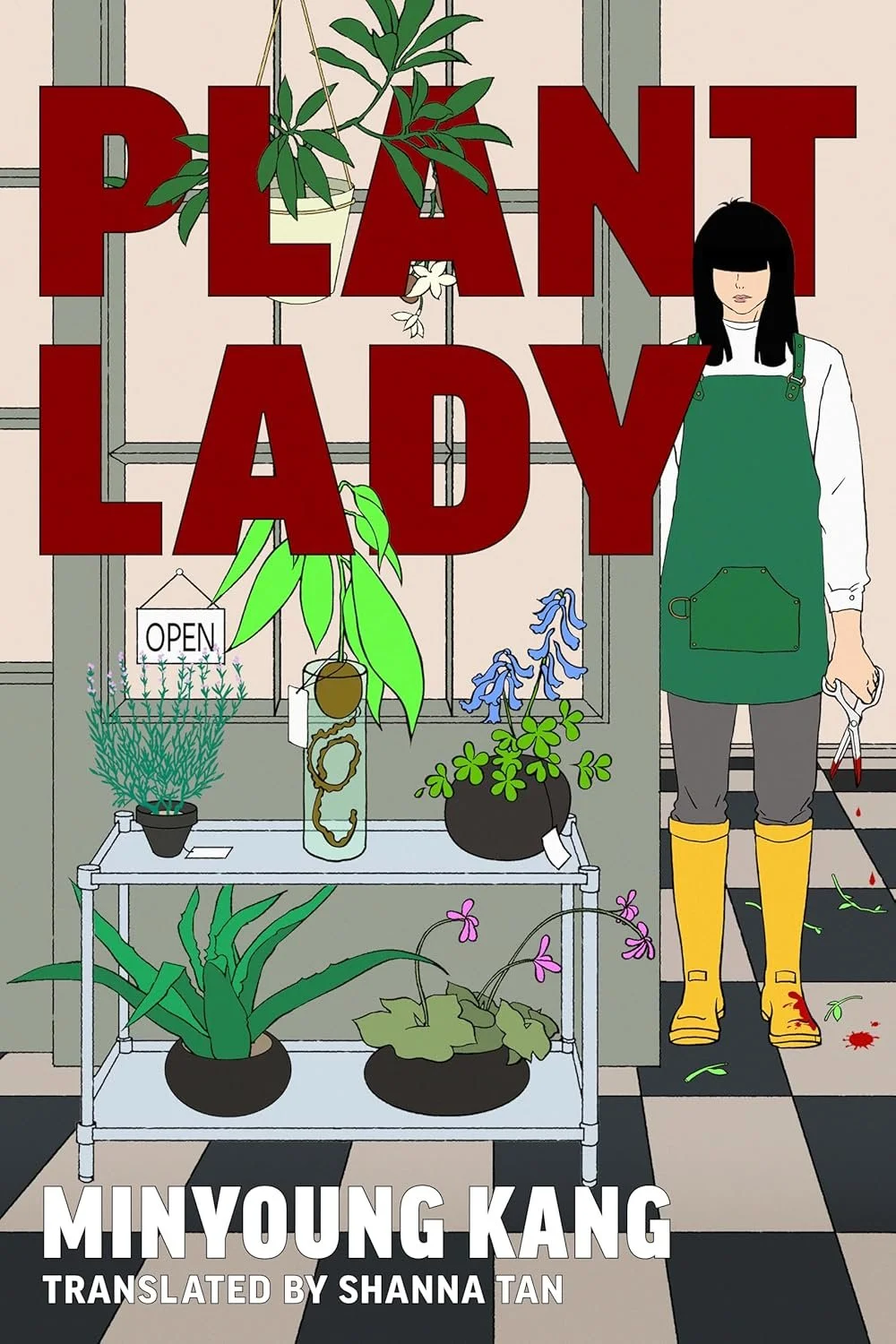
Plant Lady
By Minyoung Kang
Translated by Shanna Tan
Berkley 2026
Readers of Shanna Tan’s new translation of Minyoung Kang’s novel Plant Lady aren’t five pages in before they encounter things like this:
Over time, Yoohee became like a computer that had lost its ability to reboot. Not even a full performance optimization service and the latest antivirus technology could fix anything.
Or this:
By a stroke of luck, Yoohee had recently dropped into a bicycle shop at Dosan Market to have her bike chain repaired. Recalling the layout of that shop, she began suggesting plant varieties that would complement its vibe, describing each one in detail and giving instructions on how to care for them.
Fairly dire stuff; this is either the work of a lazy translator or an accurate translator of a lazy author, and it continues throughout the book. Every character is stock cardboard; every description is a flat soufflé of tired cliches and idioms; every one of the plot’s minimal twists is both illogical and thoroughly telegraphed. It’s not just fans of “Little Shop of Horrors” who’ll be bored by page 70.
This is the story of a woman named Coi Yoohee, who “uproots” herself from her home town in order to escape its worrying associations in her mind, described in boringly predictable terms as “a crackling radio that couldn’t be turned off.” She opens a plant shop in Sejin City, and after a while, it becomes a quirkily popular destination not only for plant lovers but also for women with problems. Sejin City boasts a population of about 400,000 people, but even so, the problem is always the same: men. All these women, like Yoohee herself, have problems with men, not just individual men but the whole floral arrangement.
Yoohee begins taking care of these problems, weeding them out of her customers’ lives, and gradually, very, very gradually, she and her shop come to the attention of Detective Dokyung Cha, whose superiors on the police force liken him to a tenacious dog gripping a bone. “Once he set his mind to something,” readers are told, “he became completely possessed.”
He doesn’t actually show this possession at any point in the novel (an actual dog, even a basset hound, could have put together a case against Yoohee a lot faster), but then, none of the characters in the book (Yoohee herself, Detective Cha, the various women, the gallery of boorish men who simply won’t ever say “I’m sorry” and get their heads bashed in for this omission) ever actually show any of the things we’re told about them. Instead, they just shuffle onstage for their scenes, mumble their lines in a monotone, and then shuffle offstage, or, if they happen to have a penis, into the compost heap.
The problem in the book is therefore strictly biological: men are described as genetically and morally defective, even though the book’s only serial killer isn’t a man. But more importantly, perhaps, for prospective readers, the problem with the book is strictly rhetorical: either Minyoung Kang has written a trite, boring, and obvious little fable of spades-and-pruning-shears-against-the-patriarchy, or her translator has taken a book that is somehow original against considerable odds and turned it into such a thing.
Either way, the interview with Minyoung Kang included in the back of this Berkley edition makes one things explicitly clear, if the benighted 21st century hadn’t already abundantly done so: readers are supposed to cheer for the murderer.
Steve Donoghue is a founding editor of Open Letters Monthly. His book criticism has appeared in The Washington Post, The American Conservative, The Spectator, The Wall Street Journal, The National, and the Daily Star. He has written regularly for The Boston Globe, the Vineyard Gazette, and the Christian Science Monitor and is the Books editor of Georgia’s Big Canoe News