Athens and Sparta by Adrian Goldsworthy
/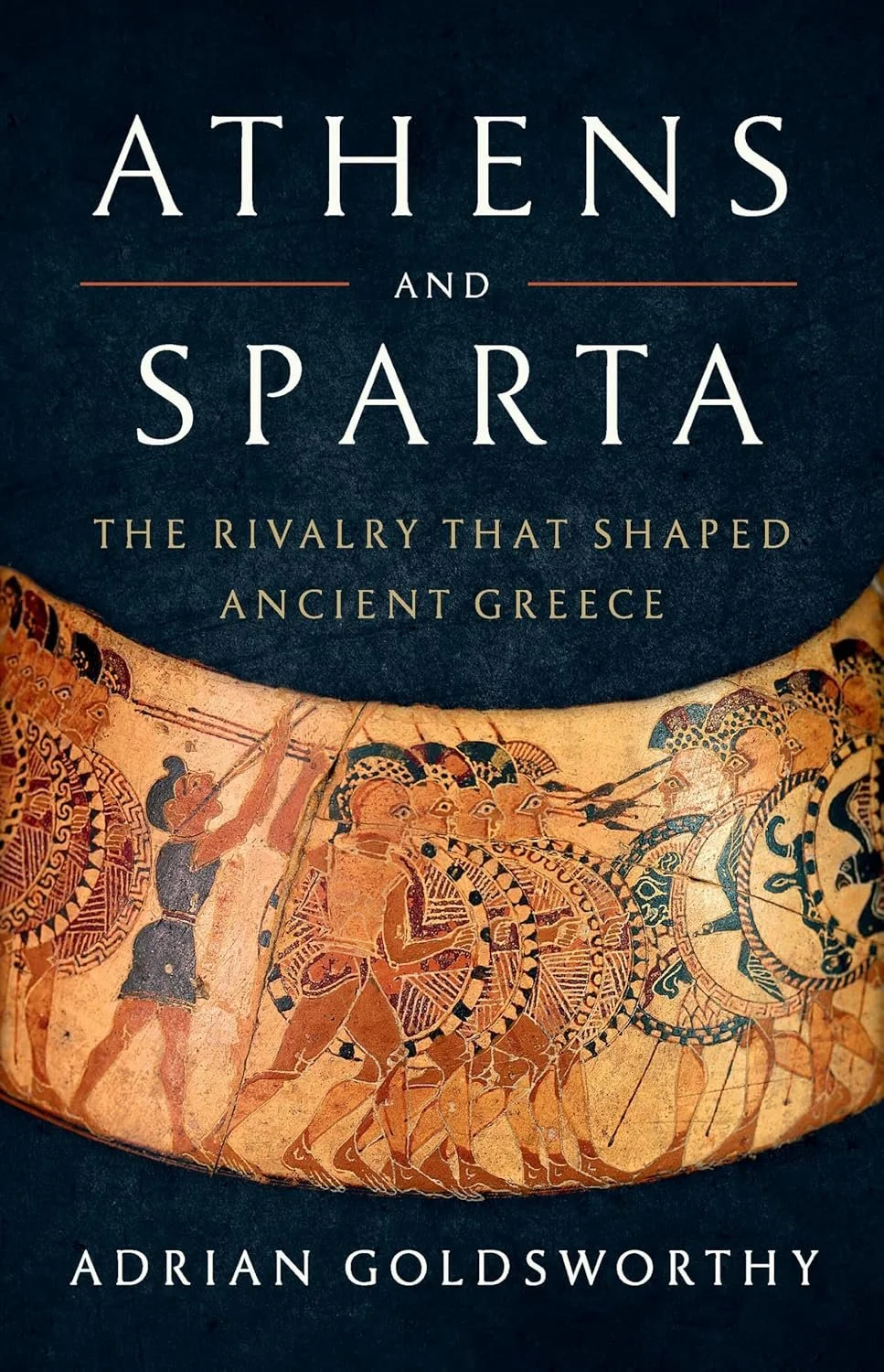
Athens and Sparta: The Rivalry That Shaped Ancient Greece
By Adrian Goldsworthy
Basic Books 2026
Prologues to big books of history can be notoriously phlegmy things in which authors boozily attempt to dispose readers in their favor for the upcoming journey. They seldom include anything noteworthy, which makes a claim by popular historian Adrian Goldsworthy in the prologue of his new book, Athens and Sparta: The Rivalry That Shaped Ancient Greece, all the more astounding. He opens by mentioning that while he was researching an earlier book, 2020’s Philip and Alexander, he kept looking for “a fairly recent and accessible history of what had come before – essentially how the Greek world had come to be as it was when Philip was born c. 382 BC.” He looks for such a book and comes up empty. “I could not find one and do not believe that one has been written since then,” he writes, “something covering the whole period, rather than just part of it, was lacking, so it seemed a good idea two fill this gap.”
What he’s talking about here is Classical Greece. The long 5th century, roughly from the fall of the last Athenian tyrant to either the birth or the death of Alexander the Great. Goldsworthy, author of a dozen well-received histories of the ancient world, seems to be saying there was no “fairly recent and accessible history” of Classical Greece until he needed one and decided to write it.
As mentioned, astounding. True, slippery words like “fairly recent” and “accessible” allow for some equivocating, but does it allow Goldsworthy to dismiss Tarn, Bury, Grote? Surely the works of titanic Ancient Greece scholars like these are “accessible” to Goldsworthy, who must have old friends at his alma mater of Oxford, or at least a London Library card? They aren’t “fairly recent,” but they’re not generally older than, say, Mommsen, Lessing, and Gibbon, all of whom crop up in Goldsworthy’s bibliography right alongside half a dozen 21st-century books covering the same subject. Or for that matter, what about Will Durant’s humble 1939 The Life of Greece, which sold more copies than all the others combined and must occasionally appear in Welsh charity shops?
This opening note creates a little frisson of doubt that feels utterly alien in connection with such a solid scholar as Goldsworthy, like hearing a college professor confidently proclaim that the main significance of President Kennedy’s assassination was that a presidential assassination was at that point unprecedented in US history. No matter how good the rest of the course is, you’ll inevitably wonder what else that professor might have missed.
The rest of the course, in this case, is the remaining 600 pages of Athens and Sparta, which is generally excellent. Goldsworthy kicks off his story in the mists with Homer, brings it forward through Solon and company, eventually hinging the book around the half-way point at the Hot Gates, the well-known fight between the handful of soldiers under Spartan King Leonidas and the nearly-limitless forces of Xerxes, king of Persia. Goldsworthy naturally dramatizes the moment at Thermopylae:
The Persians made no headway, so as the day drew on, Xerxes committed the Immortals to the attack, but these did no better than the rest as all the advantages still lay with the defenders. There were losses on both sides, but the Persians suffered far greater casualties and inevitably had difficulty bringing back their wounded. The Greeks were better protected by their shields, helmets, and armour and, since they held their ground, could evacuate their own injured. The first day of the attacks ended in utter failure for Xerxes’s men, and the second day went no better than the first. Leonidas and his men were being worn down, but only slowly and at dreadful cost. At this rate they could hold out for many days.
Nothing flashy or dramatic, certainly, but this isn’t a flashy or dramatic book. The prose throughout is reserved and authoritative, although occasionally it can get tangled in itself: “The Athenians offered protection against the Persians or any other potential aggressors – which included the Athenians, at least in the long run,” goes one such passage. “When enthusiasm for the alliance wavered, fear of retribution deterred most of the allies from breaking away, at least most of the time.”
By the conclusion of the story, when Philip II “united Macedonia and created a state and a military system unlike anything seen before in the Greek world,” Athens and Sparta have gone through testy dominance-jockeying, outright hostilities, and the bitter acrimony of mutual decline. It’s a familiar story (because, as mentioned, it’s been written up so many times over the centuries), and Goldsworthy tells it with skill and a pleasing amount of supporting discussion in the End Notes.
Steve Donoghue is a founding editor of Open Letters Monthly. His book criticism has appeared in The Washington Post, The American Conservative, The Spectator, The Wall Street Journal, The National, and the Daily Star. He has written regularly for The Boston Globe, the Vineyard Gazette, and the Christian Science Monitor and is the Books editor of Georgia’s Big Canoe News