City of the Muse by Kate Hilton
/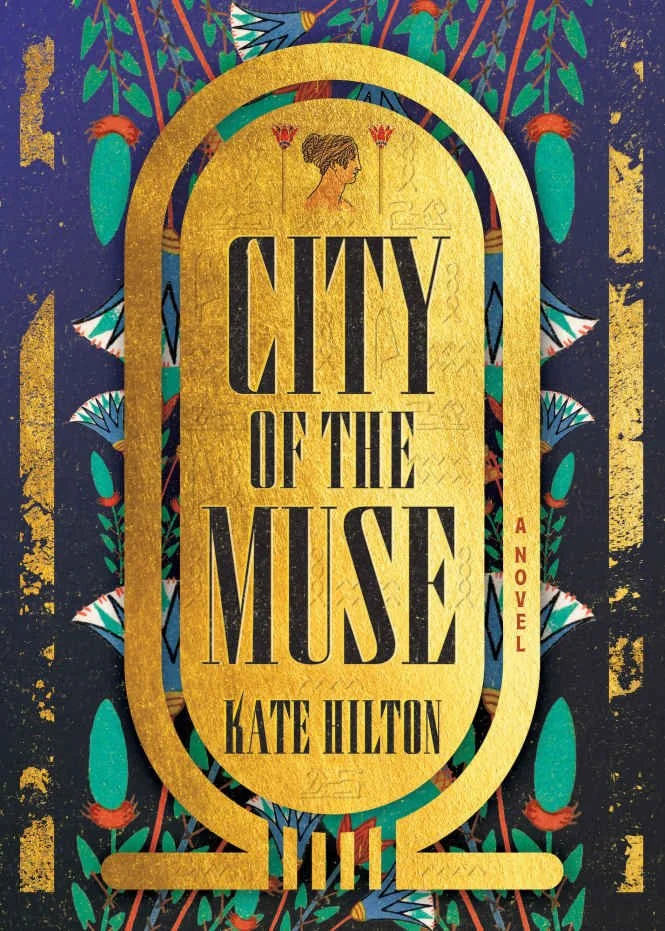
City of the Muse
by Kate Hilton
Simon & Schuster, April 2026
If you're looking for another Elizabeth Peters, or you're averse to tangled narratives, move on. If you're neither of those, you may just enjoy Kate Hilton's new release: City of the Muse.
Hilton, a Canadian writer with several titles under her belt, sets up City of the Muse as a dual timeline mystery, where an unsolved murder committed on an archaeological site in Egypt in the early 1900s is reexamined by a descendant of Iris Wentworth, an artist who worked at the site at the time. In 1903, our victim, Helen Gardiner, a papyrologist, arrives at the dig site, replacing her predecessor who has disappeared under strange circumstances. As one of the only women on the dig, Helen is particularly put off by the egos and hidden agendas of her male counterparts. And, soon enough, she learns they are willing to kill to keep those agendas secret. In 2019, Maddie Sloan, museum archivist and great-granddaughter of Iris Wentworth, meets Peter Bahar, a famous TV "scientist." He has come to the museum in search of information related to artifacts he believes came from the excavation site where her great-grandmother worked. Maddie and Peter join forces and discover there is more than historical provenances at stake: there's a host of secrets, strange events, and at least one murderer to dig out of her great-grandmother's past.
From here Hilton takes this interesting premise and plays it out to a satisfying conclusion. She weaves in enough danger, mystery, romance, and Egyptian history and atmosphere to satisfy any casual reader of historical fiction. She muses on thematic elements as well, just enough to give her story some depth: women's rights, patriarchy, racism. She even dares to put a finger on the third rail of ethical archaeology when Helen realizes she's dealing with real human remains, not just buried treasures, as she and Iris work to preserve a collection of delicate paintings that depict the true likenesses of the mummies they've unearthed:
It was odd, how we became accustomed to [the paintings], and to the mummies and the coffins, most of which were stacked against the wall of the storeroom . . . I felt protective, and responsible, having altered their eternal arrangements.
“I can see the men’s point,” I said to Iris over supper. “The mummies look so plaintive, lying there exposed. And after having seen what they looked like in life, it’s hard to be completely scientific in one’s outlook.” They had been strangely beautiful as well, their smooth faces inscrutable, untroubled. I don’t know what I had expected, but it hadn’t been the faint scent of juniper, green beeswax, and myrrh, or the crowns of braided hair.
. . . [Iris replied,] “As you say. The point is, you aren’t the first to lose your scientific objectivity in the presence of a mummy, and you won’t be the last.”
Though a good read overall, Hilton stumbles on parts of her execution. Her prose, other than using hieroglyphic as a noun in a few places and some awkward phrasings in the opening sections, is mostly solid throughout, as are her characterization and general dramatization skills. But the narrative framework she builds to play out this dual timeline story is inconsistent and overly complex. She begins with our victim Helen, in first-person present tense, in the present timeline. Helen is talking directly to the reader (as a ghost) about the events that happened at the site during the past timeline:
Iris Wentworth found my body, which was unfortunate. I would have preferred it to be one of the men. Although now that I think of it, the men would have made an entertainment of it, a tale to be shared over a drink in rooms where women can’t go. They would have made themselves the heroes of the story—my story.
Hilton then switches to the present timeline and begins narrating Maddie's story in third-person past, which in itself feels strange: the past timeline is told in present tense, whereas the present timeline is told in past tense. And that present timeline opener is told in present tense with several past tense references. Confused? Things become even more convoluted as Hilton introduces different narrative devices (audio recordings, letters, etc.) to reveal aspects of the past storyline not witnessed by Helen. Finally, after we experience Helen's murder in first-person present tense in the past storyline, Hilton drops her contrived devices and continues the past storyline with a new third-person present tense scene unwitnessed by Helen. Why all the narrative gymnastics?
Aside from that, lovers of Egyptology looking to experience what life was like on a dig in Egypt during the days of Howard Carter will get a taste of that in City of the Muse. Hilton does her homework and includes some interesting research and historical facts in her Author's Note at the end. There are enough mummies, jewels, papyri, paintings, coffins, desert sands, hieroglyphs, ornery excavation leaders, corrupt officials, and cameos of famous real-life people to keep Amelia Peabody fans entertained. Hilton may not be Elizabeth Peters, but she’s on her way.
Jim Abbiati is a writer, book reviewer, and IT professional living in Mystic, Connecticut. He's the author of Fell's Hollow, The NORTAV Method for Writers, and has an MFA in Creative Writing from National University