Spinoza, Atheist by Steven Nadler
/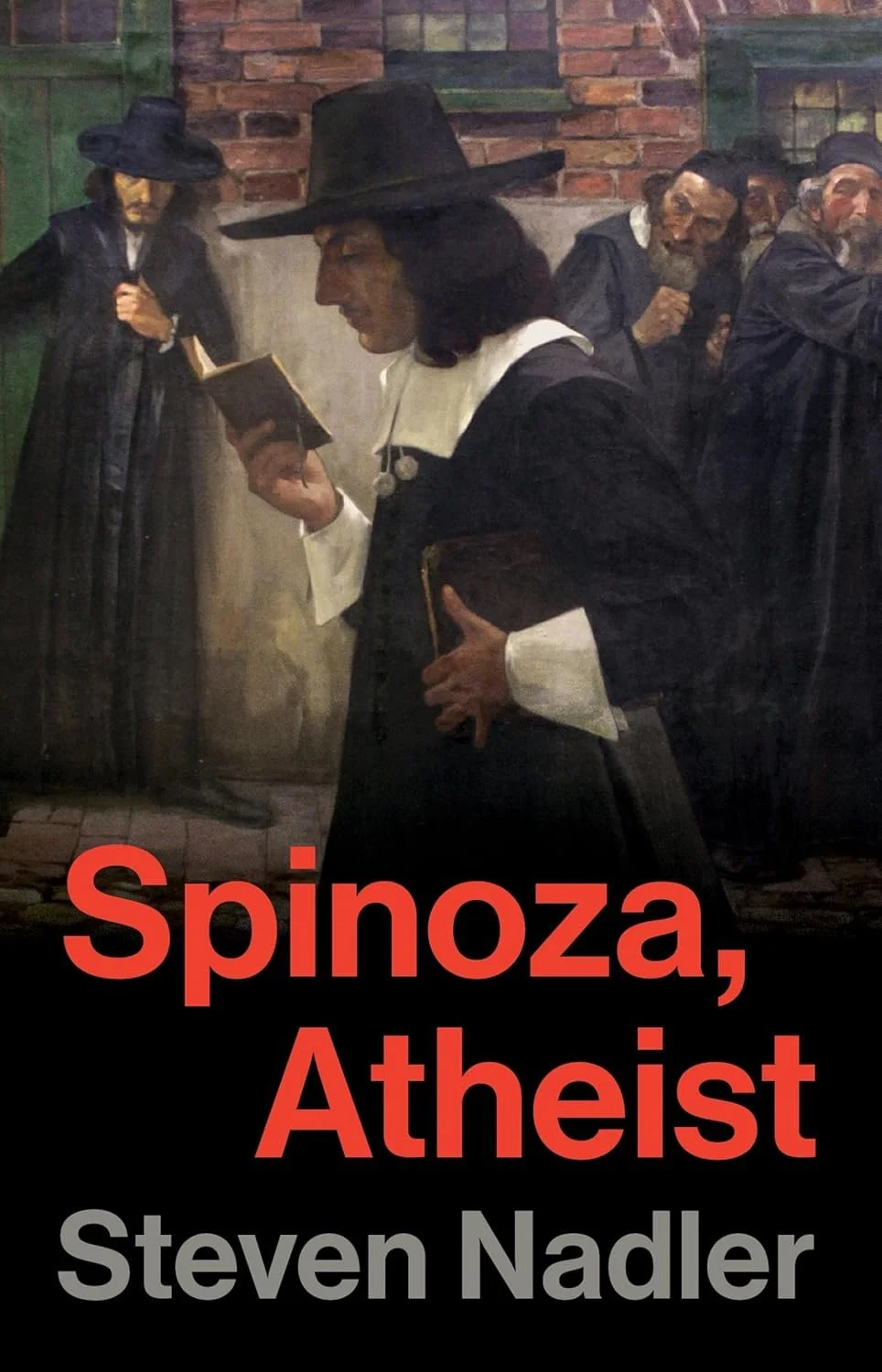
Spinoza, Atheist
By Steven Nadler
Princeton University Press 2026
Was the great thinker Baruch Spinoza an atheist, and if he was, what kind of atheist was he? Someone who rejected the teachings of his local Jewish congregation, someone who was largely indifferent to any kind of faith system, or somebody who positively averred that gods don’t exist, or if they do, humans have never had any contact with them?
Steven Nadler, professor of philosophy at the University of Wisconsin-Madison, has been teaching and writing about Spinoza for twenty-five years, obviously has his own answers to such questions, as the title of his new book immediately demonstrates. Readers worrying that academic credentials might guarantee a snoozer of a book even at a bantam-weight 200 pages might also wonder if a dabbler in philosophy might kick up more obscurity around the often-misunderstood subject of atheism itself than it actually includes. Are we talking about so-called ‘soft’ atheism, where people simply aren’t convinced that there’s any proof of any god’s existence? Or we talking about the far rarer ‘hard’ atheism, where people are 100% certain there are no gods?
Baruch Spinoza might have been many things in his turbulent life, but in 1650s Amsterdam even he would not have been brave enough to profess that ‘hard’ kind of atheism, as anybody knows who’s read his two great works, 1669’s Tractatus Theologico-Politicus and the famous Ethics, which wasn’t published until after Spinoza’s death in 1677. The Ethics is full of religious-sounding language, which seems on its face to be an effective refutation of what Nadler refers to as “Spinoza’s departure from any meaningful notion of God.”
As Nadler writes, Spinoza (who was compared to Jesus by no less than Heinrich Heine, mischievously), didn’t like being called an atheist, “Understandably so,” Nadler allows, “give the ambiguous, vague, and malleable but always pejorative connotations of the label.” Spinoza’s enemies, men like Gijsbert Voet (“arguably the most zealous atheist hunter of the seventeenth century”) or Pierre Bayle, charmingly a favorite of Nadler, who refers to him as “the most important thinker of the remarkable seventeenth whom most people are likely never to have heard of” – figures like these might have used the term ‘atheist’ to vilify somebody who simply wasn’t the right kind of Christian. But Nadler seeks to find the unfindable in these pages, sifting for what the private Spinoza thought on subject he would never have dreamt of writing about in public.
Inevitably, pantheism and panentheism come up, for instance, pantheism believing that all of Nature is divine and panentheism believing that all of Nature is part of God (the Judeo-Christian God, that is; nobody’s talking about Chalchihuitlicue here, regarding which both Spinoza and all of his friends and all of his enemies were ‘hard’ atheists every day of their lives). These and other aspects of the faith-landscape of Spinoza’s day are scrutinized by Nadler in his search for just what Spinoza believed.
As noted, he’s taught on this subject for a long time, and he’s come to a conclusion that he believes explains all the God-talk readers might be surprised to encounter in the work of this famous atheist. Spinoza, Atheist (including its very generous bibliography) would slip comfortably into just one section of Jonathan Israel’s enormous, magnificent 2023 biography of Spinoza, but it covers its more narrow patch with tremendous specifying energy. Nadler mentions that whenever people learn that he studies Spinoza, they inevitably ask about the nature and extent of the man’s atheism. This book supplies plenty of lively thinking about such question – and maybe an answer or two.
Steve Donoghue is a founding editor of Open Letters Monthly. His book criticism has appeared in The Washington Post, The American Conservative, The Spectator, The Wall Street Journal, The National, and the Daily Star. He has written regularly for The Boston Globe, the Vineyard Gazette, and the Christian Science Monitor and is the Books editor of Georgia’s Big Canoe News