Days of Miracle and Wonder by Ashley Kahn
/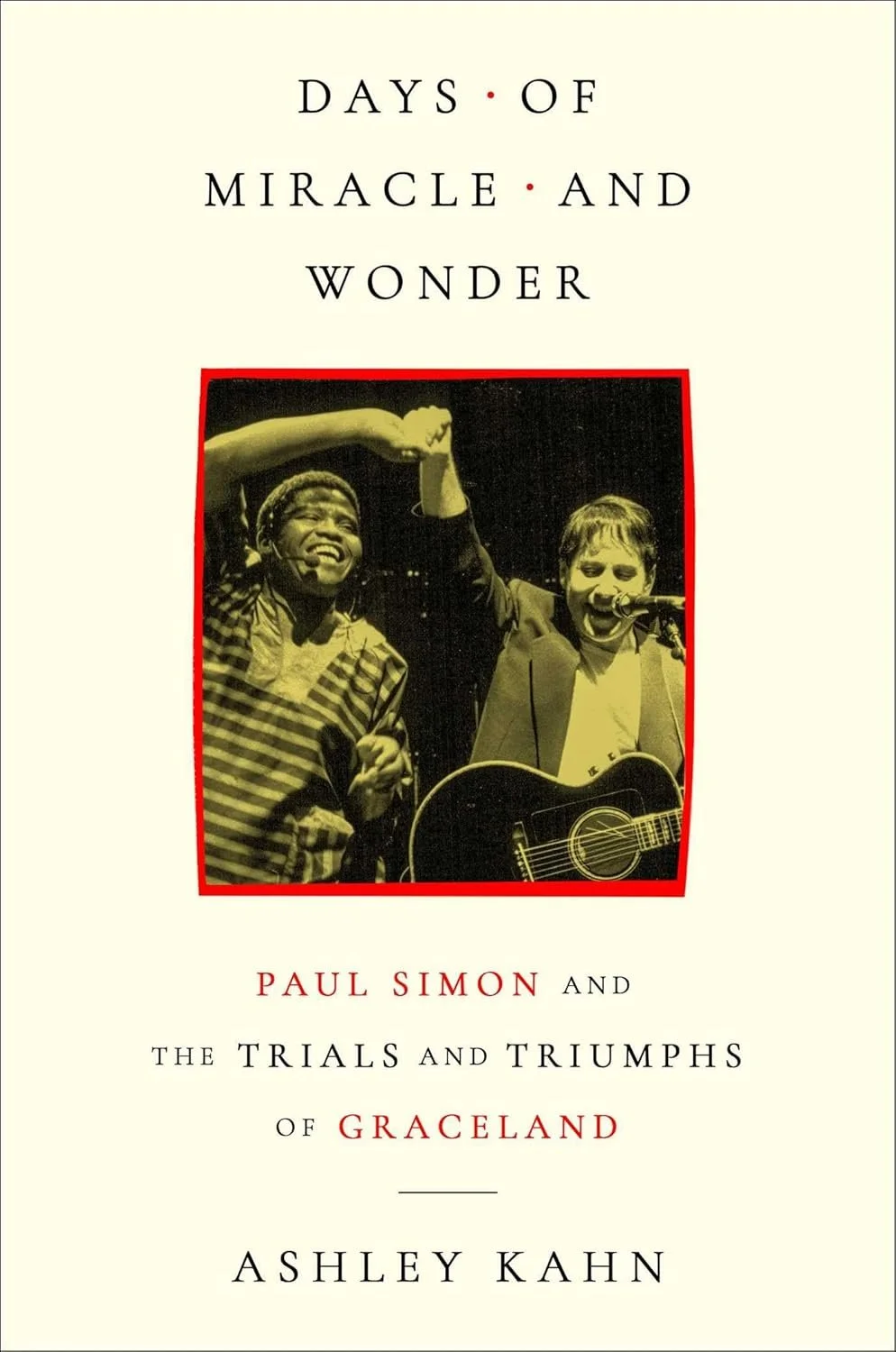
Days of Miracle and Wonder: Paul Simon and the Trials and Triumphs of Graceland
By Ashley Kahn
Atria Books 2026
After the unsuccessful 1983 album “Hearts and Bones” and its tepid predecessor “One Trick Pony,” Paul Simon was in a creative malaise and was no longer perceived as a force in an evolving music industry now focussed on Bon Jovi, the Beastie Boys, Madonna and Metallica. The release of the “Graceland” album in 1986 changed all that.
The source of Simon’s musical inspiration, South Africa, was in the throes of its darkest hours, just before the political dawn of the 1990s. Apartheid was at its most repressive, with escalations in protests, international resistance and increasingly brutal clampdowns by a paranoid regime facing the inevitable countdown to their demise.
The amazing co-incidence of a cassette tape of South African Township Jive music, passing through several internationally random hands and eventually being lent (and never returned!) to Simon is what links these threads together in Grammy award winning music historian Ashley Kahn’s new book Days of Miracle and Wonder: Paul Simon and the Trials and Triumphs of Graceland, which tells the story behind the making of the album “Graceland.” Kahn, author of definitive books on Miles Davis and John Coltrane, tour-managed Ladysmith Black Mambazo, South Africa’s leading “isicathamiya”(Zulu acapella) harmony singing group in the post-“Graceland” period when the band was the hottest ticket in global music, which gives him unique insight into his subject, and afforded him a close relationship with Simon, whom he interviewed along with nearly 100 others involved in the making of the album.
“Graceland” gave Simon a “new” sound from South Africa that unlocked collaborative musical connections that would endure and catapult Simon out of his artistic “funk.” The star power in the story is reflective of Simon’s standing in the music industry. The book relates many examples. Harry Belafonte, Quincy Jones, Peter Gabriel and Philip Glass all offer Simon advice, some of which he ignores. After the fact, as the political storm broke, many African musicians were supportive of Simon’s defence of the artists right to create. Benin’s Angelique Kidjo is quoted, saying that “artists have to do what they have to do.” Hugh Masekela was quick to defend him and eventually arranged for his fellow exile Miriam Makeba to join him on the tour. Joseph Shabalala gave Simon the highest honour, the Zulu name calling “Vulindela” (“the man who opens the door”).
Kahn captures the complexity of political life in South Africa extremely well, handling the ironies of those politics maturely, as in the case of two siblings – one of whom (Barbara, in the ANC Head Office in Lusaka) was insisting on an anti-apartheid boycott of a London live show while the other (trumpeter Hugh Masekela) was playing on stage with the man who was the target of that boycott. Simon reflects that “if the album wasn’t a hit, there never would have been a show, and if the show wasn’t a hit, there never would’ve been a protest and there never would’ve been a fight.” The book also cites Simon’s later meeting with Nelson Mandela, who declared that “artists are now free to come to our country.” As the author notes, “The spectacle of a group of (British) white people picketing a concert starring the black South African exiles Hugh Masekela and Miriam Makeba, two of the staunchest opponents of apartheid, seemed sufficient.”
Kahn’s account may occasionally conflict with the living memory. For instance, there’s his mention that in response to the sometimes-violent anti-tour protest action of Azapo (the Azanian People’s Organization) “concert attendances dropped dramatically”; I was in attendance at the very last concert of the global tour in January 1992 at the Durban Kings Park rugby stadium, and it was full to capacity with 50,000 ecstatic fans.
Kahn’s writing is particularly effective when covering the inner nuances of the musical creative process. He evokes the often indefinable “lightning strike” moment when musicians cross out of their traditional lanes, find new connections and create magic. This process is what defines Simon as a musician, one who seeks as much to discover music as to write it.
Simon’s methodology has always been unique, described in the book as “hearing the sounds in his head until they become musical.” Groove and rhythms take priority, lyrics follow later, serving primarily as a further percussive instrument. Why else would you find lines like “don’t I know you from the cinematographer’s party” (I Know What I Know), “ever since the watermelon” (Myth of Fingerprints) or “angels in the architecture” (You Can Call Me Al)? The book quotes from the author’s interviews with Simon on his songwriting process: “There’s a line with an absurdist idea, with what seems a placeholder word that was never replaced – ‘ever since the watermelon’ – yet that fits the song’s cadence like a glove.” It’s all obsessively about the sound, and we are the beneficiaries.
The research that went into the book is peerless, done over decades. Kahn displays a musical sensibility that holds anyone with musical knowledge enthralled throughout. Non-musical fans might occasionally find some of the detail excessive, but a book about Paul Simon needs to reflect the detailed nature of his process in order to capture his essence. Kahn is also very good at inserting quick bracketed definitions or explainers when the musicians reference something technical, to ensure that non-playing readers are not entirely disorientated.
Kahn achieves an admirably balanced equilibrium between the elements of the story, the 15-month-long musical genesis, the cultural interactions between Johannesburg, New York, Louisiana, Los Angeles and London, and the political turmoil, without allowing any to dominate.
Kahn defines albums as classic if “they transcend and endure.” “Graceland” did both, and Kahn has written a worthy and fascinating history of one of the most important albums of the 20th century. It captures the spirit of true musicianship, when cultural and language barriers fade to allow the creative potential of humanity to discover new connections. It is a life-affirming story that will appeal to a broad audience and have them replaying their favorite tracks. Against considerable odds, Days of Miracle and Wonder is a joyous, triumphant book.
Mike Raftery is a folk musician from Durban, South Africa