Hubris by David Stuttard
/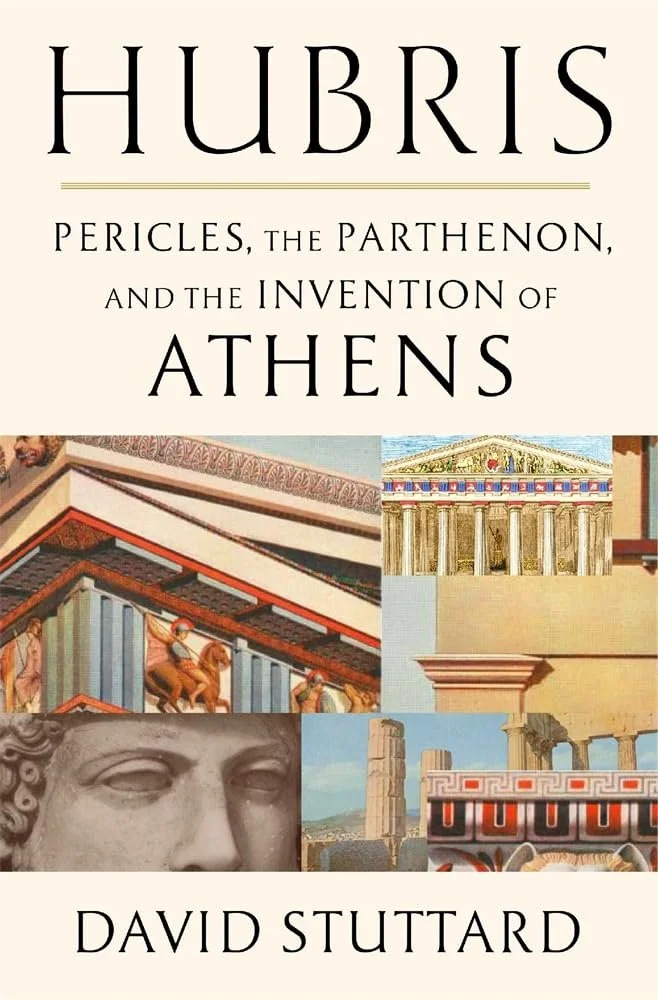
Hubris: Pericles, the Parthenon, and the Invention of Athens
By David Stuttard
The Belknap Press of Harvard University Press 2026
Readers can forgive historian David Stuttard his boyish enthusiasm when he exclaims, in his new book Hubris: Pericles, the Parthenon, and the Invention of Athens, that a new book on the Parthenon is written every month, every day, nay, every hour. Forgiveness is all the easier because a great deal of that same enthusiasm spills over into his general narrative of the book, much to its benefit.
He tells the story of classical Athens in lock-step tandem with a detailed tour of the Acropolis itself, complete with maps, floorplans, architectural diagrams, and plenty of what look like original black-and-white photos. Stuttard writes this history of the golden age of Athens, a time when “Pericles was mooting the creation of a new world order,” with attempts at quasi-dramatic interludes in which the historian interjects more colorful, quasi-fictional re-imaginings of the scenes involved. Typically when historians try this kind of thing, the results are predictably horrifying, and at first this seems to apply here too: “Already, like an evanescent dream, the darkness was evaporating, as sunrise gilded faces, arms, gesticulating hands, for a brief moment turning commonplace Athenians into glowing heroes,” and so on.
Fortunately, Stuttard swerves his narrative back to his fascinating double history fairly early and tends to keep it there, lovingly describing every feature and dimension of the Parthenon while linking those features to the outlines of Athenian history in their victory over Persia, their lightning-fast growth as a regional superpower, their increasingly bitter rivalry with Sparta, and the many changes Pericles himself instituted in his society. Stuttard looks at the carvings and statues on the Acropolis and sees that history reflected there:
Like heroes, Athenians claimed ancestry from gods; collectively they, too, could boast miraculous achievements; they, too, could rightly claim that , overcoming what once appeared insuperable odd, they had quite literally saved their world by beating off the Persian threat, and (in their own version of the Gigantomachy) upheld those central values of civilized society: justice; order; harmony. While other Greeks had fought beside them, only Athenians had made the supreme sacrifice, abandoning their land, so that their cause could win. Only they had watched their city die, before being resurrected like a phoenix soaring from the flames, shaking out the ashes of destruction from its spreading wings.
It was all doomed to an early death, of course, when Athens would be visited by military defeat, an earthquake, and the “one force of nature that humanity could never conquer,” this time in the form of a deadly plague that killed a third of all Athenians, including Pericles himself. It’s an extremely familiar story, retold often (though not hourly) in works of history. Stuttard’s architectural angle adds some new viewpoints to this old story; the book is bound to make some readers think of booking a tourism excursion up to the Acropolis in the crushing summer heat.
Steve Donoghue is a founding editor of Open Letters Monthly. His book criticism has appeared in The Washington Post, The American Conservative, The Spectator, The Wall Street Journal, The National, and the Daily Star. He has written regularly for The Boston Globe, the Vineyard Gazette, and the Christian Science Monitor and is the Books editor of Georgia’s Big Canoe News