John Foster Dulles by Bevan Sewell
/
John Foster Dulles: Apostle of American Empire
By Bevan Sewell
Johns Hopkins University Press 2026
It’s not often given to US political functionaries to get or to warrant serious biographies, and it’s even rarer for those biographies to be any good. Recent years saw Our Man, George Packer’s biography of Richard Holbrooke, and Zbig, Edward Luce’s biography of Zbigniew Brzezinski, and more to the point, it’s been over half a century since Townsend Hoopes brought out his masterpiece, The Devil and John Foster Dulles, about President Eisenhower’s near-legendary Cold War Secretary of State John Foster Dulles, who served from 1953 to 1959.
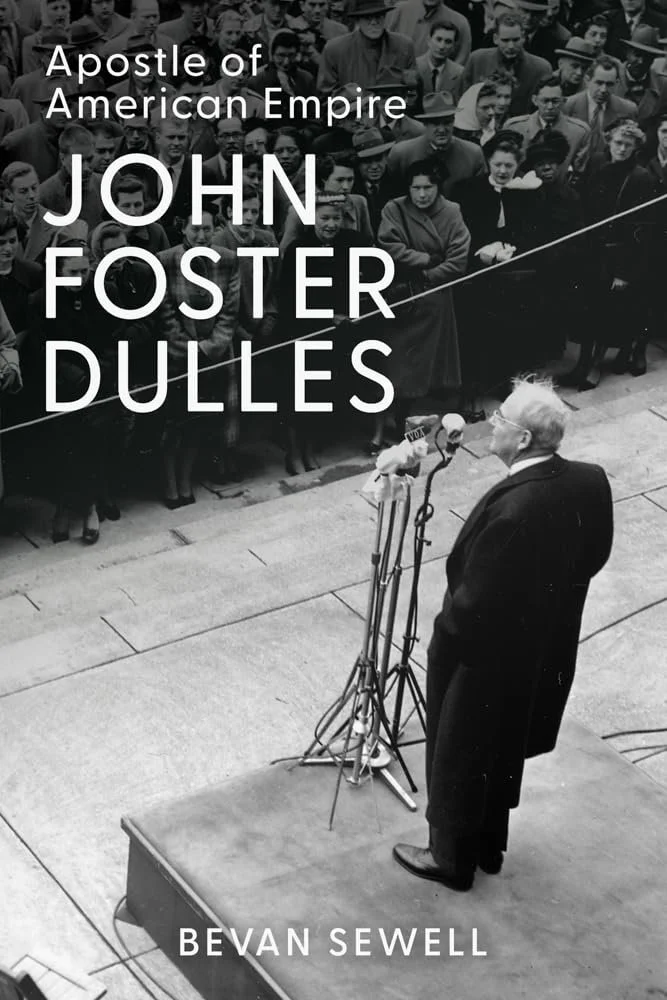
Dulles is the subject of University of Nottingham history professor Bevan Sewell’s new book (the one whose US dust jacket features a boring black-and-white picture of Dulles taken from behind and above, although there’s a nice clear shot of a disgruntled anonymous State Department babushka, for what that’s worth), and it’s an unintentionally jarring reminder of a time when the US Secretary of State was a powerfully serious figure on the national and international stage, rather than, for instance, a cocaine addict and fawning sock-puppet flunky of slurping idiot madman, a figure so inconsequential on the international stage that he’s absent from the most important negotiations of the 21st century, his slot being taken instead by one of the madman’s totally unqualified golfing buddies. Dulles might not have known more about the affairs of the world in the 1950s than did President Eisenhower, but if not, the difference would have been small. The two men very much considered each other equals.
Equals perhaps in all but one important thing. There’s a kind of moral certainty that grows stronger as it’s refined against the ethical barbarities of the world; this was the kind Dwight Eisenhower had, the quiet kind that imparts an unassuming but basically immovable inner certainty. But there’s also the kind that only strengthens by killing and consuming the moral certainties of others, forever hungry and therefore the opposite of either unassuming or certain. This is the kind possessed by religious zealots and by Dulles, rightly referred to as an “apostle” in Sewell’s subtitle. This author emphasizes Dulles’s deeply-held Christian beliefs in a far gentler way than, for instance, Hoopes did with his reference to his subject’s “self-righteous and apocalyptic style.”
In either case, the bedrock Dulles view of US foreign policy will always be his most famous quote:
You have to take chances for peace, just as you must take chances in war. Some say we were brought to the verge of war. Of course we were brought to the verge of war. The ability to get to the verge without getting into war is the necessary art. If you cannot master it, you inevitably get into war.
The clarity and the mannerly ruthlessness of that sentiment defined the man who was referred to as “the conscience and the straitjacket of the free world.” In Sewell’s telling, Dulles doesn’t get to be that with any degree of fullness until fairly late (he doesn’t become Secretary of State until page 230 of a book that’s not much longer than that); the balance is filled by his time in the military, in the Senate, and mixing with a wide circle of friends who certainly didn’t consider him the doctrinaire prig so many historians have seen (his long-standing fair weather and foul friendship with Herbert Hoover, for example, always provokes a sympathetic re-evaluation of that hapless great figure). But it’s when he gets to State that the full fervor of his hatred for “aggressive Soviet Communism” reaches its fullest expression. It was at this level that he could exercise what Sewell refers to as “his belief that ideas, ecumenicalism, and the spiritual and emotional elements of human life remained integral to forging an enduring national security strategy.”
Sewell is generous with his hero but never fawning. The failures of the Dulles “ecumenicalism” in Guatemala, the Middle East, Indonesia, Iran, Indochina, and even Cuba are given frank assessment, although in less detail than devotees of Cold War statecraft will want (in a very real but elusive sense, a 300-page book about John Foster Dulles feels fundamentally unjust; George Kennan and, God help us, Henry Kissinger regularly command great whopping tomes). Sewell judges his subject with a rhetorical control so fine you need to look for it to see it, rating Dulles as “a highly capable figure: intelligent, well read, quick on the uptake, diligent, fundamentally interested in the question of international order, and committed to a vision of the world that emphasized peace, stability order, and prosperity.” So much might also be said of the captain of an ore freighter out of Detroit – or indeed of a sharply conservative newspaper reader from Henderson Harbor.
There’s a lack of narrative electricity here that would certainly have pleased Dulles himself, who never thought he warranted it. He’d certainly have appreciated Sewell’s generous End Notes (inexcusably, the book has no bibliography); this is a smart and worldly evaluation.
Steve Donoghue is a founding editor of Open Letters Monthly. His book criticism has appeared in The Washington Post, The American Conservative, The Spectator, The Wall Street Journal, The National, and the Daily Star. He has written regularly for The Boston Globe, the Vineyard Gazette, and the Christian Science Monitor and is the Books editor of Georgia’s Big Canoe News