Rasputin Swims the Potomac by Ben Fountain
/
Rasputin Swims the Potomac
By Ben Fountain
Macmillan, 2026
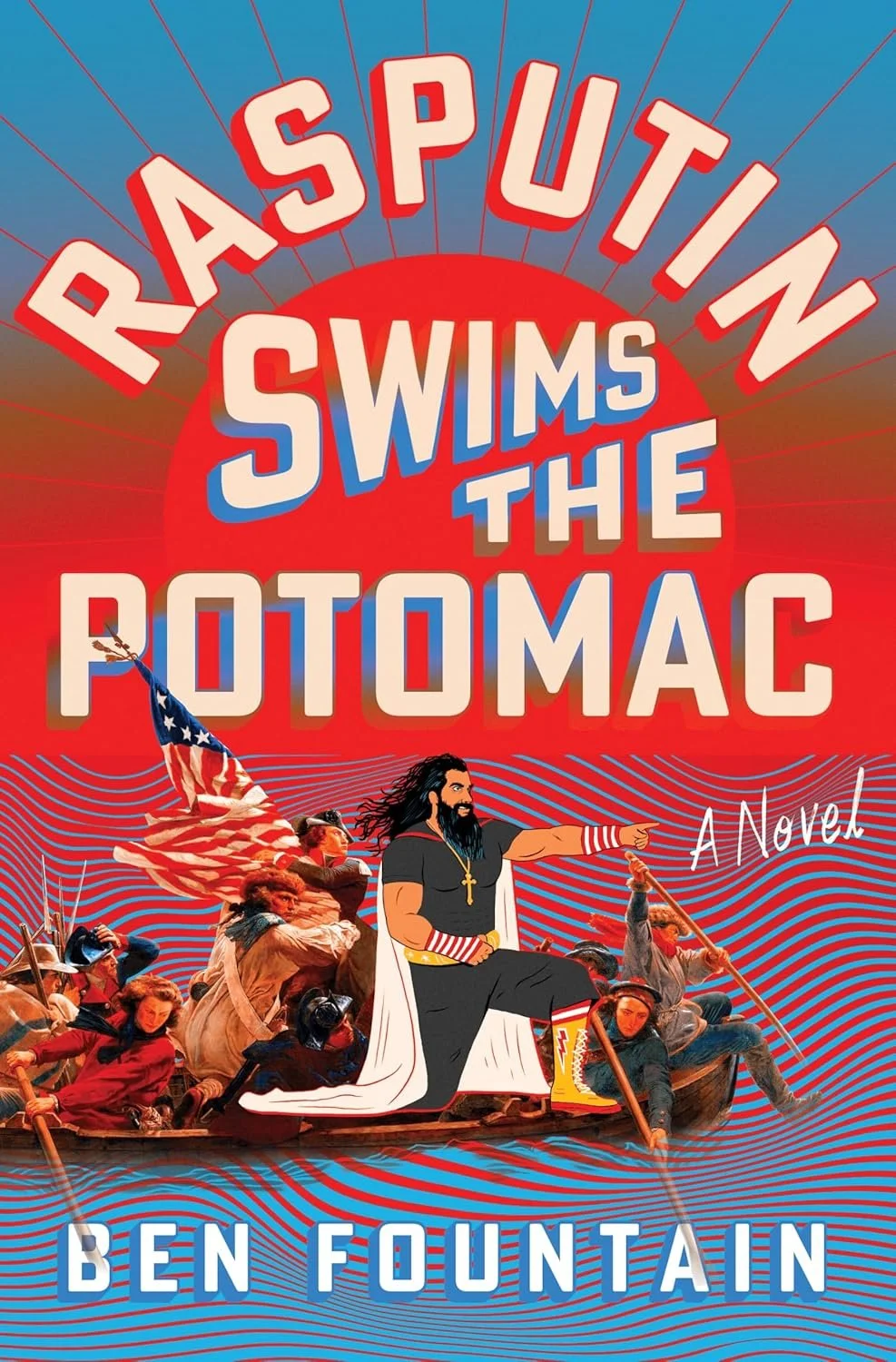
Forget Hamlet’s “readiness is all.” Timing is all. Just as Trump prepares a venue on the White House lawn for a mixed martial arts event where, no doubt, one front-row honoree will be his Secretary of Education [sic], Linda McMahon, who used to be the CEO of World Wrestling Entertainment, Ben Fountain releases his satiric novel about the Trump administration, Rasputin Swims the Potomac, in which a world-champion wrestler, whom the novel’s Trump wanted to be his vice president, becomes so popular he threatens Trump’s Supreme Court-approved third-term candidacy.
Well, maybe timing is almost all. Fountain has Marjorie Taylor Greene Trump’s V-P near the end of his second term, but she has recently jumped from the Trump train. Steven Miller is still next to the engineer in the novel, but the word “Trump,” blazoned on so many real-world surfaces, is always blacked-out in the fiction. If Trump read, if Trump could read, he would be angry about that. Washington insiders will turn the locks on this roman a clef and identify other officials to whom Fountain gives comic pseudonyms.
The wrestler also has a fake name: an American named Patrick Walsh Strickland, he plays “Rasputin” in the ring and then seems to believe he is Rasputin, the Russian fake mystic, faith healer, and tsar influencer who was assassinated in 1916. The wrestler speaks like Borat, and Trump loves him, at first, because he’s big, looks tough, and seems to be a dolt that Trump assumes he can use—before Fountain uses Rasputin against the dope.
In 2017, I published Harpooning Donald Trump, about literary responses to Trump. In one of the essays, I named some younger American novelists I thought might be capable of writing a literary Trump takedown in the future. The list included Gary Shyteyngart (who did write a Trump-infected novel), Rachel Kushner, Joshua Ferris, Paul Beatty, and, on the basis of Billy Lynn’s Long Halftime Walk, its author Ben Fountain, who was a National Book Award finalist in 2012 for that book’s satire of American athletic “culture” and its support of Bush’s war in Iraq, a warm-up for this new bout. I’ve read the novels by other writers who stepped up: Lethem, Rushdie, Kunzru, Everett, Homes, but I think, still, that the relatively unknown Mark Doten’s Trump Sky Alpha is the best—the most original and most literary—novel about Trump. Rasputin has an unusual historical and Russian Orthodox perspective on Trump along with many amusing, if familiar, parodies and new insults that include the possibility that Melania is sleeping with Rasputin. If anti-Trumpers went to the beach, instead of staying home with their social media and podcasts, Rasputin Swims the Potomac would provide many pages of slice and dice entertainment that won’t require a lot of close attention in the sun.
Fountain does take some literary risks by employing two un-Fountain perspectives. Faith—a twenty-six-year-old white woman, a former country singer, and a White House communications specialist—is enlisted to fake leaving Trump, join the Rasputin campaign as deputy press secretary, and spy on the insurgency. Less harried and more reliable is Clarence, a 65-year old Black reporter for an online newspaper. He scores the first interview with Rasputin and becomes an unlikely friend—though Clarence suspects the wrestler of deep Fascist tendencies. Accidents happen to both protagonists—pregnancy and a brain injury—that complicate their individual plot lines and extend the book, but their initially serviceable journalistic voices wear thin.
In abstract lit crit, there’s a distinction between metaphor and metonymy, with the latter basically meaning literal. Trump Sky Alpha succeeds as a send-up because its dominant metaphor—Trump as a figurative blimp flying a blimp—is original and cutting, even if it doesn’t reveal a lot about Trump’s inner life, if he has one. Rasputin is metonymic, one Fountain alternative fact after another, plausible in their exaggerations and connected in the novel’s linear plot, but just not very literary. (I realize that it may be very late in a dark time to be asking a Trump satire to have literary sophistication, but I still think it’s useful in our current gilded Entertainment State to separate the facile from the artful and, possibly, from the profound should it rear its monstrous head.)
After Clarence’s brain injury, he hallucinates himself in an “in-between” state where he meets the satirist Terry Southern, long dead, and hopes to meet James Baldwin. With his Black narrator, Fountain may like to think his book is a hybrid of those two novelists, but I found Rasputin more like an overlong Tom Wolfe hyper-detailed production without the stylistic hijinks. I enjoyed Wolfe’s energetic yarns—until I had to review one of them and judge it as literature.
By now you are probably wondering, “What about Rasputin?” That is the same question that keeps a reader of the novel turning the pages. After serving in the U.S Army, the man who took that identity spent five or six years in a Russian Orthodox monastery where he developed his Christ-centric politics and, it seems, discovered his ability to heal victims of “the weeps,” MAGA supporters who break into uncontrolled crying for no apparent reason—and are then beaten up by other MAGAs for being weak. Given Trump’s disdain for his followers, one can understand why they might find Rasputin’s platform of universal Christian love and care attractive—and the billionaires’ super PACS follow the growing crowd. Like Trump in 2016, Rasputin may be an electable fraud.
But Fountain has taken a big chance putting a simple person, who recalls “Chance the Gardener” in Kosinski’s Being There, at the center of a 400-page novel. Both Being There and Trump Sky Alpha are under 200 pages. Much as I enjoy seeing Trump mocked, Fountain is sometimes predictable, occasionally repetitive, and his dialogue has a lot of “how you doing?” filler. Fountain uses Rasputin as an occasion to investigate the roots of Trump-adjacent fascism and Trump’s admiration for that holy Russian tyrant Putin, but I think Fountain relies too much on slow-moving suspense: is Rasputin a fraud, real, or some combination of the two? You will need to reach the book’s end to decide that and understand Fountain’s title. In the meantime, Fountain throws in some side hustles: who is Faith’s secret billionaire father? And why do Faith and Clarence experience a freezing of the space-time continuum, usually when looking at their phones?
Rasputin Swims the Potomac is rather different from earlier Trump novels: it’s more explicit and it imagines a Trump near future, but I regret to report that Fountain doesn’t do much for this veteran of Trump fiction—either as a novelist or as an analyst of the Trump phenomenon. But for those who don’t read the New York Times twice a day and perhaps even for those who, like the new followers of Rasputin, are becoming disenchanted with Trump, Rasputin Swims the Potomac may well instruct as well as entertain, inform while amusing. Fountain’s heart and liver (which produces bile) are in the right place, an American place before the cons and haters and billionaires attempted their “Great Replacement” of democracy.
Tom LeClair is the author of four critical books, eight novels, and has a free Substack entitled “Monsterpieces.”