Auden by Peter Ackroyd
/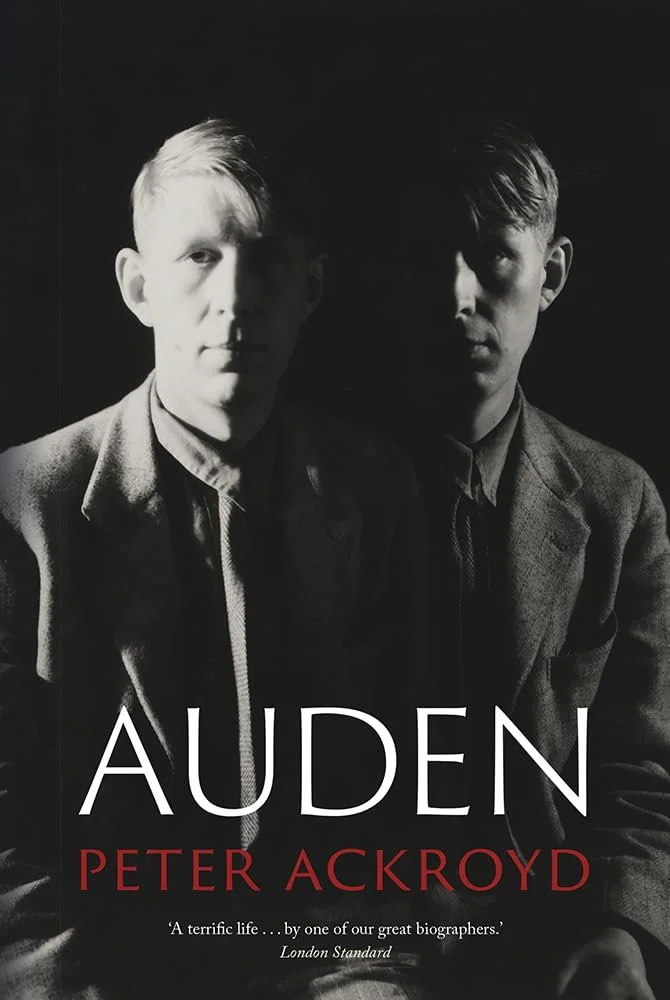
Auden
By Peter Ackroyd
Reaktion Books 2026
Peter Ackroyd, beloved biographer of both Charles Dickens and the city of London, takes as his new subject the great poet WH Auden, and the resulting volume, Auden, is an entertaining but curiously denuded. There’s no introductory essay, no afterword, no footnotes, and, almost inconceivably, no end notes or references other than mentioning the great Princeton University Press editions of Auden’s own work. Unlike so many modern allegedly serious works of history and biography, there’s at least a bibliography here, and it includes superb works on Auden like The Making of the Auden Canon by Joseph Warren Beach, Barbara Everett’s Auden, The Island by Nicholas Jenkins, and of course Early Auden, Later Auden by Edward Mendelson. But the point of a house is not a single wall, or part of a septic system, or half a window; the point is the assemblage of the whole. What good are end notes if there’s no bibliography to ground them, so the poor readers are left groping through the fine print note by note, essentially assembling the missing bibliography themselves? And what good is a bibliography if it’s not actually deployed in specific notes about specific details?
In 1938, for instance, Ackroyd tells us that Auden and his friend Christopher Isherwood were about the embark on a new joint writing venture:
Their publishers, both British and American, had asked them for a travel book that would encompass the Far East. Letters from Iceland, written in collaboration with MacNeice, had been an unexpected success, and Faber & Faber had printed more than 10,000 copies. It was hoped that Auden might repeat the achievement with a different travelling companion. This was all the more likely since the part of the world they intended to visit had become more interesting in recent months. A second war between China and Japan had started at the beginning of July, and this would become their important subject. They would be reporters rather than visitors. Auden remarked, ‘We’ll have a war all of our very own.’
Both British and American publishers asked for the same thing at the same time? The success of Letters from Iceland had been unexpected, by somebody or other? Somebody or other hoped that this success could be repeated with a different travel partner? These two pale, hapless, squidlike aesthetes would be reporters rather than visitors? Says who, to any of this?
Likewise the death of Auden’s mother in 1941:
While staying at Jamestown Auden suffered another loss. The death of his mother – in Birmingham on 21 August – was relayed to Newton on the telephone, and she passed the news to Kallman. He went up to Auden and told him that they were not going to attend a dinner party that night. ‘Goody, goody,’ Auden replied. It was one of his favourite phrases. Kallman added, ‘The reason is your mother has died.’ Auden stayed silent for a few moments before saying, ‘How like her that her last act on earth should be to get me out of a social engagement that I didn’t want.’ It was not the most appropriate response, but then he burst into tears.
A witticism, appropriate or not, at the precise moment of heartbreak? It’s possible, although far more likely as a subsequent revision, but in any case, says who? In this instance a reader might think it has to be either Auden or his longtime companion, but which was it? And when? Or was there somebody else in the Jamestown apartment at the moment the sad news was broken?
Or Auden’s Greenwich Village apartment in 1946:
Auden told Rhoda Jaffe that the apartment was ‘too expensive, too small, and in the village which I dislike, but it is a new building and quite nice.’ It was too small to accommodate Chester Kallman, and it did not remain ‘nice’ for very long. The playwright Tennessee Williams visited Auden there and recalled it as being ‘fantastically sordid … with beer cans and newspapers all about the floor.’ Harold Norse described it as ‘small and squalid, boxlike, lit by garish light bulbs in a tacky chandelier at the centre of the dusty ceiling.’ Another friend, the Russian composer Nicolas Nabokov, added that it had ‘the permanent stink of cat piss,’ since Auden had a pet.
Moments like this, multiply witnessed, intensely interrogatable, fill this book, but they fill it with the heterogenous chatter of an Upper West Side literary soirée, voices murmuring and blurring together, with suspiciously whittled apothegms flying in all directions. Without any scholarly grounding, the whole thing feels like l’esprit de l’escalier, conducted on a massive scale, 50 years after the fact.
Peter Ackroyd is a fine biographer and, even nearing 80, a first-rate crafter of nonfiction. And if his Auden ultimately amounts to him telling stories about WH Auden for 350 pages (as it must, without knowing how he knows any of the things in it), there are certainly worse fates for a reading afternoon. Readers wanting to know who said what to whom when and why will probably end up wanting some supplementary material. Mendelson, probably.
Steve Donoghue is a founding editor of Open Letters Monthly. His book criticism has appeared in The Washington Post, The American Conservative, The Spectator, The Wall Street Journal, The National, and the Daily Star. He has written regularly for The Boston Globe, the Vineyard Gazette, and the Christian Science Monitor and is the Books editor of Georgia’s Big Canoe News