Platform Decay by Martha Wells
/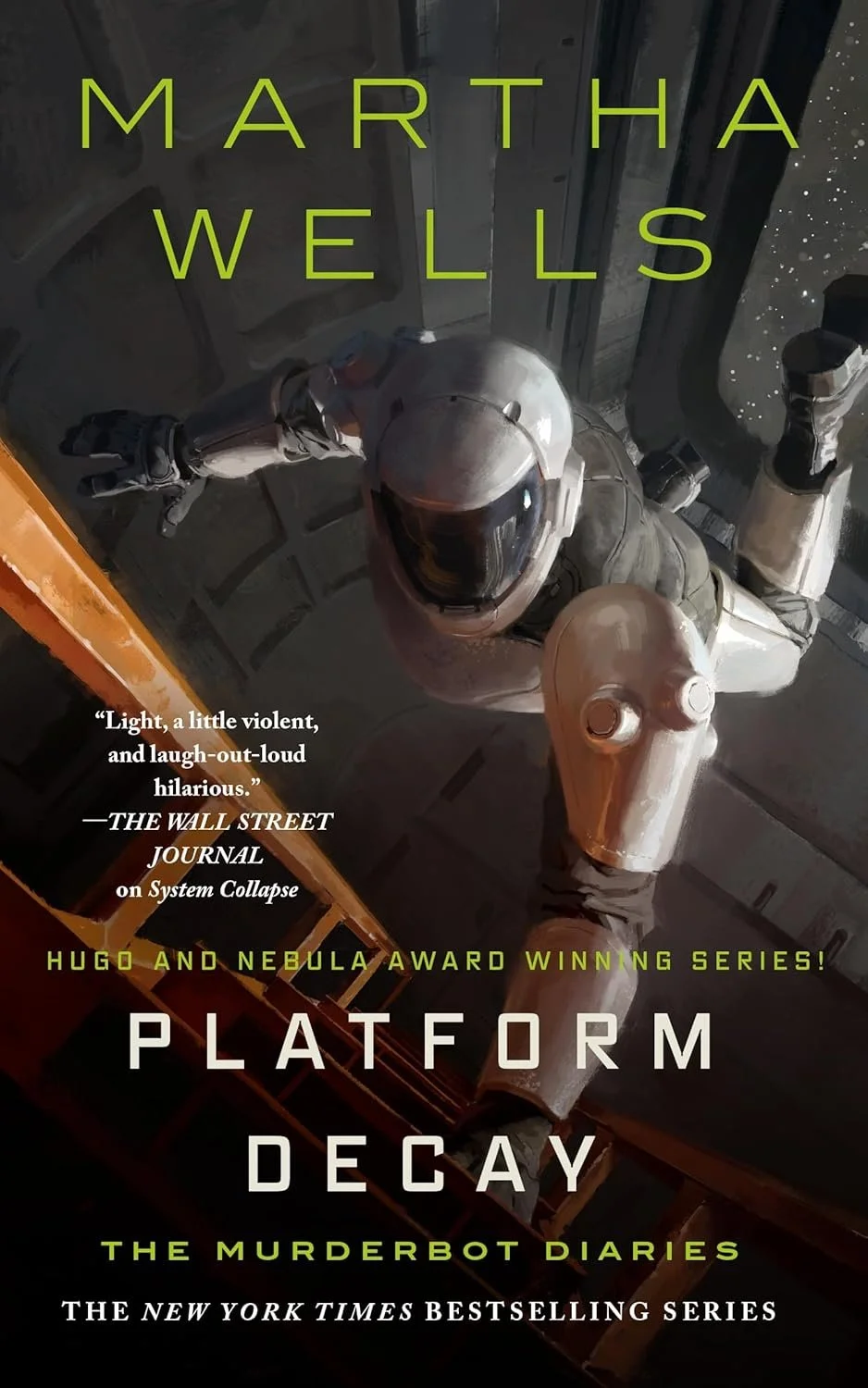
Platform Decay
by Martha Wells
Tor Publishing Group, May 2026
Fans of the Murderbot Diaries know exactly what they’re in for with each new installment: high-tech geekery, laser fire action, fear-inducing stakes, and a sarcastic, emotionally maturing robot they'd love to have a synthetic drink with, even if said robot was designed for murder. With Platform Decay, Martha Wells’s latest Murderbot novella, she once again delivers the goods.
Wells has been writing science fiction and fantasy since 1993. She's written four other series (Books of the Raksura and Ile-Rien to name two), and has more than twenty novels and novellas under her belt. Her Murderbot Diaries have earned multiple Hugo, Nebula, and Locus Awards, and have regularly appeared on the New York Times bestseller list, which shouldn't come as a surprise to anyone who's read a Murderbot story.
This latest adventure opens with our fan-favorite Murderbot working with Three, a security robot Murderbot freed when he gave it code to hack it's governor-module.
(Does Three sound familiar? If you haven't loaded the previous Murderbot stories in your memory banks then you might not remember meeting the security robot back in Network Effect or System Collapse. And Wells isn't going to waste words bringing you up to speed.)
Murderbot and Three are on a rescue mission and have just arrived at a torus-shaped space station orbiting a dying planet. Murderbot reflects in the opening lines of the novella:
Space was okay to look at but not super fun when you were out in it. And Three and I were definitely in it, clamped on to the outside hull of a small in-system shuttle. It was just as uncomfortable as it sounds.
Returning readers will gleefully sink back into Murderbot's loveable grumbling as Three heads off to create a distraction. Then Murderbot stealthily infiltrates the station using its clever hacking and feed manipulation:
I pinged the shuttle to let it know we were in place, then tapped the cargo bot’s internal feed and slipped past its wall. Before the bot finished querying me as to what the hell we were doing on its back, I removed its memory of the proximity alert and told it everything was fine, just keep following its schedule.
It never takes long for Murderbot’s perpetual snark to surface, and in Platform Decay Wells introduces a new mechanic to wring every drop out of it. Murderbot has installed a custom mental-health module that demands regular emotional check-ins, which, of course, come at the most inconvenient moments:
(Emotion check: Angry. It’s never a good idea to try to do complicated things when you’re angry. Like coding. Coding is complicated. Especially when people are shooting at you. But I do that all the time.)
(Emotion check: Exasperation. Tag for: Again? Seriously? Is this hell?)
(Emotion check: If we run into any human murderers they had better be heavily armed, because I am in a bad fucking mood.)
Readers will likely be yearning for more and more of these by the time Murderbot locates Mensah’s family (Who's Mensah? Check your memory banks.) only to discover they’re being sheltered by a former antagonist from an earlier book. (You'll have to check your banks when you get to that point.) This time, the antagonist is willing to talk turkey in exchange for getting her own family off the station. Is the antagonist no longer an enemy? Even Murderbot can't come up with a reliable threat assessment at first.
From here the story settles into classic Murderbot territory: dangerous action sequences, plenty of satisfying hacky stuff (pure catnip for nerdy readers), and snark set to maximum. Returning fans will enjoy the trek, but newcomers should really start with the series opener: All Systems Red. Without prior context, much of the emotional weight and character relationships will feel unclear, and the stakes will feel watered down. Which happens to be this novella's one drawback.
The peril in Platform Decay feels noticeably lower than previous installments. Murderbot takes its hits, sure, and it nearly drowns (though SecUnits can’t actually drown), and it deals with various forms of assault and battery, but none of the threats ever feel truly life-threatening to Murderbot. The real stakes of the story center on keeping Mensah’s family alive, which carries less emotional punch, far less if you haven’t read the earlier books or don’t remember the details well (load those memory banks, folks).
While Platform Decay might be a slight letdown in terms of dramatic intensity, it still delivers what matters most: more Murderbot. And it proves that not every installment has to have you biting your nails, but they’ll all leave you with a satisfied smirk on your face.
(Emotion check: Joyous-yet-painful anticipation. You might not see another Murderbot story for a while, but there's always the new adaptation on Apple TV+ while you wait.)
(Emotion check: An Apple TV+ adaptation? Will that be joyous . . . or just painful?)
Jim Abbiati is a writer, book reviewer, and IT professional living in Mystic, Connecticut. He's the author of Fell's Hollow, The NORTAV Method for Writers, and has an MFA in Creative Writing from National University