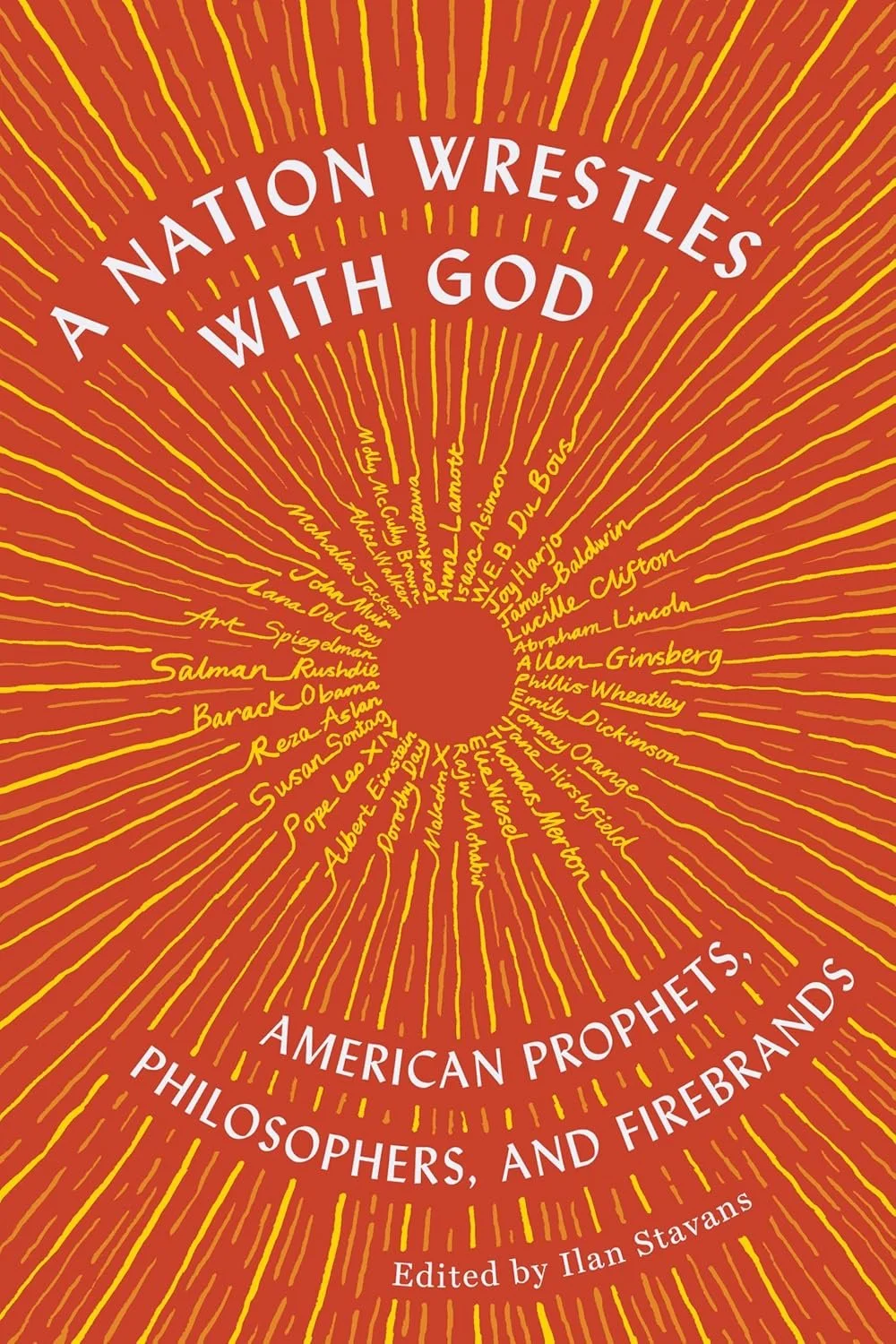
A Nation Wrestles with God, edited by Ilan Stavans
/
A Nation Wrestles with God:
American Prophets, Philosophers, and Firebrands
Edited by Ilan Stavans
Restless Books 2026
A Nation Wrestles with God: American Prophets, Philosophers, and Firebrands, edited by Ilan Stavans, is a lovely sturdy thing produced by Restless Books, with deckled edges and French flaps and a nice floppy heft. Stavans fills its 500 pages with a wonderfully varied array of writings about religion, from an ancient Navajo chant to an excerpt from Cotton Mather’s “The Wonders of the Invisible World” to bits from Walt Whitman, Henry David Thoreau, William James, TS Eliot, Father Coughlin, Flannery O’Connor, Elie Wiesel, and Martin Luther King, Jr. There are poems, prayers, New Yorker cartoons, and excerpts from Philip K. Dick, Frank Herbert’s Dune, the lyrics of Bruce Springsteen, and The Da Vinci Code. Readers interested in the subject of religion will get quite a bit for their $26.
Naturally, Stavans provides an introductory essay in which he asks the central question that would, if answered correctly, shut down the whole project: “Is the divine present in all creation, or is this merely our mental machination?” Introductions to this kind of book wouldn’t be complete without the checklist Stavans ticks off here: imply that the United States was is in some way “a Christian nation”? Check. Oversimplify things by frequent recourse to, God help us, the Merriam-Webster Dictionary? Check. Willfully misunderstand the Great Boogeyman of all religion, Charles Darwin’s On the Origin of Species? Check. (Stavans claims Darwin’s book “argued that, rather than a divine entity overseeing all creatures, there is a random process whereby animals and plants develop over time,” which he of course knows is wrong; tiny genetic variations are random; the process of natural selection is anything but)(and if not that, then what? Gods intervene to “oversee” each kitten? Each blade of grass? Each horse fly larva?).
But Introduction aside, Stavans understands anthologies and has assembled one here that is terrific in all ways but one. He rightly champions the wonderfully heterogenous mixture he’s created, citing the persistent human imagining of the divine and centering the reader in that process: “Ultimately, the real protagonist of this book is – yes! – the reader,” he writes, “whose personal questions, as the pages are turned in one direction or another (anthologies are seldom read sequentially, beginning to end, but instead are like samplers, allowing for serendipitous surprise), amplify this tradition to the oomph degree.”
A great many of the voices ringing out from these pages are well worth hearing again, as in the case of the great Shawnee spiritual leader (and brother of Tecumseh) Tenskwatawa, who in 1807 made two things very, very clear to his audience: that he was the mouthpiece of the Great Spirit, and that the Great Spirit really hates Americans:
I am your Father. When you call me so, you do well. I am the Father of the English, of the French, of the Spaniards, and of the Indians; I created the first man who was the common father of all these people as well as yourselves, and it is through him, whom I have awakened from his long sleep, that I now address you. But the Americans, I did not make them. They are not my children, but the children of the Evil Spirit. They grew from the scum of the great water, when it was troubled by the Evil Spirit, and the froth was driven into the woods by a strong east wind. They are numerous, but I hate them. They are unjust, they have taken away your lands, which were not made for them.
Or like the great (and sadly now mostly neglected) Catholic thinker and writer Dorothy Day, whose 1978 editorial “What Do the Simple Folk Do?” references the movie version of “Camelot” and speaks with sharp, resisted sadness of the work of faith (reading this deeply troubled woman write that “faith, like love, is an act of the will” still has the power to chill):
The grace of hope, this consciousness that there is in every person, that which is of God, comes and goes, in a rhythm like that of the sea. The Spirit blows where it listeth, and we travel through deserts and much darkness and doubt. We can only make that act of faith. “Lord, I believe, because I want to believe.” We must remember that faith, like love, is an act of the will, an act of preference. God speaks, He answers these cries in the darkness as He always did. He is incarnate today in the poor, in the bread we break together. We know Him and each other in the breaking of bread.
This all-inclusive, pardon the term, spirit of the book is its greatest strength, right up until the point when it leads Stavans to betray the whole project by including the 2025 “Capitol National Prayer Breakfast Remarks” by Donald Trump. “After two assassination attempts,” writes Stavans, “[Trump] frequently invokes God as his savior and guide,” even though Trump, the nation’s first genuinely atheist President, has never invoked God or Jesus as either one, and the statement that he has is merely a nauseating attempt to normalize this stupid, wicked figure, to make him the normal kind of thing you’d find in an anthology like this. Stavans provides a text of Trump’s prepared remarks for the event and scrupulously leaves out everything else: the rambling, gasping-for-breath free association, the immediate talk of an illegal third term, the lie that previous presidents skipped the prayer breakfast, the lie that armed services recruitment numbers were at an all-time high, the lie about inflation numbers under his predecessor, the lie about being a peacemaker, the slurred, meandering talk about a recent government appointee, the caked-on orange-brown makeup that made him look genuinely bizarre, or the standout off-remarks comment “I like people that make money.” The presence of this obscene moron alongside all these great thinkers and honest grapplers is a wanton insult from which no book could fully recover.
His “remarks,” however (which he labored to read even in the teleprompters extra-large phonetic breakdowns), only take up three pages. Two or three cuts with a sharp knife, and A Nation Wrestles with God is liberated.
Steve Donoghue is a founding editor of Open Letters Monthly. His book criticism has appeared in The Washington Post, The American Conservative, The Spectator, The Wall Street Journal, The National, and the Daily Star. He has written regularly for The Boston Globe, the Vineyard Gazette, and the Christian Science Monitor and is the Books editor of Georgia’s Big Canoe News