Exit Stalin by Mark Smith
/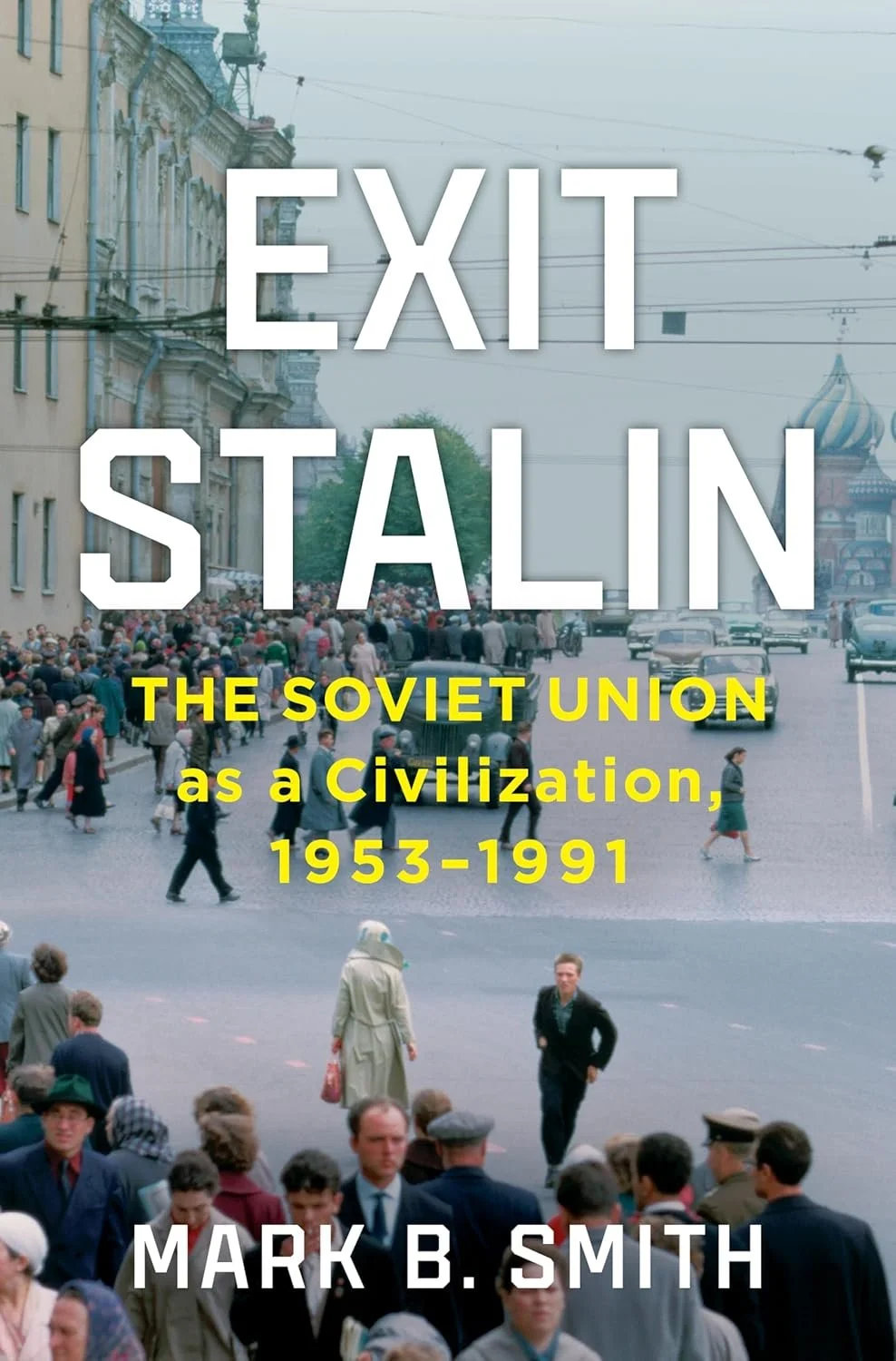
Exit Stalin: The Soviet Union as a Civilization, 1953-1991
By Mark B. Smith
WW Norton 2026
In retrospect, the Soviet Union appears to have been a ticking time bomb, a brutalizing house of cards doomed to collapse in one fell swoop, but its mercurial decline reveals a far more complex story. Fueled by brash ideology and constructed on unfulfilled promises, the socialist state persisted in a cycle of revolution and instability, even more so after Stalin’s death in 1953. In his sweeping analysis, Mark B. Smith attempts to examine six interrelated dimensions of the USSR’s demise by disentangling Soviet civilization from the state itself. Building upon cultural movements and biographical asides of notable figures, Smith’s framework exposes how the fragility of identity and society became a tipping point for political dissolution.
Structured in periods demarcated by the three major leaders following Stalin—Khrushchev, Brezhnev, and Gorbachev—Exit Stalin contains a varied overview of each era, enticing readers with snapshots of the literary and cinematic landscape, as well as the economic and political policies that shaped the daily lives of citizens. This segmentation of the USSR’s history is logical, but proves challenging even for Smith to maintain, as he frequently jumps ahead of the narrative when particular events or figures bleed into subsequent epochs. Despite these occasional jumps, his analysis largely benefits from this fluidity and captures the volatility of Soviet civilization.
Joseph Stalin’s death became a pivotal moment of transition from the bloodied purges and brutal labor camps of the previous era, and also a moment of reflection on such heinous crimes. Nikita Khrushchev seized this moment by exposing Stalin’s sins and pursuing de-Stalinization policies in an effort to decouple the USSR from its past. As Smith explains, this period, known as “The Thaw,” expressed hope and optimism for the promised utopia, but beneath the surface of ice lay entrenched layers of bureaucracy and stagnation. Although the ‘60s and ‘70s witnessed a blossoming of individuality and personal choice—expressed through newly constructed apartments, fashion trends, and pet ownership—the police state and censorship apparatus never disappeared.
From Khrushchev to Brezhnev to Gorbachev, Smith underscores the role of power and control wielded over Soviet satellites like Hungary and Czechoslovakia, as well as over dissidents such as Andrei Sakharov and Aleksandr Solzhenitsyn. Although less threatening than the terror of the 1930s, a lack of personal initiative and an instinctive conformism became instilled in the average Soviet citizen, later termed homo sovieticus. Smith describes this psychological complex as follows:
Characteristics which homo sovieticus lacked included a coherent sense of personhood and individual autonomy; the capacity to form beliefs, as they had spent their lives being "brainwashed' by communist power while not sincerely believing in it or anything else; and the range of normal moral commitments to other people.
Throughout the work, Smith’s analysis remains balanced, accurately conveying societal stagnation, chronic shortages, and restrictive policies without overlooking areas of success and cultural achievement, such as cosmonaut Yuri Gagarin’s monumental orbit of the Earth. The rigor of his approach allows readers to grasp the multitude of forces at play and properly assess the extent to which the Soviet Union's failures stemmed from ill intent rather than simple incompetence. Exit Stalin succeeds as a broad and periodically precise overview of the USSR’s unraveling, but Smith devotes far too many pages to summaries of film plots than to discussions of pivotal policies such as the Law on Cooperatives or the 500 Days Program. This balancing act between Soviet civilization and the state itself ultimately strengthens Smith’s thesis, though it leaves some of the most consequential political and economic shifts underexplained.
Equally engrossing and informative, Exit Stalin delivers a fresh perspective on the Soviet Union’s staggered erosion. By positioning the decay of Soviet civilization and identity at the forefront, Smith presents readers with a wide array of cultural, historical, political, and economic context. The result is a roughly forty-year panorama of a society in flux, revealing the layers of ambiguity still buried beneath the rubble of the Soviet collapse.
Brock Covington is an entrepreneur and writer. He can be found on the YouTube channel "The Active Mind" and on his substack: brockcovington.substack.com