There's Only One Sin in Hollywood by Rasheed Newson
/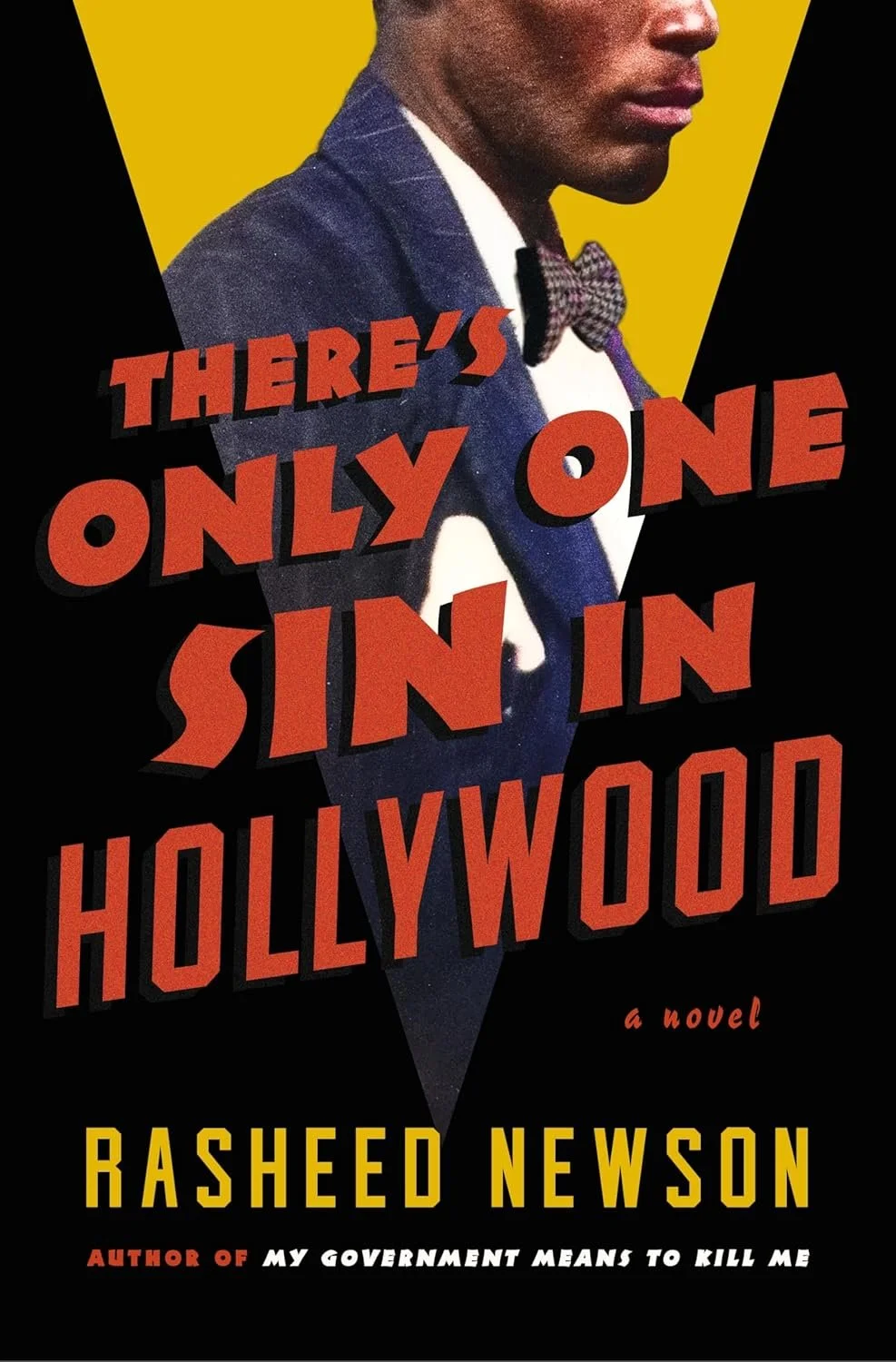
There’s Only One Sin in Hollywood
By Rasheed Newson
Flatiron Books 2026
The capacious imagination and rock-solid storytelling skills evident in Rasheed Newson’s electrifying debut My Government Means to Kill Me acted as both a sign and a warning, since it both announced the arrival of a first-rate writer and raised the specter of that writer suffering the notorious sophomore slump that so often happens with second novels. So many promising debuts are retroactively blighted a bit by some gaseous anomaly emitted on tight contract half a dozen months later.
There’s Only One Sin in Hollywood gives a quick bit of relief and an intensely involving read. It’s the story of a tall, gorgeous man black man named Ruben Singleton, whose story is told here by a studio enforcer and backstage problem-solver named Aaron Toussaint. Ruben is a thunderbolt of looks and charisma, and his ascent in a still very segregated Hollywood begins when a smitten George Cukor sees him in all his glory and immediately renames him Xavier C. Barlow, who’s quickly outfitted with a print-ready version of his sordid, unhappy past. “His life story, after it was condensed, sanitized, and fabricated,” Toussaint recalls in his trenchant, sardonic narrative tone, “has only a fleeting reference to his upbringing in Gary, Indiana: Xavier was orphaned at a young age before being raised by a loving aunt.”
Toussaint tells his own story as well, likewise mostly unhappy, taking readers from his service in Korea to the beginning of his association with Horace Dixon, whose business manager he would later become. But the book’s focus is Xavier, and through him the world of race and power in studios of the 1950s, on the sets, and at the parties of the dream factory. And since Toussaint’s work has introduced him to virtually everybody, particularly the minorities struggling for work and recognition, the narrative is full of name-dropping. “At an outer table were Black men and women, who drew worldwide fame from the characters that they pretended to be,” reads one such passage. “There at a table for ten sat Sidney [Poitier], Diahann [Carroll], Xavier [Westwood], Harry Belafonte, Sammy Davis Jr., Lena Horne, Ruby Dee and Ossie Davis, James Edwards, and Eartha Kitt (eight months pregnant).” In scene after scene, all our main characters encounter discrimination both overt and more insidious, as when they visit “almighty” studio boss MK Garten on a hot sunny day. “He made a show of having his manservant bring us water, there was ice in Mr. Garten’s glass of water, unlike ours,” readers are told. “He called us by our first names; we’d been instructed by his secretary to refer to him as Mr. Garten.”
This racial element is naturally prominent and persistent throughout the ultimately sad story Toussaint has to tell, but the more memorable thread running through There’s Only One Sin in Hollywood is its illicit and overriding sensuality, with Toussaint characterizing his feelings for Xavier as “a purifying high, a sing worth the damnation.” It’s this thread that makes him such a fascinating narrator, reliable to exactly the extent that he distrusts his own reliability. “My heart wasn’t to be trusted,” he confesses. “It chose arousal over prudence. It confused risk with romance.”
No sophomore slump here, in other words. There’s Only One Sin in Hollywood is every bit as solid and thoughtful and moving as its predecessor.
Steve Donoghue is a founding editor of Open Letters Monthly. His book criticism has appeared in The Washington Post, The American Conservative, The Spectator, The Wall Street Journal, The National, and the Daily Star. He has written regularly for The Boston Globe, the Vineyard Gazette, and the Christian Science Monitor and is the Books editor of Georgia’s Big Canoe News