Two Ships by David Reynolds
/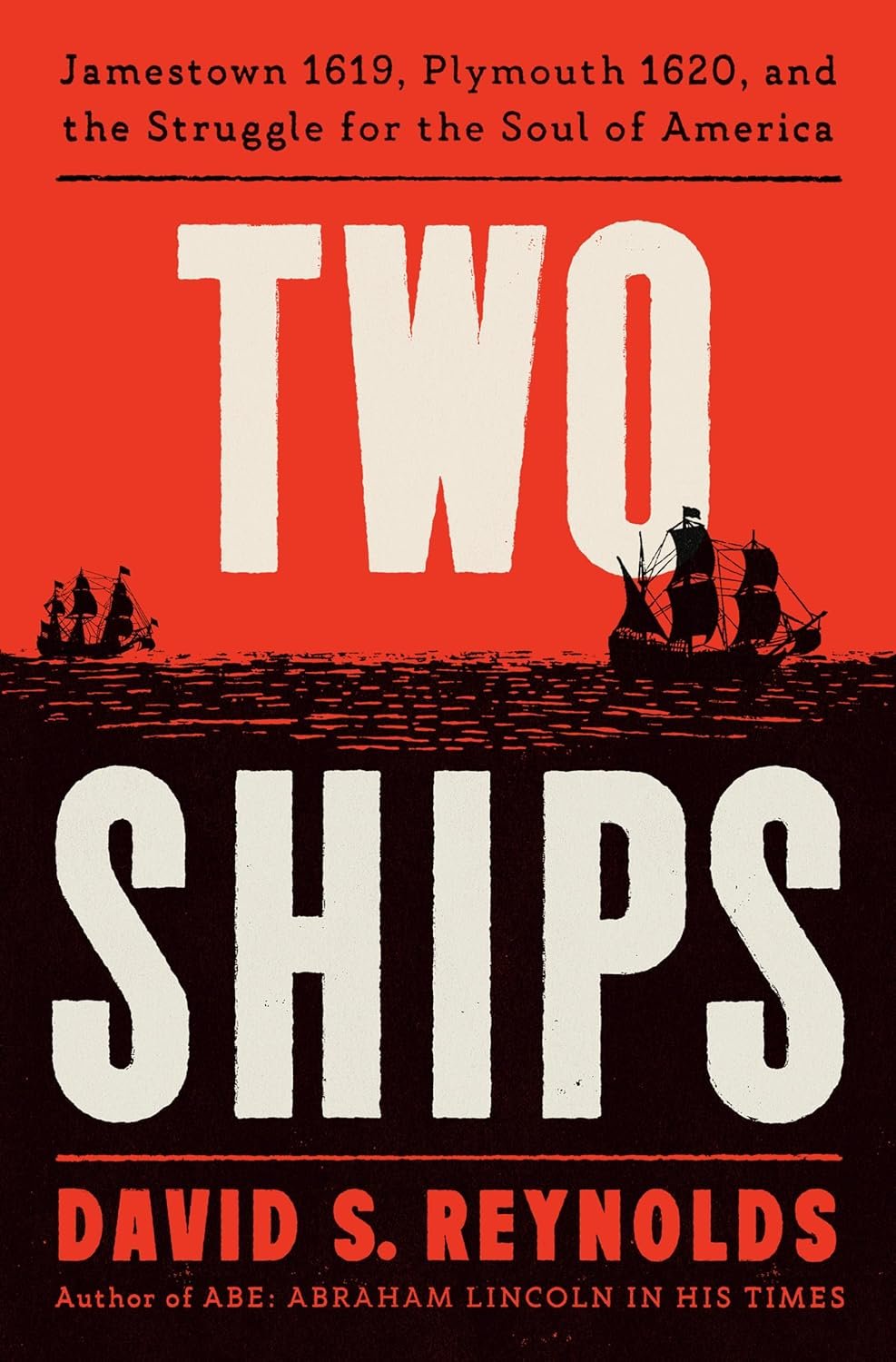
Two Ships: Jamestown 1619, Plymouth 1620, and the Struggle for the Soul of America
By David S. Reynolds
Penguin Press 2026
David Reynolds, author of a fairly good biography of Abraham Lincoln and a very good book called Beneath the American Renaissance, has a new book: Two Ships: Jamestown 1619, Plymouth 1620, and the Struggle for the Soul of America. It’s an animated look at the tortured history of American slavery and its immediate aftermath, but even so, general-interest readers of popular-market history can rightfully tremble at the phrase “struggle for the soul of America” in the subtitle of any book. It’s a signal of running sap, an open invitation to deplorable manipulative nonsense.
There’s a bit of nonsense. Despite writing a book about slavery, Reynolds never actually calls anyone the word “slave” (one of academia’s newest and most ridiculous ironclad demands), for instance, and, utterly inexcusably, the book includes no bibliography.
But in the big majority, Two Ships is excellent and fast-paced, taking its title from the so-neat-it-could-only-be-real historical parallel of the Dutch ship White Lion, which brought 20 slaves to Jamestown in 1619, and the Mayflower, which brought the Pilgrims to Massachusetts in 1620. Thinking about the American Civil War, Massachusetts Senator Charles Sumner reflected that “In the holds of those two ships were concealed the germs of the present direful war, and the simple question now is between the Mayflower and the slave ship.” These were the fundamental opposing forces Sumner saw, and he solemnly declared “The Mayflower must surely prevail.”
Reynolds takes up this essential conflict, between Puritan and Cavalier, and traces it through a century of American history, touching on dozens of key moments and narrating them with unflagging energy. He catalogs firsts, including 1700’s The Selling of Joseph by magistrate Samuel Sewell, infamous for his involvement in the Salem Witch Trials; Reynolds calls Sewell “the first American colonist to publish an antislavery tract,” naturally invoking the rare Scriptural passage that seems not to endorse slavery: “He that Stealeth a Man and Selleth him, or if he be found in his hand, he shall surely be put to Death.”
A religious tug-of-war happens throughout the book, and Reynolds, author of a book on John Brown, is insightful about every aspect of it. Noting that “there had long been a strain within Puritanism the prioritized divine law over human law,” he writes that Brown reveals “both the perils and the promise of antislavery Puritanism,” and the main strength of Two Ships is its skill at balancing that promise with those perils.
Steve Donoghue is a founding editor of Open Letters Monthly. His book criticism has appeared in The Washington Post, The American Conservative, The Spectator, The Wall Street Journal, The National, and the Daily Star. He has written regularly for The Boston Globe, the Vineyard Gazette, and the Christian Science Monitor and is the Books editor of Georgia’s Big Canoe News