Summer of Freedom by Oliver Hilmes
/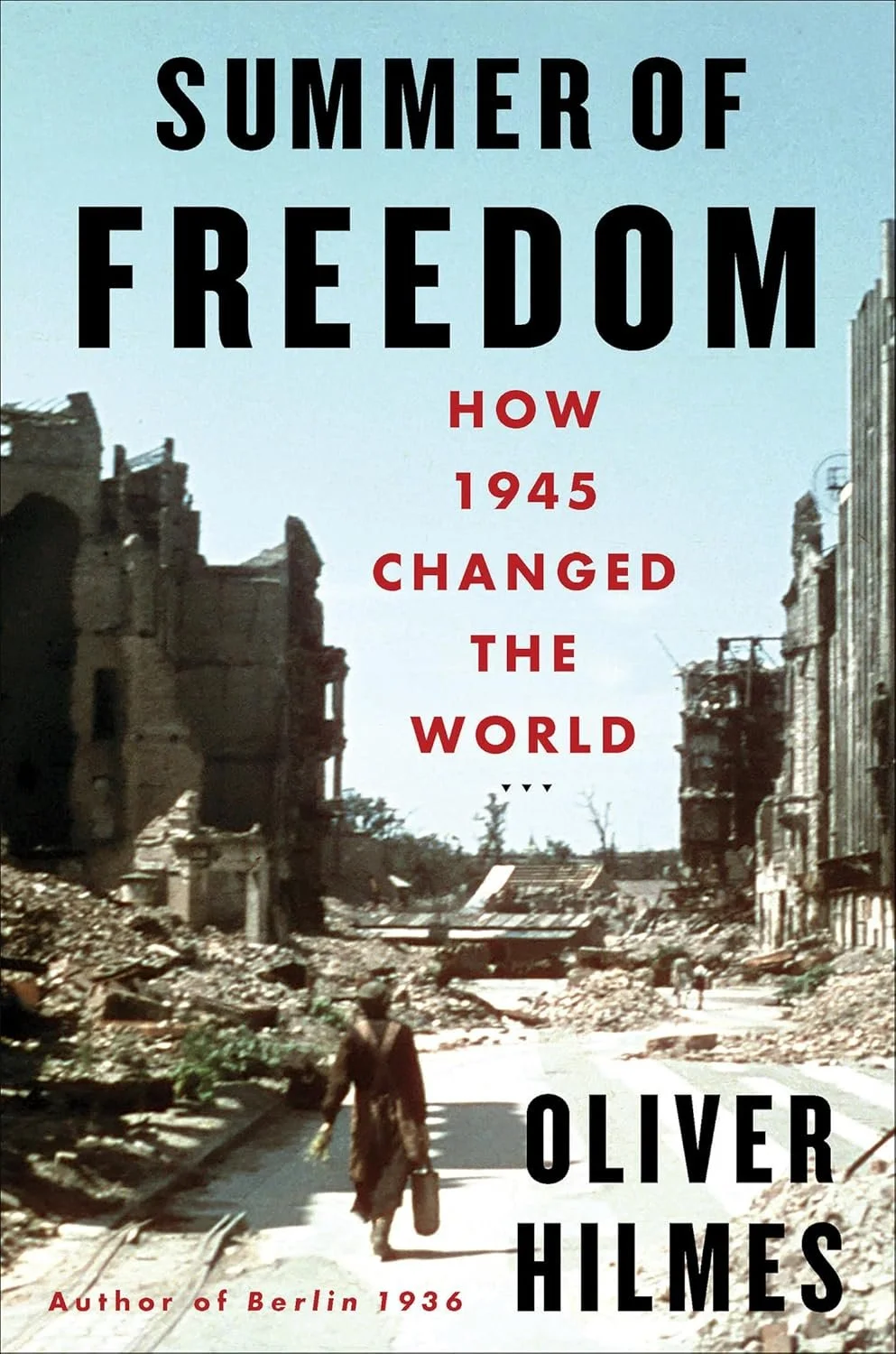
Summer of Freedom: How 1945 Changed the World
By Oliver Hilmes
Translated by Jefferson Chase
Other Press 2026
Historian Oliver Hilmes’s 2025 book Ein ende und ein Anfang: Wie der Sommer 45 die Welt veränderte now appears in an English-language translation by Jefferson Chase for Other Press, a slim thing, 220 pages in a smaller form factor. The goal of the book is to give a series of prismatic sketches of the immediate postwar world through the adventures and dilemmas of a handful of individual characters: former soldiers, ordinary citizens, a famous movie director, world leaders like Winston Churchill and Harry Truman, and, regular as a cuckoo clock sounding, the literary expat Thomas Mann.
Chase unaccountably changes the book’s title, introducing an editorial slant that’s not only absent from the original but also, more importantly, absent from the book. The happy tone of “summer of freedom” seldom crops up in the book’s stories, and then mostly in fugitive glimmers. The leaders are all too worried; the ordinary citizens are scrounging through the rubble-piles that were once their homes (and waiting in endless lines every day for starvation rations); and virtually everybody else is desperately trying to piece their lives back together. The title-change also raises a small worry about the rest of the text; does Hilmes have the weakness for lazy idioms on display throughout the book (“like a house of cards,” “the crack of dawn,” “hustle and bustle,” etc. etc.), or is Chase adding those? Readers of the original from Siedler Verlag could say, but the English-language market is left to wonder.
And the book itself is decidedly odd, feeling most often like the polished gleanings of some larger, more comprehensive work about the Western shift to postwar footing. Seen as a series of colorful vignettes, the chapters and running storylines here make for vivid, pacey reading full of novelistic sleights of hand. We get scenes with a young man named John, for example, wandering around the ruins of Germany and poking into abandoned rooms with a kind of morbid curiosity:
Now, in the summer of 1945, John wants to understand how Hitler was able to seduce an entire nation. Although John is not a Nazi himself, he is fascinated by Hitler’s defunct empire. He therefore embarks on a grim search for clues, visiting the destroyed Reich Chancellery with its “Führer’s bunker” and inspecting the room where the dictator ended his life.
… only to have Hilmes then melodramatically tell us that John’s full name is … slow drum-roll … John Fitzgerald Kennedy. No foregrounding. No subsequent analysis. Just the third-act reveal.
Probably no figure among the book’s central dozen or so characters suffers more from this kind of hit-and-run theatrics than the aforementioned Thomas Mann, the century’s greatest novelist, who fled from the Nazis first to Switzerland and then the US. Readers are repeatedly given similarly tetchy scenes:
Thomas Mann has been grumpy for days. If he’s not being tormented by a severe nasal congestion, the late summer weather exhausts him. In any case, the septuagenarian is prone to getting upset. In such moments, he’s so thin-skinned that even trifles can have negative consequences.
These ill-tempered moments, complaining about poor room service or a willful little dog or some such, are almost always taken from Mann’s private diary, where we are neither required nor expected to be thinking always of Mount Olympus. The persistence of this graceless undermining will have readers naturally wondering both about the various sordid complaining going on in the author’s own private diary and about whether or not Hilmes was assigned The Magic Mountain in college and has been patiently plotting his revenge ever since.
After a fairly quick page-turning reading experience, Summer of Freedom leaves its readers better stocked in gossip but not really wiser. Books about the postwar experiences of Mann or Truman or even Billy Wilder have been written to much better effect, and a dozen novels have captured the ‘novelistic’ side with far greater depth of feeling. And as for that bit about how the year changed the world, even the author seems almost to forget such a high-flying promise shortly after it’s made.
Steve Donoghue is a founding editor of Open Letters Monthly. His book criticism has appeared in The Washington Post, The American Conservative, The Spectator, The Wall Street Journal, The National, and the Daily Star. He has written regularly for The Boston Globe, the Vineyard Gazette, and the Christian Science Monitor and is the Books editor of Georgia’s Big Canoe News