The Lost Founder by Jesse Wegman
/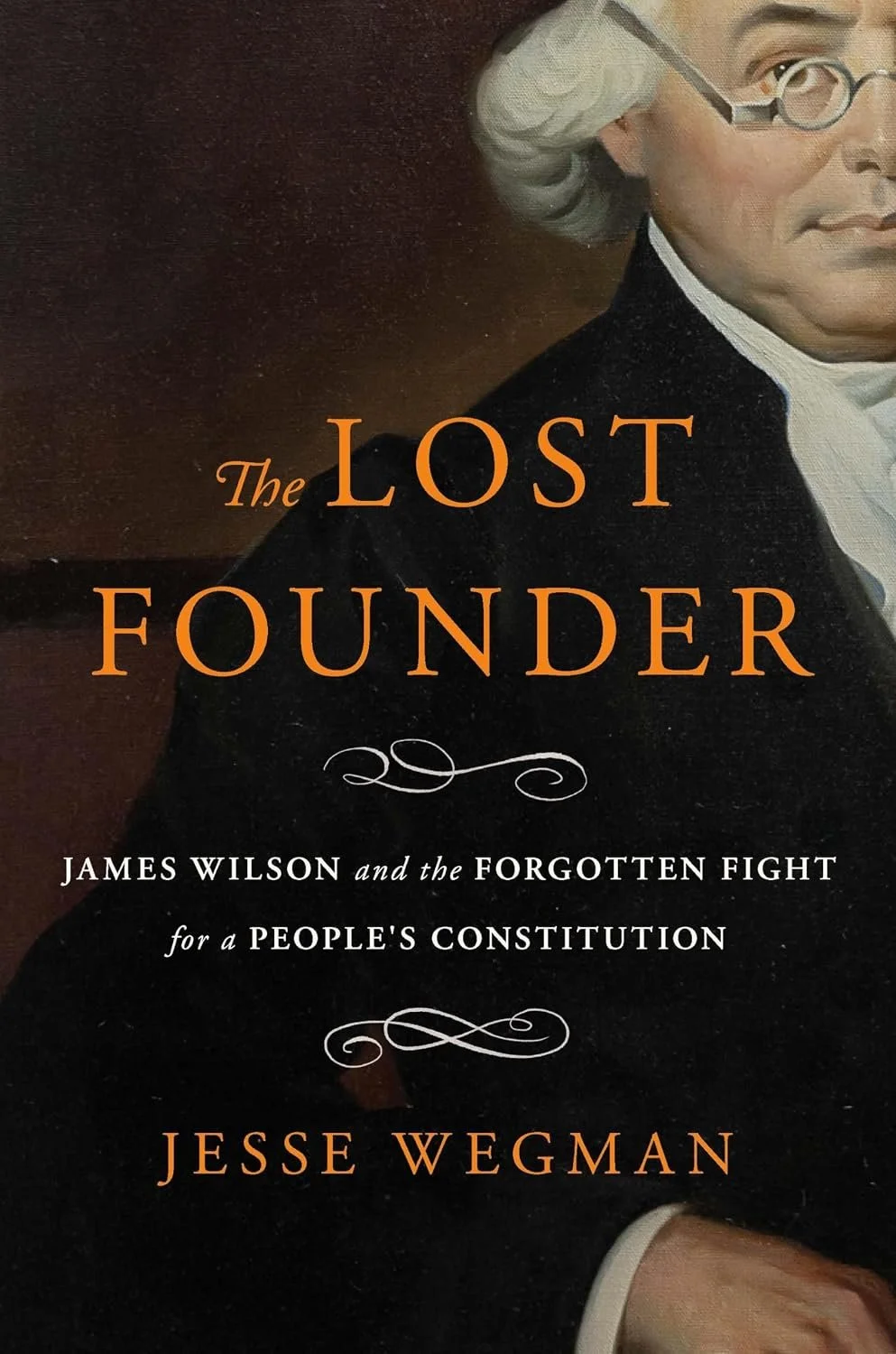
The Lost Founder: James Wilson and the Forgotten Fight for a People’s Constitution
By Jesse Wegman
Celadon Books 2026
No less a cultural artifact than Peter Stone’s fantastic stage play “1776” made an unambiguous claim about Scots-born US Founding Father and Supreme Court justice James Wilson, a prophecy uttered with scorn and certainty: “No one will ever remember the name of James Wilson.”
In The Lost Founder: James Wilson and the Forgotten Fight for a People’s Constitution, Brennan Center senior fellow Jesse Wegman clearly wants to contest this kind of verdict. He looks at Wilson’s views about the new Constitution that delegates created in 1787 in order to replace the Articles of Confederation and he teases out Wilson’s own participation, not always window-clear, since the conference sessions were secret and mostly unrecorded. Wilson was held in some regard by his fellow delegates; “No man is more clear, copious, and comprehensive than Mr. Wilson, yet he is no great Orator,” one of them wrote. “He draws the attention not by the charms of his eloquence, but by the force of his reasoning.”
In Wegman’s lively telling, the Convention of 1787 is the literal and thematic centerpiece of any attempt to “restore” Wilson to his proper place in the story of US independence, that convention in which delegates debated the nature of a new and stronger federal government, the nature of state representation in the new nation, and what kind of “chief executive” might preside over it all.
This last question prompted some awkward pauses, as Wegman writes with the same kind of narrative gusto that fills this book:
There were two explanations for the awkward silence – one absent, one present, both named George. The first: George III, by the Grace of God, King of Great Britain, France, and Ireland, Defender of the Faith and so forth. Many of the delegates had personally taken up arms against the king in a bloody yearslong war for their independence, and they were in no mood to replace his transatlantic tyranny with a homegrown version.
Wegman follows Wilson from his boyhood in Scotland, his legal apprenticeship to John Dickinson, his signing of the Declaration of Independence, his participation in the fateful Constitutional Convention of 1787 in which so much of America was penned out on blank paper, his installment as one of the first justices on the Supreme Court, and right down to his squalid end, deathly ill and hiding from creditors right up until the moment of his death in 1798. And at regular intervals, he makes the case to his readers that Wilson was an almost singularly prescient figure at the founding of the country:
Consider the many ways the Constitution and American government have evolved since the founding – the expansion of the franchise to include Black former slaves, women, and virtually all adults eighteen and older; the elimination of property requirements for voting and holding office; the right of the people to elect their senators directly; the Supreme Court’s adoption of the principle of one person, one vote. In all these ways and more, modern America is remarkably aligned with what Wilson envisioned in 1787.
“Were he alive now,” Wegman writes of his mole-eyed double-chinned hero, “he would look at a Senate increasingly skewed in favor of smaller states and an Electoral College that has turned popular-vote losers into presidents twice in this century and say, I told you so.”
He was more vocal and eloquent than he’s remembered, and it’s doubtful he’ll ever get a better popular biography than this one. Time will tell if it changes anything, but any reader could be forgiven for doubting.
Steve Donoghue is a founding editor of Open Letters Monthly. His book criticism has appeared in The Washington Post, The American Conservative, The Spectator, The Wall Street Journal, The National, and the Daily Star. He has written regularly for The Boston Globe, the Vineyard Gazette, and the Christian Science Monitor and is the Books editor of Georgia’s Big Canoe News