Pushing the Wall by Frank Miller
/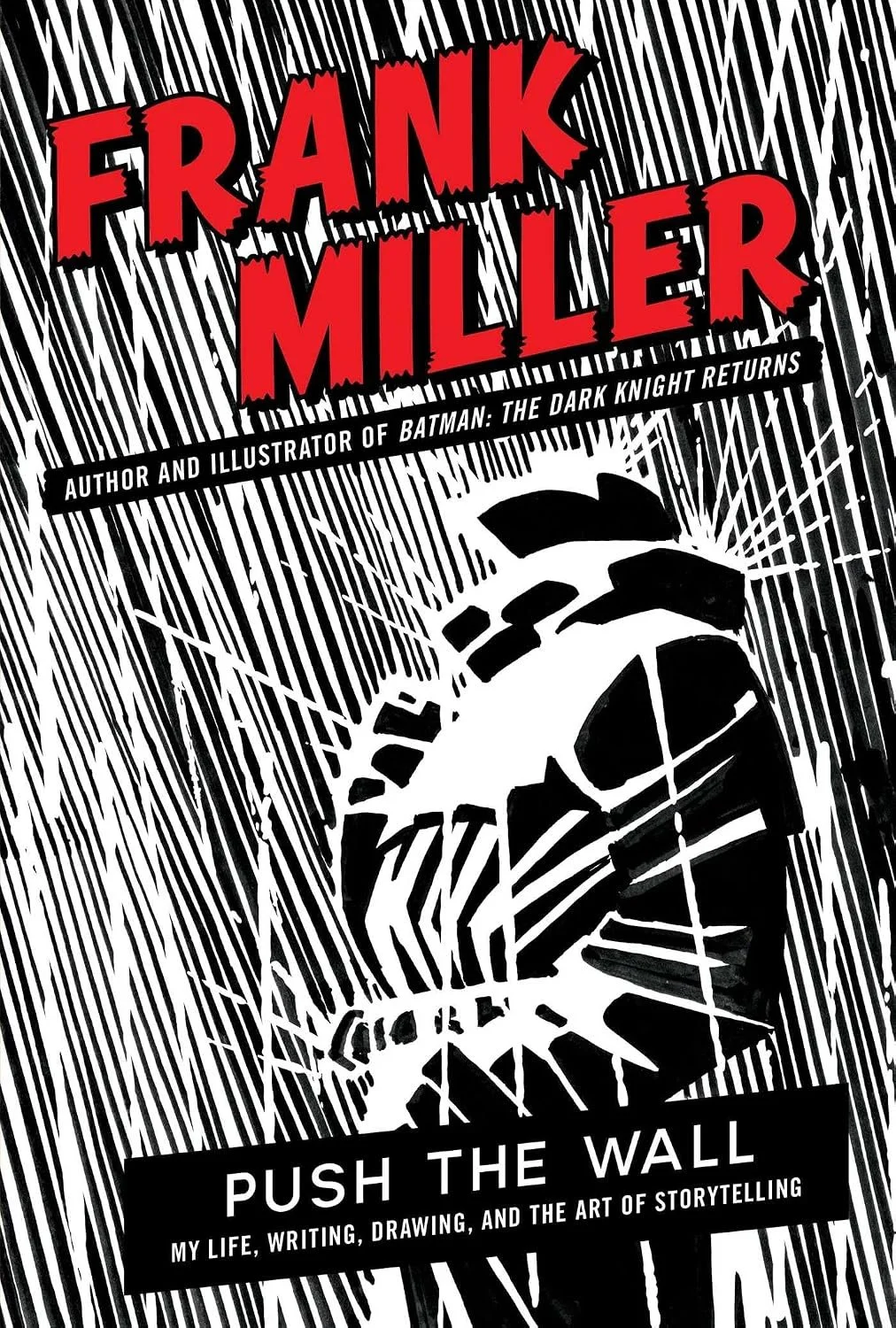
Pushing the Wall: My Life, Writing, Drawing, and the Art of Storytelling
By Frank Miller
Saga Press 2026
Writer/artist Frank Miller is legitimately legendary in the field of comic books, firmly stationed in a company of three dozen or so men and women who did landmark work. Miller was the creative genius behind black, nihilistic oddities like Ronin or Sin City, the genius behind signpost superhero stories like Batman: Dark Knight Returns or Batman: Year One, and the genius behind black, nihilistic masterpieces like 300 or the “Elektra saga” run in Daredevil. Any one or two of these would guarantee a creator immortality in the comic book field, so Miller’s status is secure no matter what sloppy, downright cracked work he might add to that body of work, incomprehensible things like Dark Knight Strikes Again or, God forbid, Holy Terror.
This kind of status imbues his new memoir, Push the Wall, with inherent interest. The many thousands of comics readers who’ve enjoyed their work would very much like to see similar memoirs from all the other greats of the comics world. How fascinating and valuable it would be, for instance, if we had honest, grappling, detailed memoirs from figures like Bill Everett or Gil Kane or Jack Kirby.
Finishing Push the Wall, some readers will be thinking about how fascinating and valuable it would be if we had an honest, grappling, detailed memoir from Frank Miller. This sure isn’t that.
Miller organizes the book around 18 “lessons” about both life and working in the comics industry, and he fills in the inevitable pabulum of old-man-imparting-lessons with glimpses from his own autobiography: boyhood in Vermont, formative exposure to gritty New York and specifically the Greenwich Village of bygone decades, the initial scrambling in the comics industry, the burgeoning success after Elektra and Dark Knight Returns. And sometimes some of these memories, though decked out in the hack-purple prose that’s characterized Miller’s writing for fifty years, are interesting, particularly the Horatio Alger bits before he hit it big, when he was wandering around a pre-Bloomberg New York that would be all but unrecognizable to the city’s current wall-to-wall 1% inhabitants. “I arrived wide open to the strange gifts of the city’s seedy decline,” he writes in one such passage, “the Sodom and Gomorrah of Times Square, the hard-up characters hanging around fleabag hotels by Port Authority, the graffiti and urban dross in the subway, the misfits skulking in the East Village parks after dark, the crumbling, uneasy feeling of it all.”
Miller might not be the most eloquent of writers, but he’s articulate and sure as hell prolific; instead of tarping over the subject with something like “the crumbling, uneasy feeling of it all,” he could have written that feeling. His book is barely 200 pages; Saga Press would certainly have sprung for another 100.
So what’s left are the lessons, and the bits about Miller’s professional life. But the lessons are mostly things Miller himself has very publicly, very repeatedly not followed. “Sometimes you have to work with others to grow,” he writes, for example. “You have to put yourself back into learning, back into wonder, back into some spooky action.” And the anecdotes from the professional comics world are so bland and sanded-down as to be virtually press releases. About his decision to kill off his massively popular character Elektra, he writes:
Exit Elektra. When it came to my decision to end her life, I have to say, it just felt like the right thing to do. Bringing this storyline to a conclusion was the most dramatic thing I could do for the story: the narrative demanded an exclamation point, so I gave it one, in the most lapel-grabbing way possible.
Or this, about his decision in Dark Knight Returns to turn Superman into a fascist lapdog:
At the time, Batman suited my creative vision for a superhero much more than Superman. I grew up reading and idolizing Superman. He was my first favorite superhero. But, truth be told, I had gotten pretty sick of the guy. He was just so ridiculously powerful, and his invulnerability reached the point of limiting him as a character for me.
Obviously, “it just felt like the right thing to do” and “I had gotten pretty sick of the guy” are serious disappointments, especially coming from an author who’s gotten a good deal of profitable mileage out of the crafted public image of a straight-talking maverick. There’s precious little maverick straight-talking in Push the Wall, and we’re unlikely to get a more satisfying follow-up. Although it’s at least theoretically possible that Frank Miller could strike again.
Steve Donoghue is a founding editor of Open Letters Monthly. His book criticism has appeared in The Washington Post, The American Conservative, The Spectator, The Wall Street Journal, The National, and the Daily Star. He has written regularly for The Boston Globe, the Vineyard Gazette, and the Christian Science Monitor and is the Books editor of Georgia’s Big Canoe News