A Biography of a Mountain by Matthew Davis
/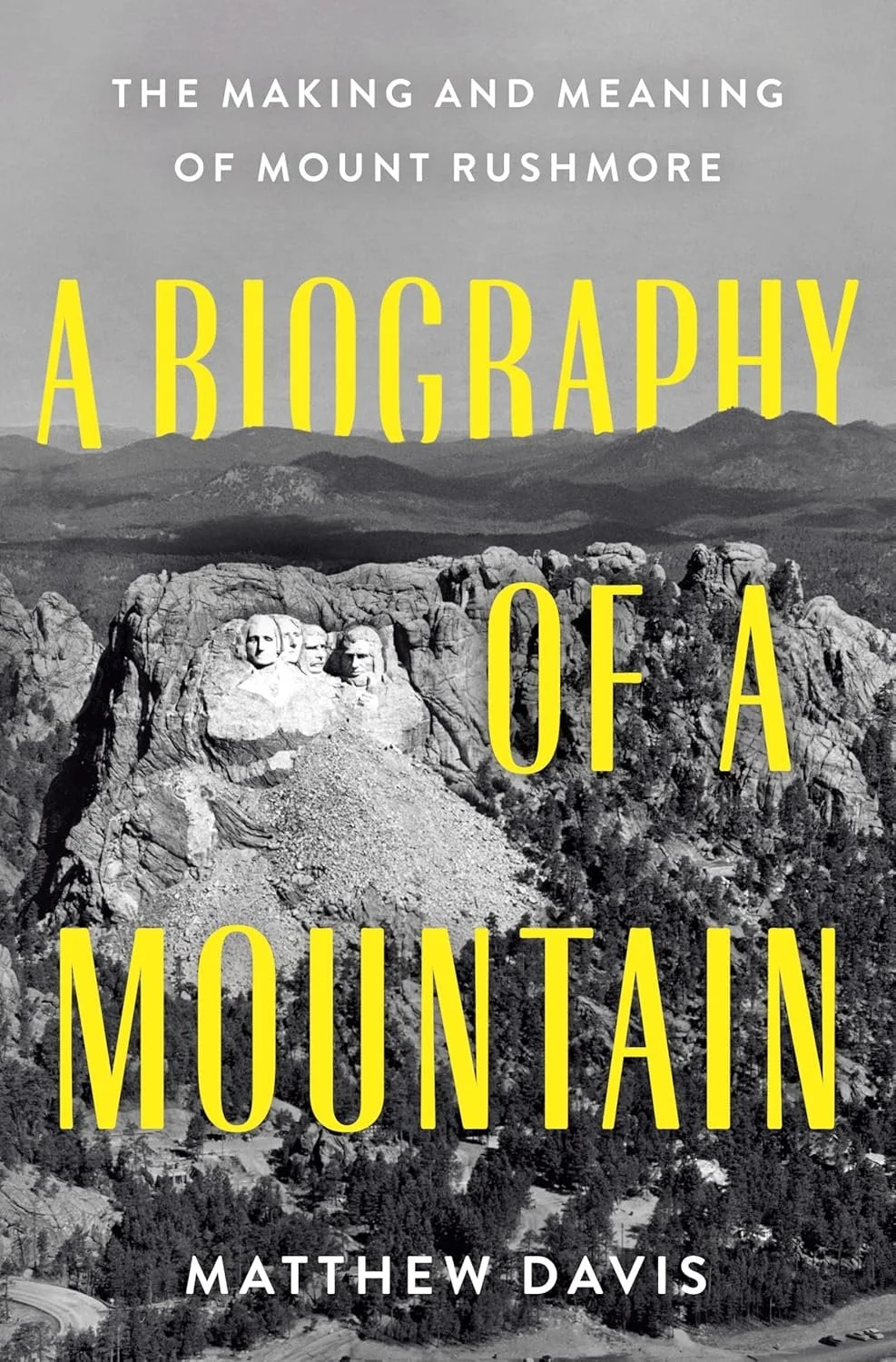
A Biography of a Mountain: The Making and Meaning of Mount Rushmore
By Matthew Davis
St. Martin’s Press 2025
The central character, “hero” being multiply wrong, of Matthew Davis’s new book A Biography of a Mountain: The Making and Meaning of Mount Rushmore, isn’t US President Calvin Coolidge, who dedicated the national eyesore in 1927, and it’s not South Dakota Senator Peter Norbeck, who did so much hustling to raise funds for the eyesore, nor even the New York City lawyer Charles Rushmore, whose name was haphazardly slapped onto the rock face the Lakota Sioux had called The Six Grandfathers for a thousand years. Certainly it’s not the four figures carved into the mountain, George Washington, Thomas Jefferson, Abraham Lincoln, and Theodore Roosevelt.
No, the character dominating this engaging, thoughtful book goes by the odd name of Gutzon Borglum, the man who designed and oversaw the creation of the monument, taking the job when he had a rising name but no money and working on it for well over a decade. Davis, author of the terrific When Things Got Dark: A Mongolian Winter’s Tale, seems persistently fascinated by Borglum, following him through the ups and downs of the largely self-taught path of his talent’s development. Borglum was a shapeshifting expert at re-inventing himself, and Davis traces these changes with a biographer’s zeal. “The personality traits that allowed him to create this version of Gutzon Borglum – his indefatigable work ethic, his stubbornness, his self-confidence, his independence, his imagination, his physical strength, his charm – were all forged from his distinctly American upbringing,” he writes. “They would be the same qualities that would propel him to success and doom him to failure in the coming years.”
Borglum dominates the book, but naturally other shadows stretch across it. This is not, of course, the biography of a mountain, since not all the words ever written in all the languages every devised could do that, but rather the chronicle of a defilement, as the US government consecrated a monument to four of its Presidents on the face of rock long held sacred by a people the US conquered and betrayed, making a tourist attraction out of a deliberate act of sacrilege. This is the “jagged treatment” of the Lakota people that runs throughout the book and is so deftly handled by Davis.
The other shadow laying on the book likewise takes the outline of a sacrilege: the speech Donald Trump gave at Mount Rushmore on 3 July 2020. Davis notes the febrile Trump-rally atmosphere surrounding the speech but exercises some discretion when dealing with the event itself. Trump’s speech was hallucinatorily paranoid, constantly referring to an “attack on our liberty” being conducted by some vast nebulous army of savage America-haters. It was racist, needless to say (making casual reference to the “settling” of the Old West while speaking in the Black Hills), lawless, insanely messianic, and delivered in a halting monotone by a US President who stumbled twice on the name “Theodore Roosevelt” and, in the singular irony of the event, also stumbled over the word “totalitarian.”
It was a national disgrace, the airing of Stephen Miller’s Great Replacement-mongering fascist nationalism in the highest profile venue in the country by an ignoramus President who could barely trudge his way through the words. And in fairness, Davis recognizes the significance of it and wisely decides to balance it with the rest of his narrative. He does an immensely readable job with the rest of that narrative; in addition to being a solid history, this is also a powerful, personal story of the author’s encounter with this peculiar space. The fact that Trump’s speech epitomized the vicious persecution-complex Manifest Destiny nationalism that gave birth to Mount Rushmore in the first place is hardly this author’s fault and probably cannot be his subject.
Steve Donoghue is a founding editor of Open Letters Monthly. His book criticism has appeared in The Washington Post, The American Conservative, The Spectator, The Wall Street Journal, The National, and the Daily Star. He has written regularly for The Boston Globe, the Vineyard Gazette, and the Christian Science Monitor and is the Books editor of Georgia’s Big Canoe News