Behind Caesar's Back by Caillan Davenport
/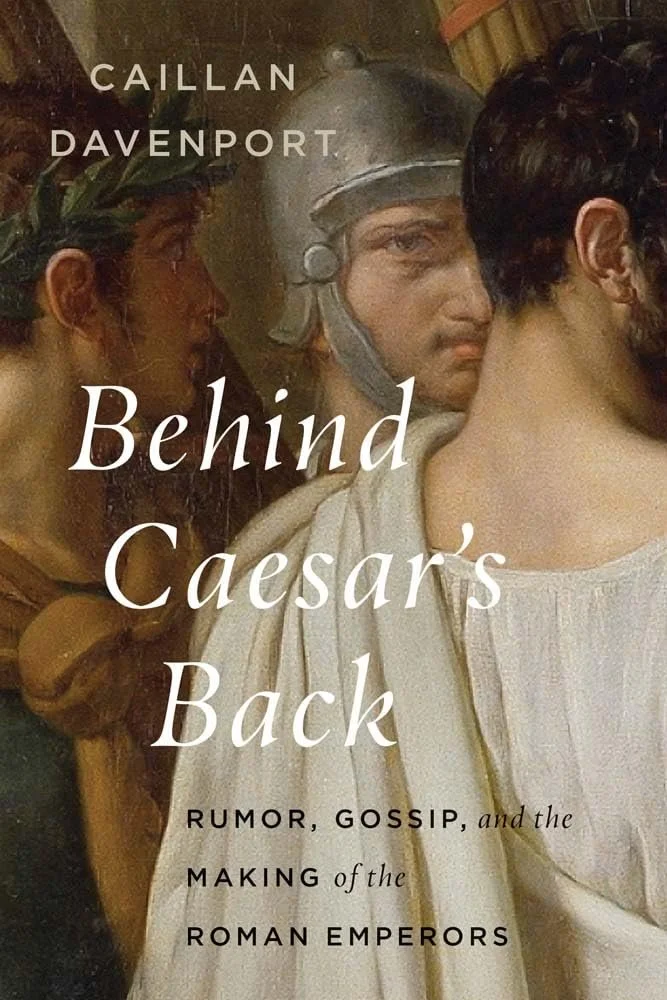
Behind Caesar's Back: Rumor, Gossip, and the Making of the Roman Emperors
by Caillan Davenport
Yale University Press 2026
Readers familiar with the great fourth book of Virgil's Aeneid will remember the vivid description of the personification of rumor, the monstrum horrendum, ingens that is the untiring spawn of monsters, ready at any time to spread alarm and backbiting and even the occasional morsel of truth, all at a speed faster than any wind. In Virgil's depiction, rumor is no respecter of persons, adheres to no rules, suffers no impediments, and is heedless of the damage it causes.
That monster is at the heart of Behind Caesar's Back: Rumor, Gossip, and the Making of the Roman Emperors by Cailan Davenport, professor of classics and head of the Centre for Classical Studies at the Australian National University in Canberra. In these pages, Davenport studies the back channels, the bawdy barbershop songs, the scuttlebutt, all the non-official murmurings that filled the Roman forum and filtered their way even into the most private rooms of the Palatine. “The extent and circulation of imperial gossip has implications for understanding the aims and power of the Roman imperial monarchy,” Davenport writes. “Roman emperors, as a rule, were not deaf to what people said about them.”
In fact, as he writes, over centuries of the imperial period, people at all levels of Roman society “reacted to, joked about, criticized, and probed the limits of imperial power.” It's a quietly dazzling performance, grounded in over fifty close-packed pages of notes, seeming to miss no meaningful instance when rumor or gossip played a role in Roman history. When the emperor Trajan fell ill in Cilicia in AD 117, for instance, his wife Plotina was closeted with him alone for some time before any word was given of his condition. Even ancient sources noted the chance that something fishy was happening, that perhaps the rumors that Plotina was having an affair with Trajan's presumptive heir Hadrian and was stalling over a dead body in order to give her lover time to cement power. A young man named Phaedimus, one of Trajan's freedmen, died a few days after he did, and it immediately sparked speculation: “Was the unfortunate Phaedimus killed because he knew too much about Plotina and Attianus's actions? Or did he perhaps have a role in advancing Trajan's death, so that Plotina's beloved Hadrian could claim the purple?” Davenport asks, before adding laconically, “The possibilities are only limited by the extent of one's imagination.”
Any history of gossip in the pre-modern, our author notes, is fraught with what he refers to as “methodological issues.” Doubtless true, but it would be difficult to imagine a more imaginative and comprehensive study than this. Davenport has produced a masterwork of Roman history synthesis, something fit to stand with Fergus Millar's The Emperor in the Roman World or Richard Talbert's The Senate of Imperial Rome.
Steve Donoghue is a founding editor of Open Letters Monthly. His book criticism has appeared in The Washington Post, The American Conservative, The Spectator, The Wall Street Journal, The National, and the Daily Star. He has written regularly for The Boston Globe, the Vineyard Gazette, and the Christian Science Monitor and is the Books editor of Georgia’s Big Canoe News