Spinosaur Tales by David Hone & Mark Witton
/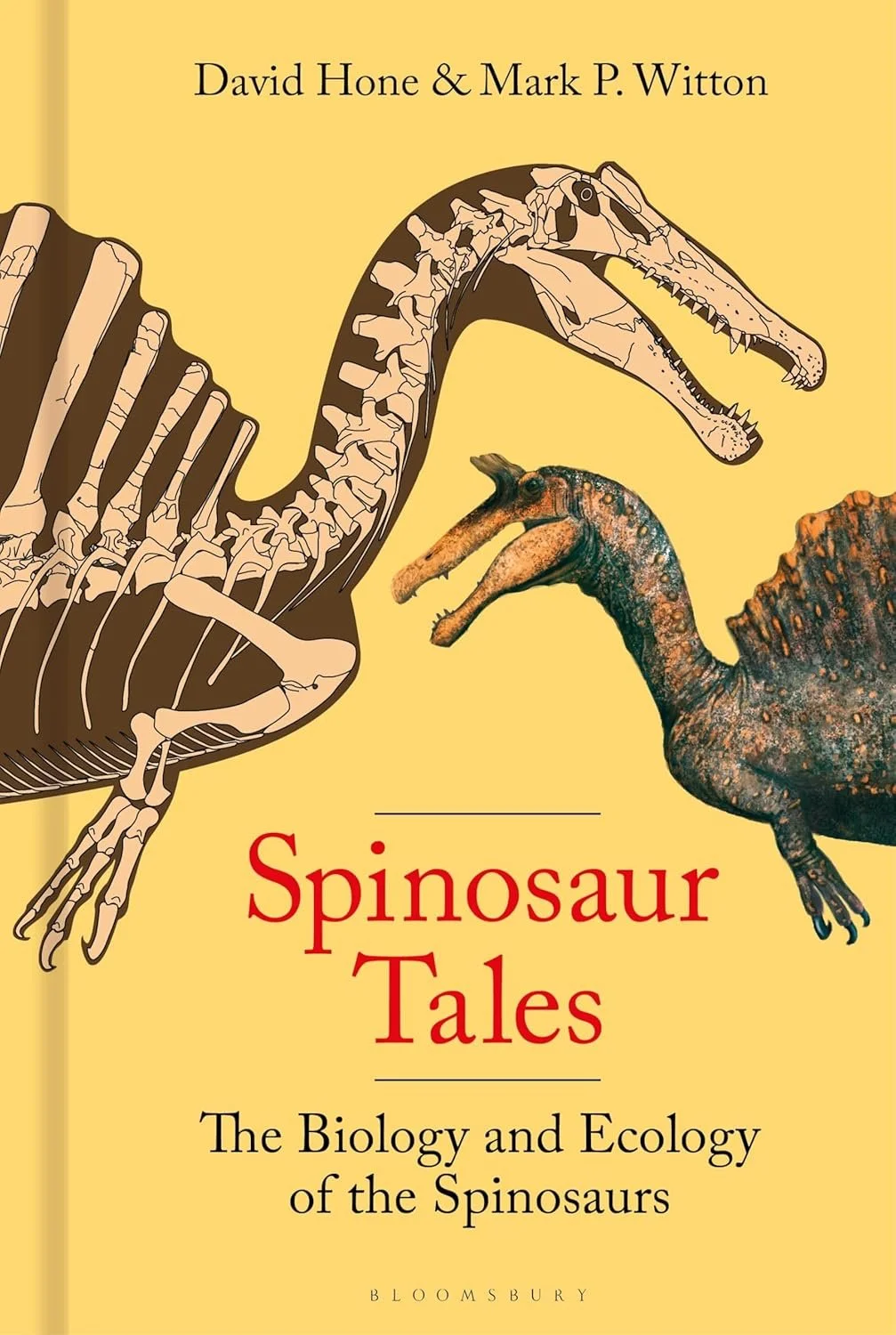
Spinosaur Tales: The Biology and Ecology of the Spinosaurs
By David Hone & Mark P. Witton
Bloomsbury 2026
Paleontologists David Hone and Mark Witton are nothing if not diplomatic in their new collaboration, Spinosaur Tales, when it comes to the highest-profile Hollywood appearance of the Late Cretaceous creature whose broad family is their subject. Spinosaurs, large therapods that lived 100 million years ago, had a dramatic design: long toothed beak, strong grasping claws, and, most noticeably in some species, a great sail of webbed bones protruding from the back. It seems like just the kind of outré getup that would translate naturally to the big screen, and yet, when a menacing Spinosaurus did indeed show up in 2001’s Jurassic Park III, it wasn’t exactly met with cheers of enthusiasm from audiences, failing, as our gentlemanly authors put it, to “draw audiences or excite critics as expected.” The movie’s director, Joe Johnston (The Rocketeer, Jumanji, and of course Captain America: The First Avenger), decided to hype his new villain dinosaur by having it commit paleontological and cinematic heresy, easily, almost casually dispatching a Tyrannosaurus rex. The heresy rightly disgusted audiences, who promptly walked away from the entire franchise for a decade.
In Spinosaur Tales, the latest in Bloomsbury’s Sigma series, the entire lot of spinosaurids sheepishly shuffles back onstage, hoping to be forgiven for the fact that some twenty-year-old movie thought any dinosaur could be cooler than T. rex, seeking to be appreciated for its own dorky particularities. And if readers are in a forgiving mood, they’ll find plenty of fascinating science in these pages. Hone and Witton are adroitly informative and entertaining in explaining everything science currently knows about spinosaur anatomy, biology, and behavior. The book has imaginative color illustrations, bone cross-sections, and most-likely anatomical reconstructions. The use of that signature spinal ridge? The strength of those dangling claws? The evolutionary development of that long toothy snout? Hone and Witton cover it all in fast-paced prose entirely accessible to non-specialists.
They also infuse most of the book with much-appreciated moments of humor, as when describing the statue of Sir Richard Owen in London’s Natural History Museum: “Owen’s statue is in bronze, making it nearly black, and he strikes a suitably dark and imposing figure in his skullcap and robes,” they write. “At least some staff at the Natural History Museum used to refer to the statue as ‘Darth Vader’, and it is not unknown for children to burst into tears upon seeing him.”
Spinosaur Tales brings together most of what’s known about this remarkable group and crafts it all into a handy, informative overview. So maybe bygones can be bygones.
Steve Donoghue is a founding editor of Open Letters Monthly. His book criticism has appeared in The Washington Post, The American Conservative, The Spectator, The Wall Street Journal, The National, and the Daily Star. He has written regularly for The Boston Globe, the Vineyard Gazette, and the Christian Science Monitor and is the Books editor of Georgia’s Big Canoe News