The Disappearing Act by Maria Stepanova
/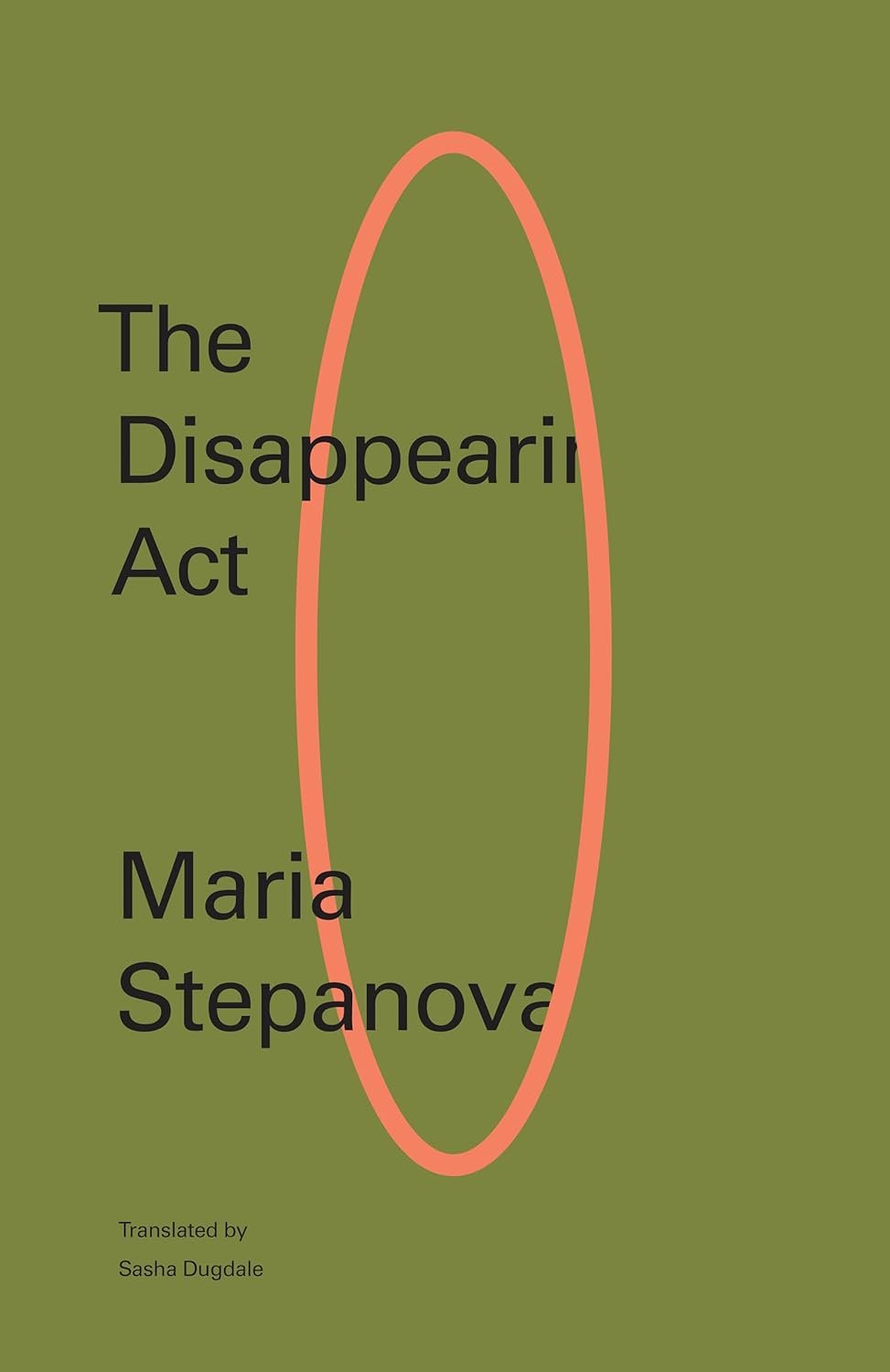
The Disappearing Act
by Maria Stepanova
translated by Sasha Dugdale
Amid a modern wave of émigré literature—led by Vladimir Sorokin and Lyudmila Ulitskaya—Russian poet Maria Stepanova anatomizes the moral attributes of language and identity in an elegiac novel mourning the disgrace of the ongoing Russo-Ukrainian war. Stepanova’s The Disappearing Act frames its autofictional narrative around a novelist known as M who is en route to a literary festival. Caught in an amalgam of delays and identity crises, Stepanova’s contrite reflections intertwine with her protagonist’s fretful flight from her motherland, as she is regretfully forced to voice her condemnation in the same tongue as the beast she’s fleeing.
For every émigré, their national identity is inextricably bound with who they are, turning physical relocation into just one stage in a deeper metamorphosis toward who they will become. This sort of existential sleight of hand is what Stepanova poetically renders through her protagonist’s journey, playing on the shades of meaning in the Russian title Фокус—a word that can denote either a magical trick or a stunt. With the crossing of each national border, M struggles to shed the burden of collectivized guilt, slipping between somber reveries and shameful memories of her homeland. Her journey marks a deliberate embrace of statelessness undertaken in the hope of shedding her cocoon of perceived culpability and emerging anew.
With a particularly lengthy, bloodstained history—including the infamous GULAG, Stalin’s purges, and the Massacre of Novgorod perpetrated by Ivan the Terrible’s ruthless oprichniki—Russia’s entangled glory and shame prompt painful inquiries into whether blunt oppression has seeped into the language itself. Dispersed through her sporadic travels, the character M—and Stepanova by proxy—probes the potential for collectivized guilt inherited through one’s ethnicity:
But the beast had expanded in dimension and now consisted of everyone who had ever lived in the land where she was born […] and also of those who spoke and wrote in the language she called her own-so it did seem that she must be the beast after all.
Stepanova’s statements suggest that Russians are born and raised within the maw of terror and are thus inevitably shaped by it. Therefore, they become not only subsumed by the immensity and sheer force of their oppressive homeland, but also become accomplices or silent bystanders, feebly resisting in their poisoned native language. In her political digressions, Stepanova’s rhetoric is sententious and unconvincing, insinuating inherited guilt rather than condemning the real perpetrators—those in power—with precision and nuance. Does the German language bear the indelible stain of Nazism, English the cruelty of colonialism, Spanish the barbarism of the Inquisition? Does a language carry moral attributes, or is it merely an innocent tool capable of both beauty and destruction, depending on who wields it? It’s a valid, provocative question, and one that has been examined with greater intricacy in the conflicted poems of Anna Akhmatova.
Never explicitly naming Russia or Ukraine in order to elude censorship laws, Stepanova’s work largely hinges on its poignant prose, while the plodding plot effectively reinforces the novella’s theme of identity when M joins a traveling circus. Playing the role of one being sawed in half, the glaring symbolism is amplified by M’s decision to adopt the new name A, distinctly marking a new beginning with the first letter of the alphabet.
Striking at the heart of a pressing crisis for a new wave of emigrants, The Disappearing Act is a concise investigation into the burden of national guilt and the hope for personal transformation. Despite its weak assertion of shared responsibility among a national group, it still serves as a provocative work that challenges an individual’s role as a witness to atrocities committed by their own nation.
Brock Covington is an entrepreneur and writer. He can be found on the YouTube channel "The Active Mind" and on his substack: brockcovington.substack.com