Needle Lake by Justine Champine
/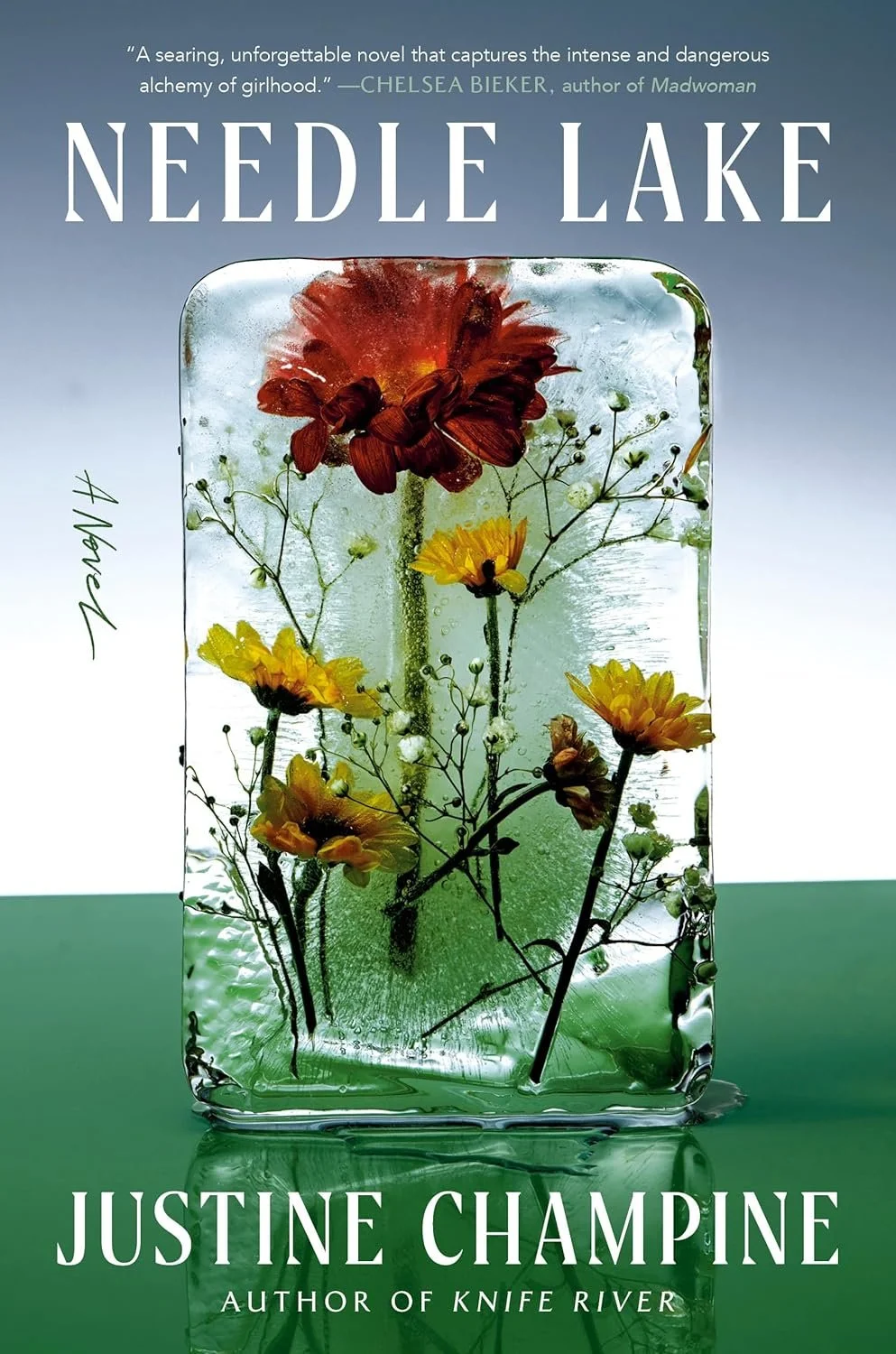
Needle Lake
by Justine Champine
The Dial Press, December 2025
Justine Champine, MFA graduate of Sarah Lawrence College and author of Knife River, is back with her second novel, Needle Lake, a first-person coming-of-age tale that's both riveting and disturbing.
Ida Robinson is a 14-year-old girl from Mineral, a small logging town just south of Tacoma. Ida has a defective heart, which keeps her from participating in most physical activities. She's also neurodivergent, which hampers her ability to form meaningful relationships. Ida is a good, friendless, smart kid (she wins geography bees) who's considered unconventional by adults (they bluntly tell her so) and downright weird by kids her own age (they bully her, of course). When her cousin Elna, a pretty, charismatic, self-assured 17-year-old, comes to live with Ida and her mother, Ida is immediately drawn to Elna. She fixates on those aspects of Elna that are everything she is not. Their attachment grows in intensity and, bit by bit, Ida starts to discover Elna has some defects of her own. Potentially dangerous ones. After Ida and Elna witness a man drown in an icy lake, these discoveries increase in frequency and danger (as does the unsettling relationship between the two) until they explode in a climax of life-threatening consequences.
If you like character-driven, psychological slow burns, Needle Lake should be on your nightstand. It's well written and at times rings so true it can impart its own sense of anxiety. Obsessive, unhealthy relationships between adolescents sometimes do lead to disaster. If you're familiar with best-selling author Anne Perry's tragic childhood, you'll know that’s true. So on one level, Needle Lake reflects a dynamic that can be real and alarming. Digging deeper, readers will likely notice how effectively Champine's writing brings Ida’s story to life:
. . . Elna asked me if I like living in Mineral.
"It's fine," I told her. "I don't have anywhere else to compare it to."
"What do people do for fun?"
"They go fishing."
"Fishing?"
"Well, I see a lot of people with like, fishing equipment on the weekends."
"Quaint."
Just then, a carload of young guys slowed down as they passed us. The driver stared at Elna, then the rest of them craned their necks to look at her, too. One of them tipped his baseball hat at her. She rolled her eyes and sighed. The car moved along, leaving our view.
"Do you have a boyfriend?" I asked.
"No," she said. "I did over the summer, but I dumped him."
"Why?"
"He grew a beard. It totally grossed me out."
"I don't have a boyfriend, either," I told her.
"I know," she said.
Champine's prose here and throughout might have been transcribed from actual interactions between teenage girls. It's efficient and believable and perfectly captures the type of connection growing between Ida and Elna. Champine's ability to portray realism in her scenes is surpassed only by her ability to paint vivid profiles of her characters, sometimes with the stroke of a single word or two, as in "quaint" and "I know" above. In just those three words one understands exactly who this precocious, patronizing 17-year-old is. Hence, when an unfortunate reality is combined with the realism of Champine's writing, the result is synergistic, unnerving, and captivating, not unlike witnessing a car crash.
One drawback to Champine's writing style is that it can be a little MFAish. In several places her metaphors miss the mark, as if she's trying more for aesthetics than for accurate comparisons. And her foreshadowing can be somewhat clunky, as if she spliced in additional details after a round of critiques. Finally, and most noticeable of these minor flaws, her descriptive passages occasionally parse as a list of random, jarringly specific observations that seem to check off the boxes of a "try to include each of the five senses" writing assignment:
I loved salt and vinegar potato chips, honing pencils into fine points on the hand-cranked wall sharpeners at school, the smell of mothballs, the sound of crickets, the way orange goldfish looked inside round glass bowls, heart-shaped chocolate boxes for Valentine's Day with white lace trim and pillowy sateen covers, how a cat's eyes shined in the dark, green olives from a can.
Though beautiful, it does carry a whiff of academia. Again, these are minor blemishes. The average reader will likely miss or ignore them in the process of enjoying such an engrossing and otherwise well-written novel. In fact, these may not be blemishes at all. One could argue, especially with the descriptions, Champine is merely reflecting the internal "offness" caused by Ira's neurodivergence. Fair enough. But as the effects also mirror shortcomings common to MFA writers, she may have been better served with a smidgen less narrative fidelity. Whichever the case, Needle Lake is sure to be well received by readers.
Jim Abbiati is a writer, book reviewer, and IT professional living in Mystic, Connecticut. He's the author of Fell's Hollow, The NORTAV Method for Writers, and has an MFA in Creative Writing from National University. Learn more at https://jimabbiati.substack.com/