Saint Petersburg by Sinclair McKay
/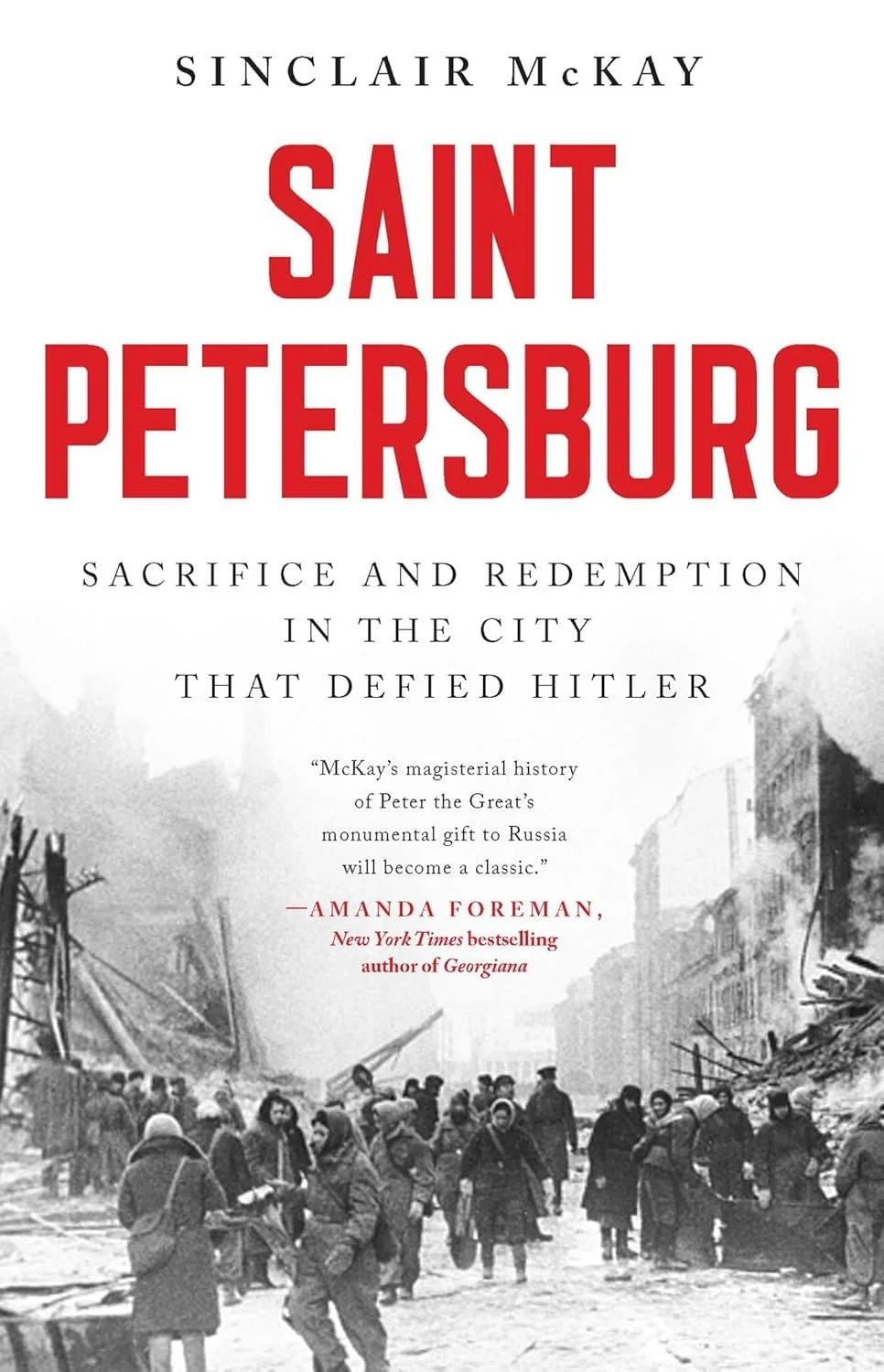
Saint Petersburg: Sacrifice and Redemption in the City That Defied Hitler
by Sinclair McKay
Pegasus Books 2026
Literary critic and popular historian Sinclair McKay turns to well-trod ground in his new book, Saint Petersburg: Sacrifice and Redemption in the City That Defied Hitler, the extremely well-documented and inadvertently symbolic siege of Leningrad during the Second World War. This was Harrison Salisbury's subject in his magnificent The 900 Days half a century ago; it was given a new sheen of research by Anna Reid in her 2011 book Leningrad, and more recently MT Anderson's 2015 Symphony for the City of the Dead concentrated on the siege's most famous story, that of composer Dmitri Shostakovich, whose 7th Symphony McKay echoes all other historians in calling “an international symbol of Russian defiance.”
Shostakovich is one of the many characters who populate McKay's book, and again, that cast will be familiar to any reader of previous accounts: the musicians and performers of the Stray Dog Cabaret on Italianskaya Street, for instance, or the poet Anna Akhmatova, “a poet of genuine widespread popularity whose volumes had found thousands upon thousands of homes.” In McKay's deft dramatic brush-strokes, we see all these characters enduring the heartaches and deprivations of the besieged city.
This was filmed, as McKay reminds his readers:
The city's cinematographers filmed everything during the entire course of the siege. There were also sharp, brief moments – acknowledgements – of horror: a body slumped in the snowy doorway of an apartment block and several passers-by stopping to see whether the figure was alive or dead (The shot was not held long enough to provide an answer.) There were also scenes of cloth-wrapped corpses being drawn along the street. In one shot, the deceased had been afforded the very rare luxury of a real wooden coffin.
McKay writes with a dramatic concision that very nearly compensates for the overfamiliarity of his subject, and as an accessible introduction to this famous siege, his book is an ideal choice, particularly in his eloquent sympathy for the ordinary people of his story. “To accuse Leningraders of fatalism would be quite wrong; they were by no means passive in their acceptance and understanding of the grim ordeal that was only just beginning,” McKay writes. “But the suffering they had endured before was framed within the steel-grey familiarity of Soviet power, and the way that it was exerted; this time the malevolence was without voice, and beyond appeal or reason.”
And he continues his story past the darkest days of the siege to better days, to the partial lifting of conditions in the winter of 1943, when, as McKay writes, “the rough melody of the bells made hearts jump: they sounded like life.”
Steve Donoghue is a founding editor of Open Letters Monthly. His book criticism has appeared in The Washington Post, The American Conservative, The Spectator, The Wall Street Journal, The National, and the Daily Star. He has written regularly for The Boston Globe, the Vineyard Gazette, and the Christian Science Monitor and is the Books editor of Georgia’s Big Canoe News