New Cemetery by Simon Armitage
/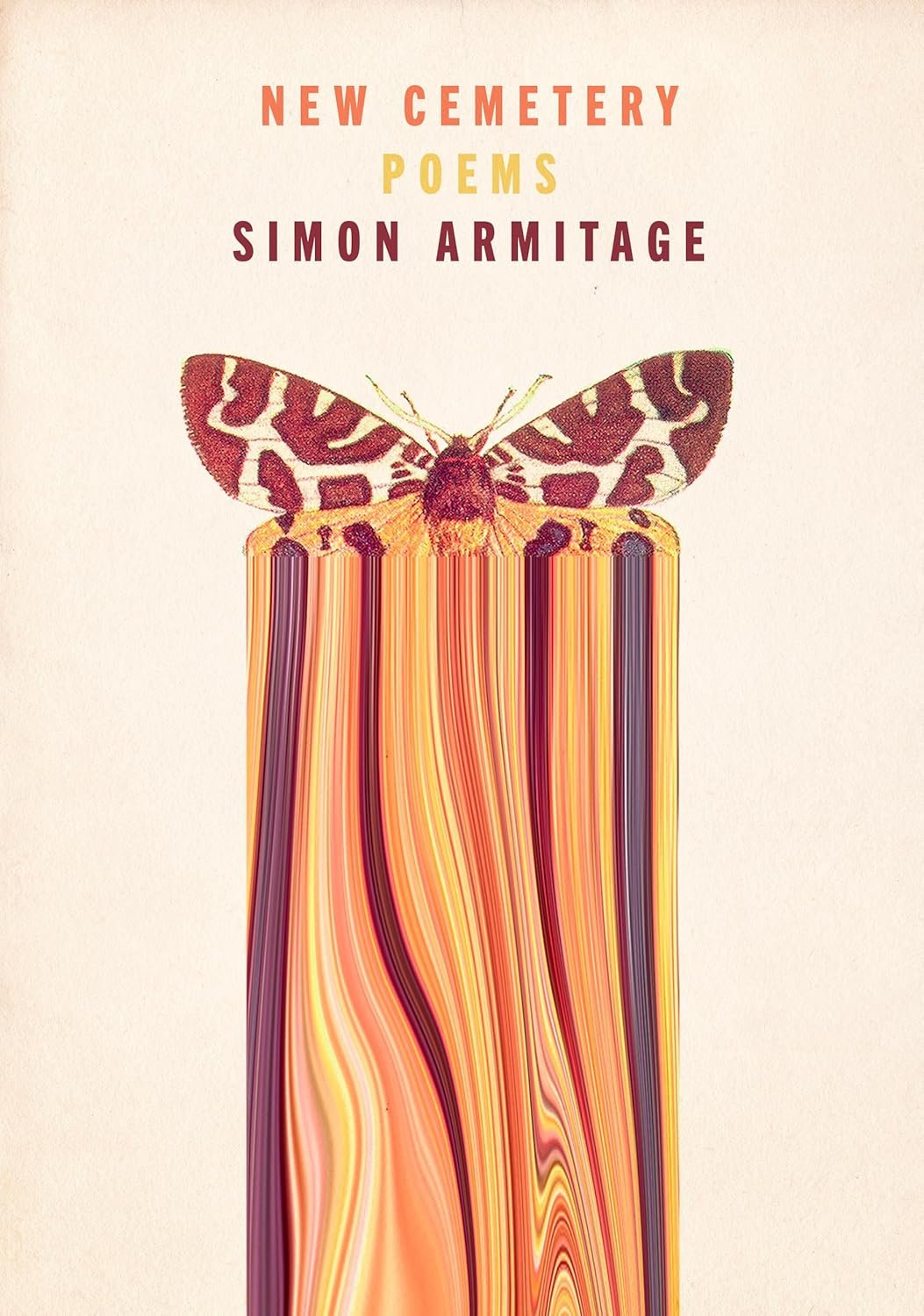
New Cemetery: Poems
by Simon Armitage
Knopf 2026
Moths have two collective nouns: an eclipse and a whisper. In New Cemetery, the latest collection of poems from Simon Armitage, a whispering eclipse of tercets take wing on every page. In “Speckled Yellow” (every poem is named after a different moth species) the poet addresses, well, everything, everywhere.
Dear universe,
I shaved this morning –
look at these
fine black pinpricks
constellated
in the white sink.
The new moon
of this nail clipping
proves I’m alive,
and once every couple of months
I regrow a fringe.
Universe, it’s against you
I measure myself:
the laws of thermodynamics
are calling my warm atoms
into deep space,
but for now
I’m holding
this hair, these bristles,
this middle finger
up to your smug face.
Falling somewhere sanely between Virginia Woolf and, say, Nabokov, Armitage seems more than merely enraptured with the literary potential of Lepidoptera (though what poet could resist, on a purely linguistic level, the fragile allure of such specimens as the Dark Brocade, the Blossom Underwing, and the May Highflyer?). No, Armitage seems to care about their fate, too.
Moths, the poet announces in his preface (itself titled, you guessed it, “Moths”) – moths aren’t doing great. “Gone are the days,” he writes, “when the windscreen would be smeared with a gluey porridge of splattered bugs after a drive through a summer night.” Their populations, he reports, are in decline. So, why not make moths out of words? And tercets: Every poem offers, in measured repetition, the ideogram of a line-slim body flanked by line-thin wings, the titles themselves finding all manner of serendipitous resonance (though Armitage assigned them, apparently, at random) with their contents (such as the alliterative mirroring of the phrase “printed page” in the poem “Pauper Pug”).
But the moths are something of a distraction. The book takes its title from the construction of a new cemetery in Huddersfield, the West Yorkshire town that Armitage (Britain’s sitting Poet Laureate) calls home. It would be fair to expect such a big fish in such a relatively small pond to occasionally come across as sanctimonious, but he doesn’t – nothing new for the poet whose verbal facility has always seemed just as comfortably couched in the argot of Oxford as the patois of pubs and phonebooks.
Such a combination of circumstances has made for a bracingly intelligent, profoundly local kind of book. Documenting everything from the “bulldozers / peeling back turf” to an afternoon cloud the shape of a “retired Olympian / stealing his sister’s purse,” the poet’s role in the course of his hundred pages is to occupy a position not so much of authority or power as of hard-won jurisdiction. More Gilbert-White-in-Selborne than busy-body-binocular-fumbler, the book’s best poems hit the kind of perfectly domestic note that can’t be faked by transplants, as in “Rannoch Sprawler,” which opens with a “Site inspection / and weather report: light snow / fringing cemetery lanes, // old ice / lending all graves / a pewter-cum-frosted glass- // cum-marquisette frame.”
And then there’s the humor, that unmistakable wit that is part and parcel of Armitage’s trademark self-deprecation. In “Chevron,” as elsewhere, he addresses the poem to you – yes, you.
Dear reader,
this evening the poet
has gone to his shed,
to temper his thoughts
in the prayer-shaped furnace
of a candle’s flame,
to throw with his hand
wild shadow puppets
onto the starched page. So what
if there’s nothing to say:
this poem, born to itself,
for its own sake.
In New Cemetery, Armitage proves yet again that he can do it all. Here – in epigrams and back-of-the-napkin narratives, in brief appreciations that approximate gratitude lists in their childlike reverence and songs in their musicality – he hasn’t written a poem that wouldn’t fit on one side of a standard tombstone. Literary smallness is in, after all, and everyone is downsizing. But for Armitage the move toward brevity is a call to compression, a contest of nuance and efficiency, the same trial that any poet worth his salt has ever taken seriously – that of saying more with less. As this book so amply demonstrates, he remains one of his artform’s most brilliant holdouts, and as long as he stands at the helm poetry is bound to survive another day. When it does die, let’s hope he’s here to write its elegy.
Eric Bies is a high school English teacher based in Southern California.