Literary Forensics by Gary Alan McBride
/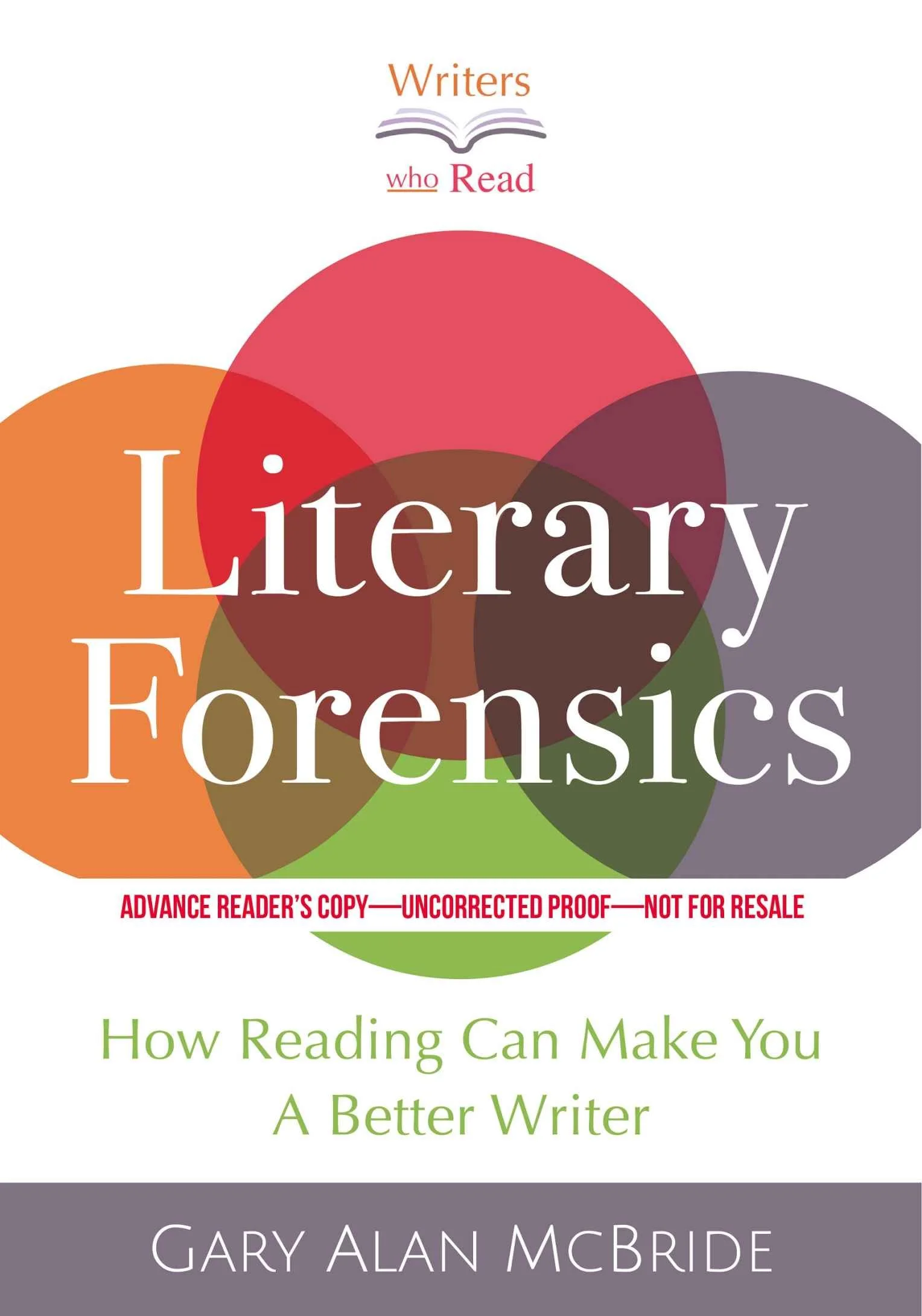
Literary Forensics: How Reading Can Make You A Better Writer
by Gary Alan McBride
In Res Media, January 2026
Imagine sifting through a barrel of nickels in search of a handful of quarters. If you're trying to learn (or learn more) about the craft of writing and you pick up Gary Alan McBride's new book Literary Forensics: How Reading Can Make You A Better Writer, this is the type of experience you'll need to embrace. McBride's book is chock full of nickel and quarter advice, but only the latter are objective, accurate, provable, adaptable across all cases of fiction, and thus worthy of adoption.
To be fair, this is the same experience offered by most how-to-write books and programs. There is no standardized creative writing pedagogy that defines a universal set of advice (core skills) for aspiring writers. It's well known that learning to write is all about discovering the best advice, these quarters if you will, the hard way, via thousands of hours of writing and reading and how-to learning.
Even so, McBride's book has a couple key elements that make it stand out among the how-to-write crowd. First and foremost is McBride's approach. He recognizes this "pedagogy by discovery" and attempts to provide aspiring writers with a means to reverse engineer solid writing advice out of existing novels. This is rather unique and especially appealing to those who are looking for tips and methods for doing just that. Unlike other how-to-write books, Literary Forensics is organized from a readers' perspective to facilitate this approach. When aspiring writers come across an aspect of a novel that make them feel or notice something, they can look up that feeling or note and find ideas on how the author may have accomplished it from a craft perspective. For example, while reading a novel . . .
. . . you may want to:
• Learn something new, perhaps through insightfulness . . .
• Be entertained, through humor, plot twists, or a feeling of wonder and awe
. . .
• Encounter an intellectual challenge arising from complexity
• Enjoy a frictionless ride, the opposite of being challenged
If you don’t find what you want—if your expectations are thwarted—you may find yourself bored. But those elements relate directly to voice and tone, and so are integral to the overall character of the narrative. Not engaging for these reasons is partially due to what you bring to your reading . . .
But your boredom may be a result of flow, interrupted—you find you just can’t get into the novel. This can happen when you encounter the following:
• Monotony: Writing that is predictable and repetitive
• Non-specificity: Writing without description
• Simplistic content: Over-explaining, requiring no engagement from the reader
• Passivity: A lack of action
• Coldness: A lack of emotion or engagement of the senses
• Inconsistency: Lack of structural clarity or clear transitions
• Complexity: Misused syntax and unfamiliar vocabulary
McBribe goes on to provide craft-based advice (i.e. explicit things to do or avoid) for handling each of the seven potential sources of boredom listed. Boredom is just one of six categories under his chapter "What You Feel." His chapter "What You Notice" contains nine categories. Together, these two chapters by far make up the vast majority of useful information in the book.
McBride's second key element is his near understanding that there are no absolute rules for writing a novel, but there are expectations that need to be understood and managed. (The most valuable quarter for any aspiring writer to discover.) He tries to apply this philosophy throughout, but there are cases where he succumbs to misunderstanding and mandates five-cent rules such as:
Every novel begins with a premise, a hook, and an inciting incident . . . Almost exactly halfway through the novel at the midpoint is the twist . . . Finally comes the climax or denouement.
At best these are expectations for a plot-driven genre novel, and there are plenty of novels where some or all of these are non-existent. This waffling between rules and expectations tends to diminish McBride's authority.
Unfortunately, managing expectations can at times be a double-edged sword if the expectation isn't predominately valid, as McBride himself proves. He goes out of his way to identify himself as a white, cisgender, heterosexual who acknowledges his white privilege. He admits that capitalism is evil but unfortunately necessary. He equates the vast number of potential genres to the vast number of potential genders. And he complains that classic literature was primarily authored by old dead white men and implies it isn't inclusive enough to be deemed classic. His book is littered with subtle and not-so-subtle signals to his personal ideology, which clearly McBride assumes the majority of his readership (or perhaps his publisher) is expecting him to include. Frankly, it often makes the book difficult not to toss out a window.
In the end, while Literary Forensics has more than its share of five-cent advice, be it inaccurate, misleading, or agenda-stamped, there are certainly enough quarters here to make it worth the investment, provided you have the patience to sift them out.
Jim Abbiati is a writer, book reviewer, and IT professional living in Mystic, Connecticut. He's the author of Fell's Hollow, The NORTAV Method for Writers, and has an MFA in Creative Writing from National University. Learn more at https://jimabbiati.substack.com/