Carthage: A New History by Eve MacDonald
/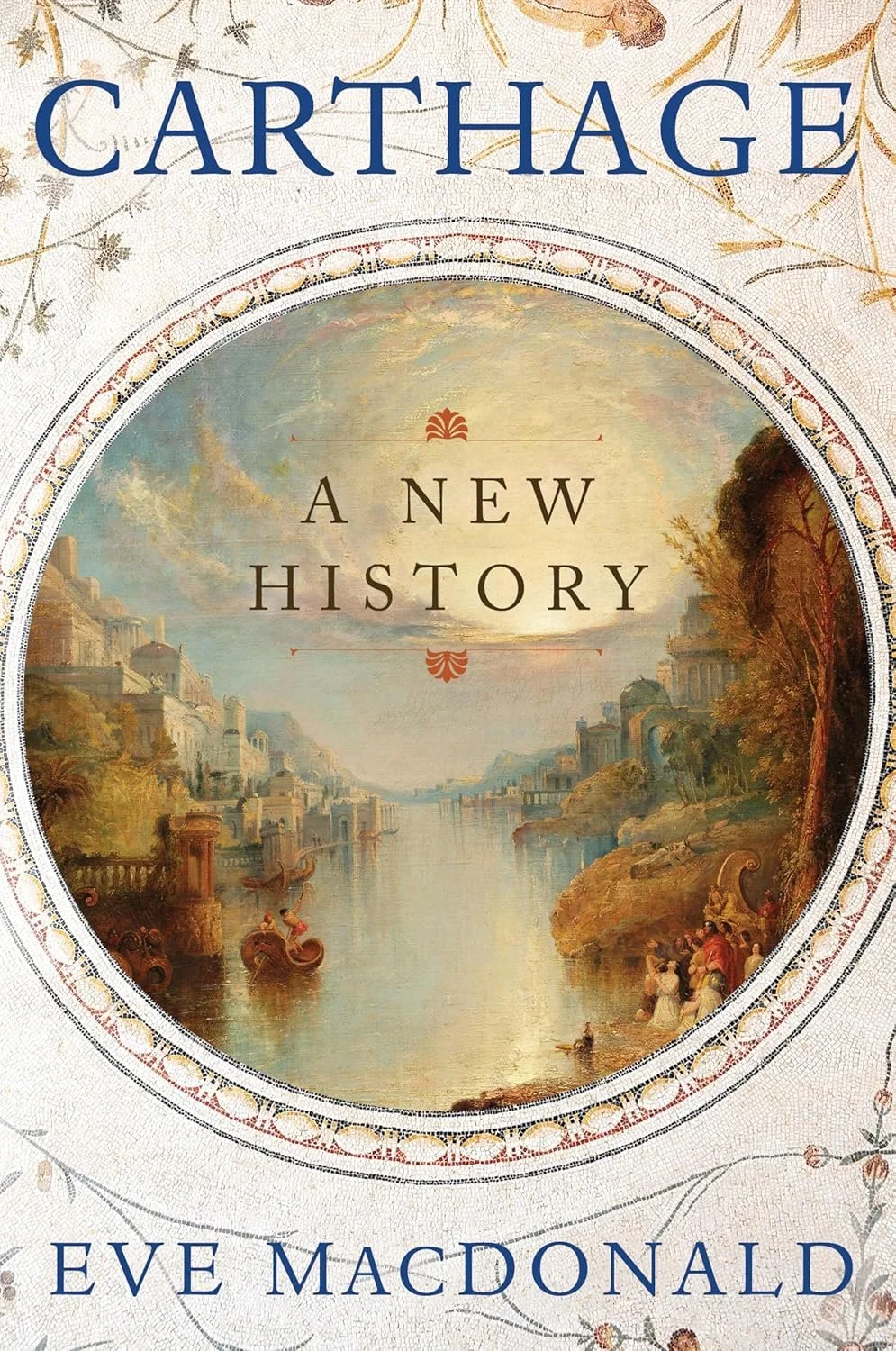
Carthage: A New History
by Eve MacDonald
WW Norton 2026
The old maxim that the victors write the history books is scarcely better illustrated anywhere in the annals of history than with the case of Carthage, a vibrant, multi-cultural African empire that was so thoroughly defeated by the Romans that only a handful of faint echoes of their entire world can still be caught in the cracks and creases of the historical record. The Romans wiped out the Carthaginians’ colonial possessions, then their armies and navy, then their homeland, then their culture. What remained was mostly a cautionary tale in Roman history books about the greatness of Rome.
Thus, when Cardiff University historian Eve MacDonald writes in her new book “My ambition with this book is to tell a story of Carthage that is both an epic tale and an account that helps us to gain a better understanding of the real people who lived and thrived in this beautiful city on the sea in the centuries before Rome,” readers will know to expect a heaping amount of conjecture and a sprinkle of wishful thinking. No significant trace of Carthaginian literature survives, so those real people living their daily lives are as lost to history as any people could be. This is the challenge and the inevitable defeat of Carthage: A New History.
MacDonald is compelled to rely on the coldest of historical comforts, archeology. In this she’s largely successful, evoking a crowded city of multi-story houses and the teeming streets of a busy urban center. The people in those streets, she comfortably infers, “practiced medicine, forged iron and steel, cultivated crops and piloted boats in the ports.” People in all cities do these things and always have, so such pictures are safe to paint. Safe bets like this abound in MacDonald’s book, not that they could rightly be avoided. When she writes that everyday Carthaginians were “parents, farmers, and scholars, legal experts and musicians, generals, admirals, priests and priestesses,” she’s unavoidably but emptily right. We know nothing about those people and likely never will, but it stands to reason that temples need priests and a navy needs admirals.
The hardest truth of that bit about the victors writing the history books is that any production like Carthage: A New History is inevitably going to capitulate to Rome. The one historical Carthaginian we can feel we actually know, the only one given a genuine three-dimensional personality, is the general Hannibal who led his polyglot army to the suburbs of Rome during the Second Punic War. And even that truth is ribboned in ironies: for all we know, that personality may be a wholesale creation of the Roman historian Livy, who in any case was drawing that personality as a moral manqué for a noble-savage foreign menace.
MacDonald does her best, like Livy before her, to bring the setting of the Second Punic War to life. “The day after the battle of Cannae, the scene on that Apulian field was gruesome,” she writes in a typical passage. “Steam rose in the morning off the still warm bodies of the dead and injured, making the grim job of combing the field of battle and gathering the spoils shocking, even for those that had won.” It’s effective, but it’s still a defeat: long stretches of a new history of Carthage, any new history of Carthage, are devoted to Carthage being vilified, dispossessed, and finally beaten by Rome.
Carthage: A New History is smooth, inviting reading; readers interested in the actual identity of this ancient Roman adversary will find here pretty much everything that’s known, all conveyed in clear, vivid prose. For a book that ultimately lacks a subject, those readers could certainly do worse.
Steve Donoghue is a founding editor of Open Letters Monthly. His book criticism has appeared in The Washington Post, The American Conservative, The Spectator, The Wall Street Journal, The National, and the Daily Star. He has written regularly for The Boston Globe, the Vineyard Gazette, and the Christian Science Monitor and is the Books editor of Georgia’s Big Canoe News