Incompleteness by Amit Chaudhuri
/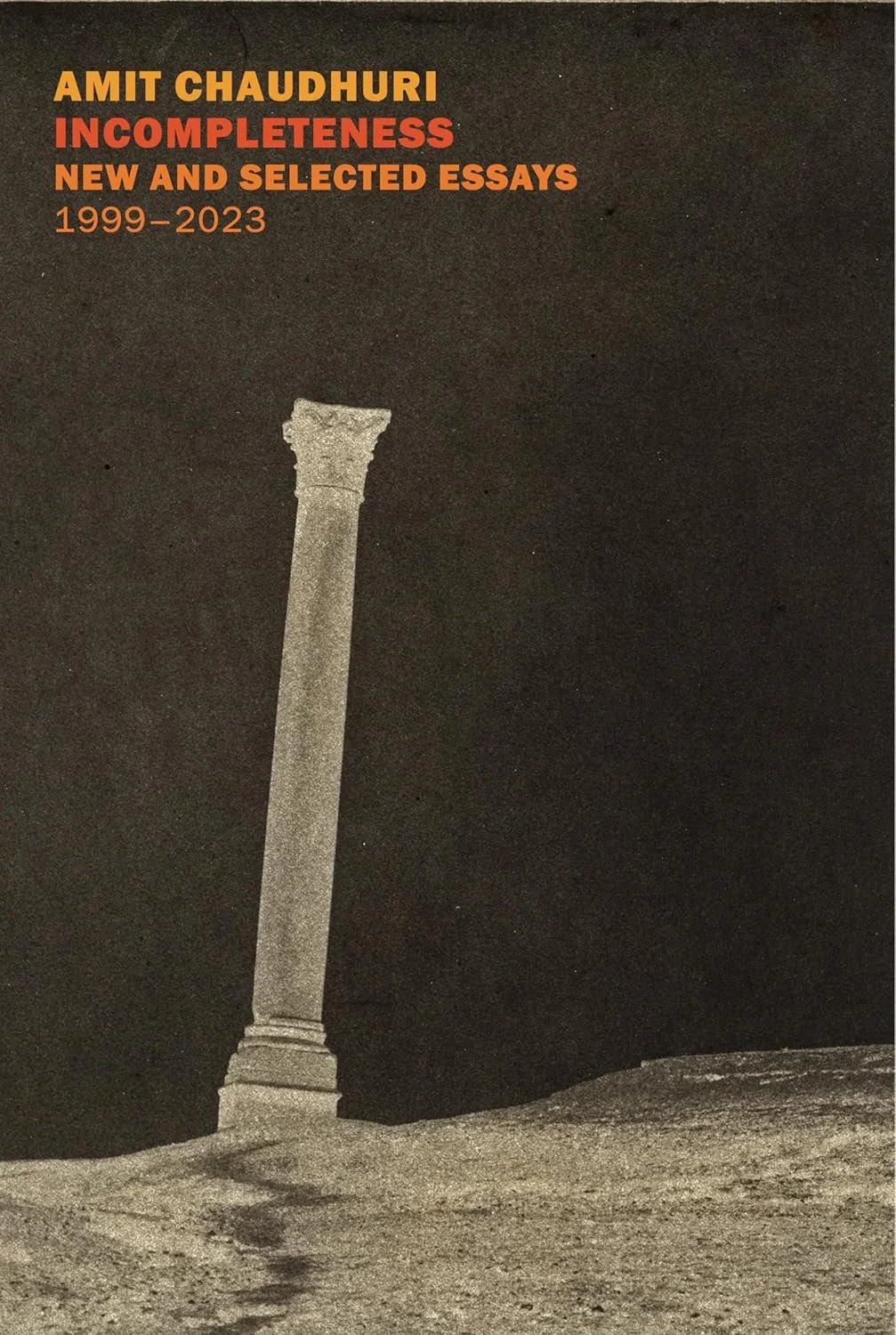
Incompleteness: New and Selected Essays 1999-2023
By Amit Chaudhuri
New York Review of Books 2026
The odd little ongoing miracle of the New York Review of Books reprint line, now extensive and still burbling along, continues at the start of the new year with more additions to its worthwhile project of reprinting the works of Amit Chaudhuri. Eight of these works are now joined by three more, the 2000 trifle of a novel A New World, a nice new paperback of Chaudhuri’s greatest novel, 2009’s The Immortals, and Incompleteness, a collection of essays ranging over a quarter of a century.
The range of these various works, now wonderfully reprinted in sturdy paperbacks, is clearly a temptation to repeat the standard characterization of Chaudhuri as a polymath: novelist, essayist, critic, and poet. The author himself has sometimes seemed borderline leery of this characterization, as well he should be, since it’s largely hooey, an extended quibble over terminology. As Chaudhuri’s earliest editors pointed out, and as has remained true ever since, this writer is solely a memoirist. His criticism is entirely subjective; his essays are entirely about himself; and his novels are strictly that dreaded publishing, autofiction. He admits as much in 2020’s flyweight “Why I Write Novels”: “People have pointed out to me from the start that I have been writing about my life,” he writes. “I have been at pains to point out to them that I’m interested in ‘life,’ not ‘my life,’ and that there’s a subtle difference between my understanding of the first and the second.”
His understanding, maybe. But nobody else’s. When reading of dreamy, precociously intelligent Nirmayla in The Immortals, clutching Will Durant’s The Story of Philosophy at a succession of rainy bus stops, every reader in the world will expect with perfect confidence that they’d find that battered copy of Durant somewhere in Chauduri’s attic.
In many ways, this adds rather than subtracts interest from a volume like Incompleteness, which contains some newer, less-collected pieces like Chaudhuri’s sometimes insightful “Where Does the Time Go?” from 2015, his reflection on the music of Joni Mitchell. “Time makes Mitchell not only a composer who survived the ordinary moment in the late sixties that created her generation,” he writes. “More significantly, it makes her a curator of music: others’ and her own.” No explanation of how Mitchell is the curator of anybody else’s music is given.
Incompleteness also, thankfully, includes classic older essays like 2010’s “The Origins of Dislike,” which among other things pricelessly refers to Ishiguro’s An Artist of the Floating World as “the perfect example of a novel of prevarication” (he also mentions that the novel brings “a rare note of uncertainty to the English ‘period’ novel,” even though English ‘period’ novels scarcely feature notes of any other kind). 2007’s “Notes on the Novel after Globalisation” is also here, featuring Chaudhuri’s delicious meditations on taking periodic trips from New York to Pennsylvania or Boston, always (if a bit ironically) seeking to disappear from the narrative:
It was on one of these trips that I realized how difficult it was, in the globalized world, to escape, to convincingly take refuge in namelessness and anonymity. I was going through all the motions of travel; as the bus took the highway in the evening, I sought to be cocooned by movement and invisibility. But there was a false note. I could never bring myself to believe I was completely alone (this had nothing to do with the strangers on the other seats, who, typically, contribute to the traveller’s aloneness rather than take away from it).
The New York Review of Books publishing arm promises even more Chaudhuri titles to come (including 2013’s Calcutta, another masterpiece), so the happy little miracle goes on.
Steve Donoghue is a founding editor of Open Letters Monthly. His book criticism has appeared in The Washington Post, The American Conservative, The Spectator, The Wall Street Journal, The National, and the Daily Star. He has written regularly for The Boston Globe, the Vineyard Gazette, and the Christian Science Monitor and is the Books editor of Georgia’s Big Canoe News