The Meditations of Marcus Aurelius, translated by Aaron Poochigian
/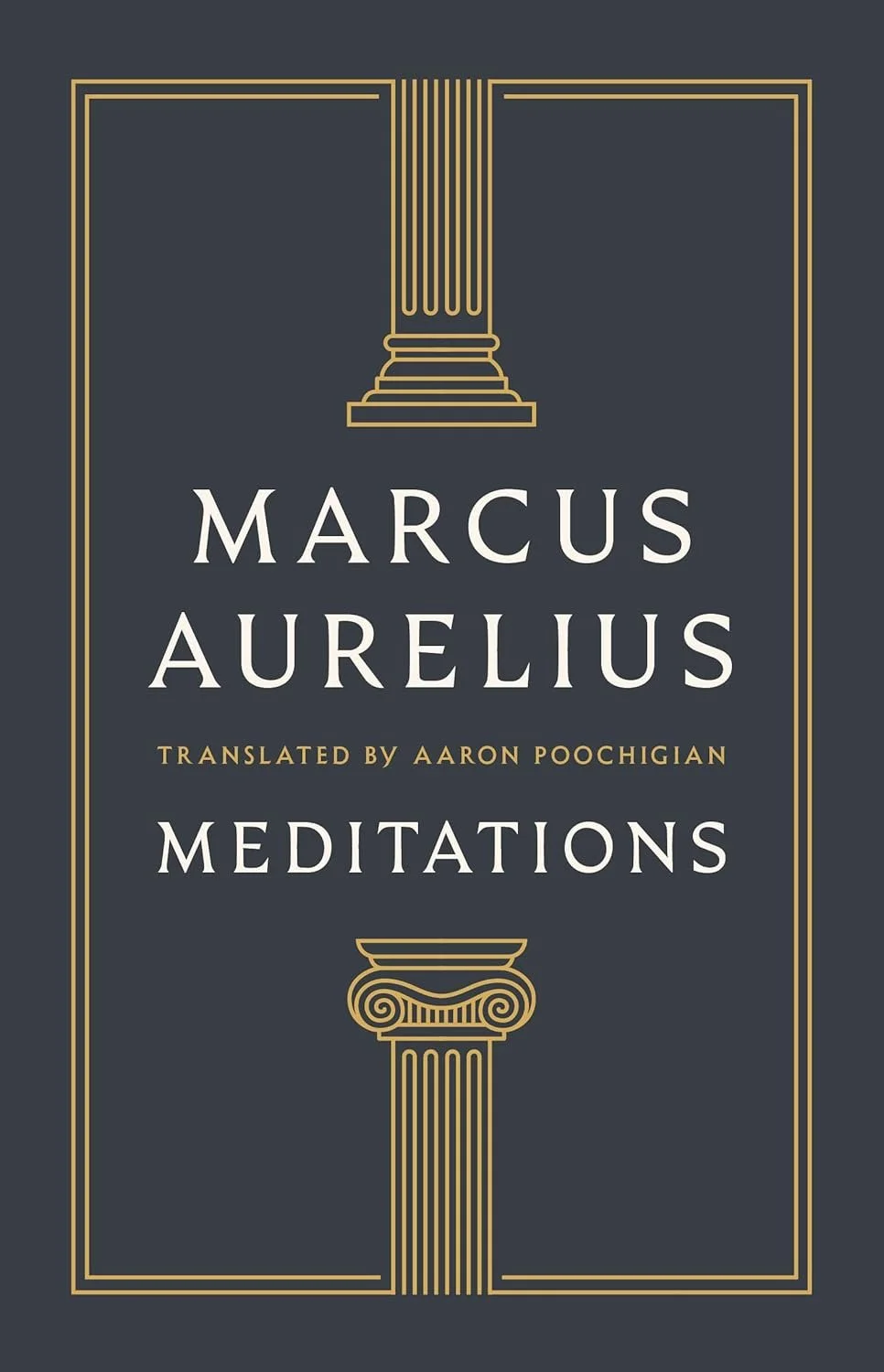
Meditations
by Marcus Aurelius
translated by Aaron Poochigian
Liveright 2026
Aaron Poochigian's new translation of the Meditations of Marcus Aurelius, which could cheekily but accurately be described as defiantly drab, opens with an introductory essay by the translator. This is the normal course of events for most translated canonical works these days, but with this particular work, a certain amount of dread is in order. Marcus Aurelius, Roman emperor and foundational arch-saint of Stoicism (repeatedly referred to by his adherents as “Marcus,” like they just got off a three-hour podcast together and are now heading out to the gym to take selfies while pretending to lift weights), has a tendency in the modern era to bring out the worst in his readers, all of whom are men, all of whom have dodgy relationships with their fathers (either due to personality or mortality, or both), and all of whom are a whole hell of a lot more attracted to the “emperor” part than the “Stoicism” part, though most of them won't admit it. That the ones who will admit it, Elon Musk, Peter Thiel, Curtis Yarvin & co., are by any objective measure the worst humans alive speaks as much to the nature of Stoicism as it does to the nature of its first cousin fascism.
Poochigian starts off stably enough, positing three narrative aspects of the author that crop up in the Meditations, the aspirant, the objector, and the instructor, three roles that the emperor adopts throughout these little musings. These are both aspects of his own personality and very effective levers he can use to keep the writing moving along, and maybe Poochigian is right to assert that “Previous translations have tended to dissolve these voices into one general tone, but they are quite distinct.”
But it isn't long before the, shall we call it fervor, starts to peak through, which with this author almost always includes three things: Messianic implications, the rather silly claim that the author never intended his writings to be published (megalomaniacs typically have no private mode), and, as mentioned, that chummy “Marcus.” Poochigian is a true believer:
Step by step, Marcus moved himself closer to the ideal of living in harmony with Nature, and many thousands have traveled on the trail he cut. The human need for guidance is, it seems, perennial, and Meditations truly is a fully functional guide to living: It tells us how to relate to ourselves, others, and God (or the gods). It is a quaint irony in the fact that there is so much popular enthusiasm for a work that was originally just a man writing for himself with no thought that his words would outlive him.
Syrup like this is the price to be paid for any translation of Markie. It's there in Martin Hammond's opening remarks for his popular Penguin Classics translation, for instance, it was all over Tom Bissell's 2023 Harper's piece about the Meditations, in which this ordinarily worthwhile writer descends into standard-issue Marcus drivel, suggesting Richard Feynman's famous “I think I can safely say that nobody understands quantum mechanics” by saying that Epicureanism isn't really Epicureanism, Cynicism isn't really Cynicism, and of course Stoicism isn't really Stoicism, although he steers very close to the heart of things when he notices that “With its unsentimental insistence, Stoicism offers special comfort to the recently fatherless.”
His translation is more straightforward, even more blunt than most others into English, which is sometimes a curious little discourtesy to the fussy turns of the original Greek. It does serve to make the underlying sentiments that much clearer, which is good for understanding Marcus Aurelius as it should be bad for venerating him as any kind of profound thinker.
He's certainly a hierarchical one, as his adherents seldom admit but often secretly second. “Nonrational beings are created to serve us rational beings because lower species are in every instance created to serve the higher,” he writes in one passage among many of this kind, always insisting that the universe has intelligence, and that this intelligence “made lower beings subject to higher ones.”
But every bit as often as he's hierarchical (important reminders: Marcus owned slaves, trafficked in slaves, and spent half his life militarily attempting to impose slavery on lots of other people), this revered thinker is also vapid and self-evidently a bit dim, always prone to the dour self-pity that's at the heart of Stoicism. The aforementioned intelligent universe, for instance, he asserts “always gives everything exactly what it is meant to have,” which would be news to any of those slaves.
“Don't let the future distress you,” he jotted down at another point, this man who had dozens of staff to plan every one of his activities, prepare every one of his meals, clean and present his clothing, wash his body and wipe his ass, lay out the roads and supply trains of his conquests, strangle his enemies, and sing the praises of his every stray remark. “You will come to what's to come if you must, and you will face it fortified with the same rational mindset with which you are facing the present moment.”
Poochigian's notes are nothing more extensive or attentive than in previous translations, but they amply serve to clarify the relatively few obscure items lodged in these adolescent musings. And then there's the sheer wisdom, which can stand without any annotation: “If a person does wrong, the harm of it remains in him alone. But maybe he hasn't, in fact, done wrong.” Ah, Marcus.
Steve Donoghue is a founding editor of Open Letters Monthly. His book criticism has appeared in The Washington Post, The American Conservative, The Spectator, The Wall Street Journal, The National, and the Daily Star. He has written regularly for The Boston Globe, the Vineyard Gazette, and the Christian Science Monitor and is the Books editor of Georgia’s Big Canoe News