A Training School for Elephants by Sophy Roberts
/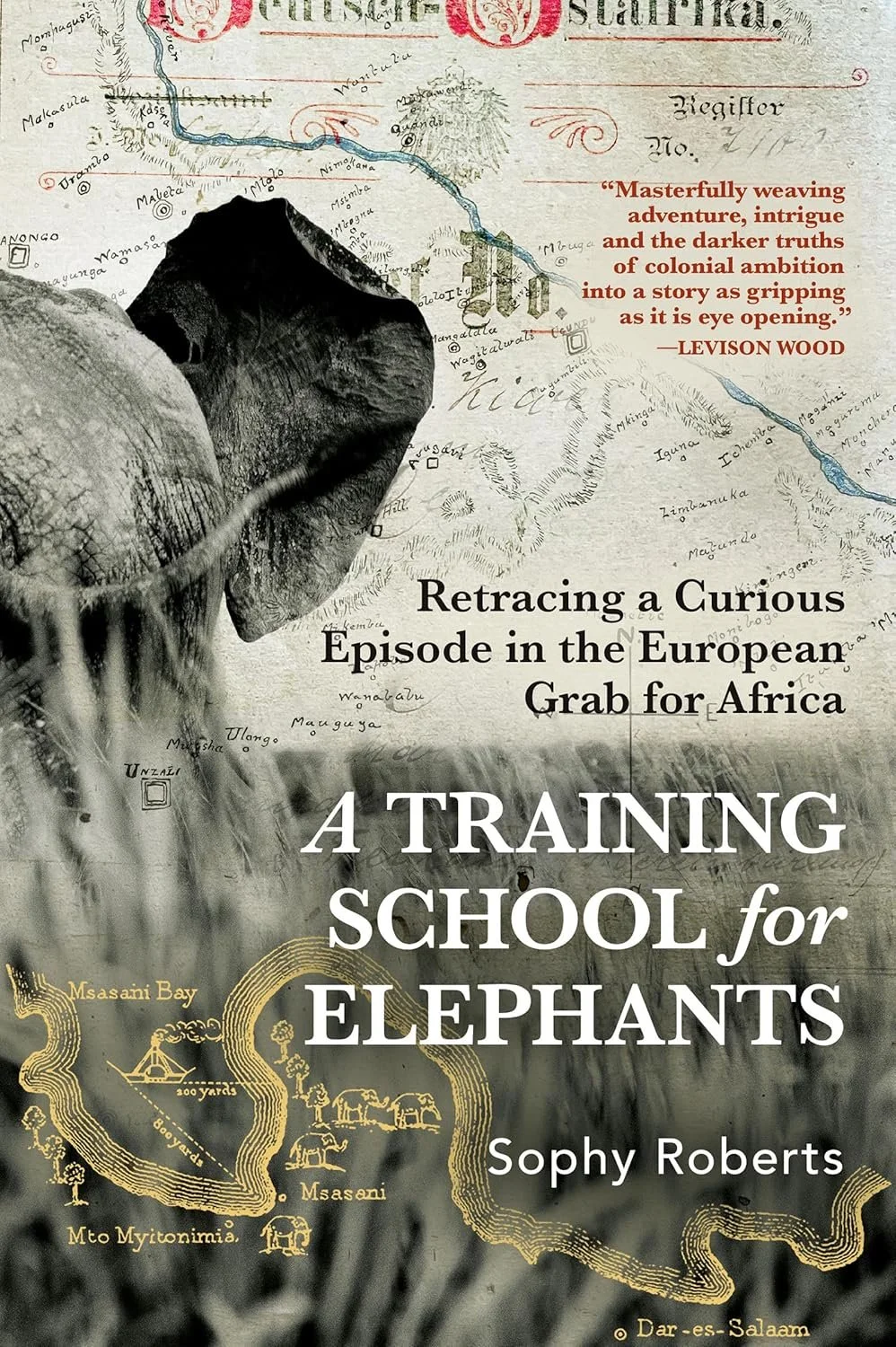
A Training School for Elephants: Retracing a Curious Episode in the European Grab for Africa
By Sophy Roberts
Atlantic Monthly Press 2025
Most often history is told through big sweeps of time, where years pass in paragraphs and empires go from their genesis to their crumbling in a chapter. The opposite, starting from a historic detail and from there untangle a much bigger story, is much rarer. How does a writer make the reader interested in a wound without first telling the story of the wounded? Sophy Roberts has been comfortable and masterful with the latter. In her much-acclaimed The Lost Pianos of Siberia (2020), she tells the modern history of Siberia through the pianos that crept in from the west. Now she publishes her second book, A Training School for Elephants, to tell part of the history of Congo's exploitation, using the story of a journey involving Asian elephants.
In her new work, Sophy Roberts, a renowned journalist and travel writer, follows Frederick Carter's journey from Zanzibar, across Africa with Congo as his final destination. The nineteenth-century Irishman, working for King Leopold II, was tasked with transporting four Asian elephants: Sosankalli, Pulmalla, Naderbux, and Sundar Gaj. These animals were part of Leopold's plan to exploit the Congo: the Asian elephants would help train their African cousins to serve as beasts of burden in the colonization effort.
Roberts is generous with her readers. Her narrative includes not only the journey but also the process in which all its elements were put together. She invites readers to follow both her physical travels and her intellectual detective work. The journey becomes enticing even before the narrative arrives in Zanzibar. In the case of this book, everything started snowballing during a stay in a friend's cottage in Donegal, where Roberts connects an old photograph from an abandoned building in Congo to “a nineteenth-century map of Africa's Great Lakes tucked among the spines, which drew me into a line of thought that had nothing to do with where I was.”
The author's physical journey follows Carter's path from Zanzibar to the interior of Africa, through Tanzania. Using meticulously researched history, Roberts layers the travels across east Africa. Such a combination results in vivid descriptions that combine the present and the past with palpable energy. Zanzibar is brought to life through sensory impressions and the knowledge of its present languages and the echoes of the old ones:
But if I could smell Zanzibar's story the moment I arrived, I could also hear it in the sounds bubbling up through the narrow backstreets of Stone Town, in the puttering rise and fall of voices drifting down its passageways. Swahili, a singsong mix of Arabic and African Bantu languages, stems from the Arabic word sawahil, meaning 'coast'. Those maritime origins surface in the fluid syntax, in the jaunty upwellings of 'y's and 'z's, in the sufficed 'a's and 'i's as light as the surf, in the liquid vowels spilling out of the windy mausin root of 'monsoon'. Even the word 'safari' has the breeze blowing through its origins. It comes from the Arabic safara, which means 'to journey'.
Remarkable human characters, like Peter Matthew Sudi, the sexton of the Church of St John in Zanzibar, whom Roberts describes as "slight and sinewy," populate the book and often serve as living testimonials of the history being told. By interweaving her travel discoveries and observations, and archival documents, the book becomes more than a photograph of a passage. It gains depth and further meaning. Roberts' dedication to finding letters and other documents is evident, African and European lives are portrayed with nuance. “As I read through Carter’s letters,” she writes, “I could sense him adapting to this situation by doing what we're all guilty of at one time or another, to different degrees: we cling to our absolutes, yet become more self-delusional in a bid to keep control when a situation is running away with us.”
A feeling of complexity captures the book from cover to cover, and it is fascinating to see Roberts create a narrative through it. The surreal journey of Sosankalli, Pulmalla, Naderbux, and Sundar Gaj tells a history of European exploitation and suffering of African people and these animals. The book, however, is not monochrome; further layers of complexity are added to the story. Roberts delves into human nature, and explores why men, such as Carter, decided to give physicality to such ideas of greed and power.
Training School for Elephants is a narrative that travels between the present and past; among letters of men, kings and writers; and across distant and nearby lands. Roberts weaves together history, travel writing, and philosophical inquiry to build a story where nothing is simplified and reality, past and present, is kept as intact as possible. All is combined in a narrative that advances between shores without stuttering. The book is not about a heroic adventure across savage lands, it is not a compilation of crimes and suffering, it is a book about our worst and how we live with it.
Marcelo Silva is a PhD candidate in computational electromagnetics currently living in Uppsala, Sweden.